

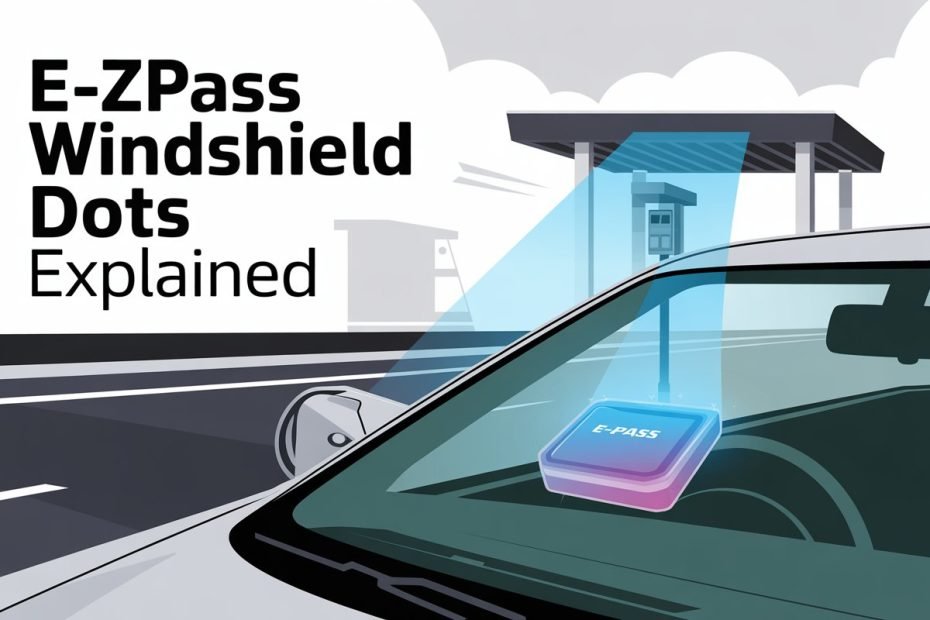
Ever been stuck in an E-ZPass lane, frantically waving your toll tag around like you’re trying to signal a passing ship? Yeah, me too. It’s a special kind of panic. You start wondering if the tag is dead, if you forgot to pay your bill, or if your car is just actively trying to sabotage your commute. But what if I told you the problem might be those little black dots on your windshield?
That’s right. Those seemingly random black dots, technically called a “frit”, can be the secret hero or the dastardly villain in your E-ZPass saga. For most cars, the standard mounting spot behind your rearview mirror works just fine.
But for a growing number of modern vehicles with fancy, heat-reflecting windshields, that frit area is the only place your E-ZPass will work. Let’s get this sorted out so you can cruise through tolls without a care in the world.
On the go or just prefer to listen? Press play below—I’ll read this to you, no toll required.
- So, What Are Those Black Dots on Your Windshield Anyway?
- How Your E-ZPass Actually Talks to the Toll Booth
- The "Normal" Way to Mount Your E-ZPass (For Standard Windshields)
- When Your Windshield Hates Your E-ZPass: The Deal with Special Glass
- "Why Isn't My E-ZPass Working?" - A Troubleshooting Checklist
- When All Else Fails: The External (License Plate) Tag
- Quick Tips for Popular Car Brands
- The Future is (Almost) Here
So, What Are Those Black Dots on Your Windshield Anyway?
First off, let’s clear this up: those black dots aren’t just for decoration. That black band and the fading dot pattern around the edge of your windshield are called the frit. Think of it as a super-durable, ceramic-based paint that’s literally baked onto the glass during manufacturing. It’s not a sticker, and trust me, you won’t be scratching it off.
So, what’s its actual job? It’s surprisingly important.
The Frit’s Day Job: A Super-Strong Grip and Sunscreen
The frit’s main gig is to create a rough, etched surface so the urethane adhesive can form a rock-solid bond between the windshield and your car’s frame. This bond is critical for your vehicle’s structural integrity.
You know, the stuff that keeps the roof from flexing and helps airbags deploy correctly in a crash. Without that frit, the glue wouldn’t stick well to the smooth glass, which would be… bad.
Furthermore, that solid black band acts like a powerful sunscreen for the adhesive. It blocks harmful UV rays that would otherwise cook the urethane, weakening it over time and potentially compromising the seal. It’s a small feature that plays a huge role in your car’s long-term safety and durability.
More Than Just a Pretty Face
Beyond its tough-guy structural duties, the frit also has an aesthetic role. It neatly hides the often-ugly line of adhesive from view, giving your car a clean, finished look.
The dot pattern also helps create a smoother visual transition from the black band to the clear glass, which is less distracting to your eyes. So, it’s both functional and fashionable. Who knew?
How Your E-ZPass Actually Talks to the Toll Booth
Now, let’s talk about that little plastic box on your windshield.
Your E-ZPass tag uses Radio Frequency Identification (RFID) technology, specifically what’s called an active RFID transponder, meaning it has its own internal battery and actively broadcasts a signal. As you approach a toll gantry, an antenna detects your tag and the tag transmits its unique ID number back to the gantry’s reader.
The system then checks your account, deducts the toll, and voilà, you’re on your way. The whole process is incredibly fast, but it relies on one key thing: a clear signal path.
This is precisely why holding the tag up or leaving it on the dashboard is a recipe for failure. Metal, in particular, is the mortal enemy of RFID signals. The overhead antennas are calibrated to read tags in their proper, fixed location, and anything getting in the way, including parts of your car can cause a misread.
The “Normal” Way to Mount Your E-ZPass (For Standard Windshields)
For the vast majority of cars with standard, uncoated windshields, the mounting instructions are refreshingly consistent across almost every E-ZPass agency, from New York to Virginia. Getting this right is the single most important step for reliable performance.
The Goldilocks Zone
There’s a “just right” spot that offers the best line of sight to the overhead readers and keeps the tag out of your field of view.
- Position it behind your rearview mirror. This is the prime real estate.
- Place it about 1 inch to the right of the mirror’s center post.
- Mount it at least 1 inch below the top edge of the windshield or below any dark factory tint strip at the top.
Don’t Forget to Prep!
You wouldn’t put a screen protector on a dirty phone, right? The same principle applies here.
- Clean the glass: Use a glass cleaner to thoroughly clean the spot where the tag will go, then let it dry completely. Any oil or dirt will ruin the adhesive bond.
- Use the provided strips: Those super-strong adhesive strips that come with the tag are there for a reason. Use them! They are often the Dual Lock™ type that clicks together.
- Press and hold: Peel the backing off the strips and press the tag firmly against the glass for about 15-30 seconds to ensure a secure bond.
- One and done: FYI, these mounting strips are designed for single use. If you need to move the tag, get new strips from your E-ZPass agency. Don’t try to reuse the old ones.
When Your Windshield Hates Your E-ZPass: The Deal with Special Glass
So, what if you followed the rules and your tag still doesn’t work? You might have a “special” windshield. Many modern cars—especially luxury brands, EVs, and models with advanced climate control—have athermic, solar-control, or infrared-reflecting windshields.
These windshields are awesome for keeping the cabin cool and protecting the interior from UV damage. The catch? They achieve this by embedding microscopic metal particles into the glass. As we just learned, metal blocks RFID signals, creating a huge headache for toll tags. It’s a classic case of one cool technology messing with another.
How Do I Know If I Have a “Fancy” Windshield?
This can be tricky, as they don’t always look different. Here’s how to investigate:
- Check the owner’s manual: This is your best first step. Some manufacturers are great about including a diagram showing a specific “RF-transparent” zone for placing RFID tags.
- Look for clues: Some metallized windshields have a faint purplish or bronze hue. More reliably, look closely at the area around the rearview mirror. You might see a “cut-out” in the frit area that looks slightly different or less reflective. This is your target. This is the spot the automaker intentionally left uncoated specifically for devices like your E-ZPass.
- Ask the dealer: When in doubt, call your vehicle’s dealership or the manufacturer’s customer service line. They should know.
- Consult E-ZPass: Some agencies, like NJ E-ZPass, keep lists of vehicles known to have problematic windshields.
Finding the Sweet Spot on a Tricky Windshield
If you have a metallized windshield, forget the standard mounting advice. Your one and only goal is to find that RF-transparent zone, which is almost always within the black dotted (frit) area around the rearview mirror. Car manufacturers aren’t clueless; they know these windshields block signals, so they create this little “window” for you.
For example, Ford Mach-E owners have found this dotted area is the only place an internal tag works. The same goes for many BMW and Mercedes-Benz models.
Test Before You Stick!
I cannot stress this enough. Before you permanently stick that tag on, test the location. Use painter’s tape or just hold the tag firmly in the suspected sweet spot and take a trip through a toll lane. Wasting a set of good adhesive strips because you guessed wrong is a real bummer. Once those things are on, they are on.
“Why Isn’t My E-ZPass Working?” – A Troubleshooting Checklist
If you don’t have a special windshield but are still having issues, let’s run through the usual suspects. It’s often something simple.
- Bad Mounting: Is it in the wrong spot? Is it oriented correctly (label facing you, arrows pointing up)?
- Obstructions: That aftermarket metallic window tint is a known signal killer. So are dashcams, GPS units, and even snow and ice on the windshield.
- Dead Battery: Your tag’s battery won’t last forever. Interior tags typically last 8 to 10 years. The standard transponder carries a 10-year battery warranty, while the E-ZPass Flex is warrantied for 7.5 years, and many transponders continue working beyond these windows. If your tag is getting old, it might just be out of juice. Call your E-ZPass agency for a replacement.
- Account Problems: This is a big one. Did your credit card expire? Is your account balance empty? An account with no money is the same as having no tag at all.

When All Else Fails: The External (License Plate) Tag
For some vehicles, an interior tag is just a non-starter. If your windshield is basically a fortress against radio waves (looking at you, certain Tesla and Land Rover models), the solution is an external, license-plate-mounted transponder.
You can request one from your E-ZPass agency. It bolts right onto your front license plate and completely bypasses the problematic windshield The downsides? They aren’t as pretty, and they’re more vulnerable to theft or damage from a parking bump or car wash. But hey, at least it works!
Quick Tips for Popular Car Brands
While you should always check your own manual first, here are some quick insights for brands known for being a bit… particular.
- Tesla: Early (pre-2016) Model S vehicles have a metallized windshield that blocks RFID signals, typically requiring an external plate-mount tag or placement at the rear window. Most later Model S and all Model X vehicles include a designated RF-transparent cut-out near the rearview mirror check your owner’s manual for the exact spot. Model 3 and Y generally work fine with standard interior mounting anywhere on the windshield.”
- Mercedes-Benz: Most models have infrared-reflecting glass. Look for the designated clear rectangle on the windshield, usually near the mirror.
- BMW: The frit (dotted area) near the rearview mirror is your best bet. Models like the iX require placement here due to an IR film on the glass.
- Ford Mach-E: The black dotted frit area is the only spot that works for an internal tag. Period.
- Volvo & Land Rover: These brands often have heated or coated windshields. Look for a specific designated zone described in the manual, which might be near the mirror or even in a corner of the windshield.
The Future is (Almost) Here
The world of tolling is getting smarter. We’re seeing a shift toward smaller RFID stickers instead of bulky plastic tags, and some manufacturers are now including Integrated Toll Modules (ITMs) built into the rearview mirror and managed through the infotainment system, no external tag required. Audi pioneered this with its e-tron SUV in 2019 and has since rolled it out across much of its lineup, with Mercedes-Benz following suit. More places are also using advanced license plate recognition as a primary tolling method.
These changes aim to make tolling invisible. But for now, for the tens of millions of us with a plastic tag, knowing where and how to mount it is what stands between a smooth journey and a frustrating one.
So next time you see those dots on a windshield, you’ll know they’re not just for show. They’re a critical piece of engineering that might just be the key to your E-ZPass success. A little knowledge goes a long way in saving you from future toll lane headaches.

Pavithra Vinoth is the founder of nytollsinfo.com, where she simplifies U.S. toll systems through expert insights and custom-built calculators. Her research-driven tools help drivers avoid costly mistakes and make smarter car decisions.