

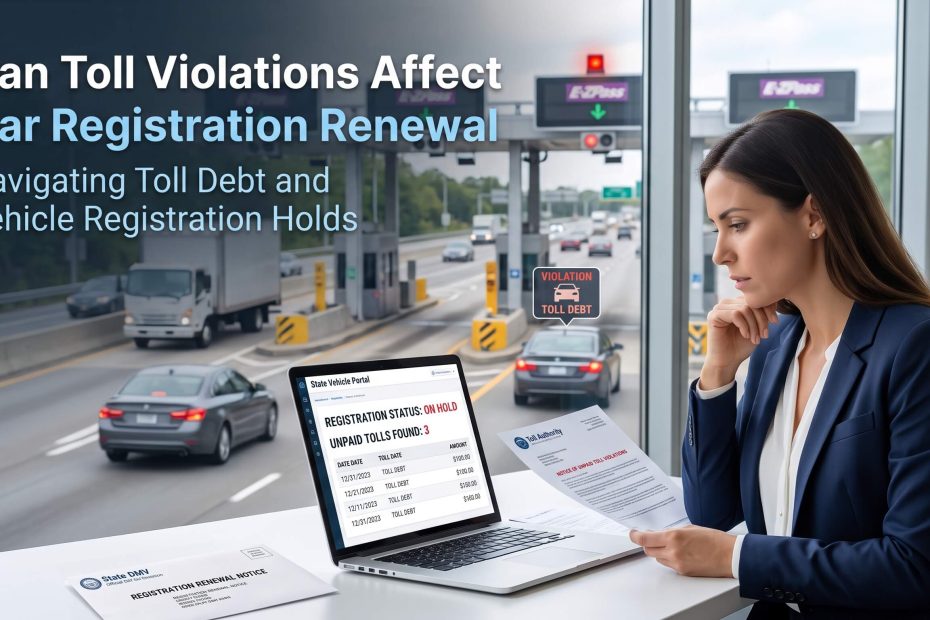
You may find out about a toll debt at the worst possible time. Your registration is due, the state website will not process the renewal, and somewhere in the background is an unpaid toll you barely remember.
It happens more easily than you might expect. A card expires. A transponder stops reading. A bill goes to your old address. Nothing seems urgent until the renewal notice arrives.
So, can a toll violation really block your registration? In many states, yes. In some places, the state can go further and suspend a registration that has not expired yet.
The details matter, especially if the toll happened during an out-of-state trip.
- The Practical Answer
- A Hold Is Not the Same as a Suspension
- Why Toll Debt Can Grow So Quickly
- State Rules at a Glance
- What Happens When the Toll Is From Another State?
- Why Some States Are Tougher Than Others
- If Your Registration Is Already Blocked
- Be Careful With Toll Text Messages
- A Few Habits Can Prevent Most of This
- The Bottom Line
The Practical Answer
An unpaid toll is not just a billing issue in many jurisdictions. It can become a registration issue after the required notices and appeal periods have passed.
Depending on the state and toll agency, the consequences may include:
- A hold on your next registration renewal
- Suspension of your current registration
- Administrative fees and civil penalties
- Collection activity
- A block on replacing your license plate
- A driver’s license suspension or renewal block
- A tollway ban or impoundment in serious cases
This usually is not an instant response to one missed bill. Agencies generally send invoices and violation notices first. You should also have an opportunity to pay or dispute the charge.
The mistake is waiting too long because the original toll seems small. By the time a hold appears, you may be dealing with several agencies, extra fees and a database that does not update immediately after payment.
A Hold Is Not the Same as a Suspension
Drivers often use hold, block, stop, flag and suspension as if they all mean the same thing. State systems do not always treat them that way.
The most important difference is whether your current registration remains valid.
| Enforcement action | What it does | What it means for driving |
|---|---|---|
| Registration hold, block, stop or flag | Prevents renewal and may restrict plate replacement or other registration transactions | You can usually drive until the current registration expires |
| Registration suspension | Cancels the current registration before its normal expiration date | You should not drive while the registration is suspended |
| Driver’s license action | Suspends the license or prevents its renewal | You cannot legally drive with a suspended license |
| Tollway ban or impoundment | Restricts a vehicle from certain toll facilities and may allow seizure | Using a covered tollway could lead to impoundment |
A hold can still become urgent. If you cannot renew before the expiration date, an ordinary toll debt can turn into an expired registration ticket.
A suspension needs faster attention. Do not assume you can keep driving until the date printed on your registration.
Florida, Illinois and Massachusetts also have processes that can affect the registered owner’s driver’s license in certain cases. In Massachusetts, for example, unresolved toll debt can block renewal of both the registration and the license. The official MassDOT toll enforcement regulations explain the invoice and enforcement process.
You may also be wondering about your premium. This related guide explains whether toll violations can affect car insurance.
Why Toll Debt Can Grow So Quickly
The surprising part is how often these cases begin with routine account problems rather than intentional toll evasion.
A driver may keep using the road as usual, not realizing that every trip is creating another unpaid transaction.
Common causes include:
- An expired or declined payment card
- An empty prepaid account
- A transponder that is mounted incorrectly
- A new vehicle that was never added to the account
- A plate that is not linked to the transponder
- A camera misreading the plate
- Invoices sent to an outdated address
- A vehicle sale that was not properly reported
When a transponder fails, the trip may be billed at a higher video toll rate. Late charges can follow if the bill remains unpaid.
Now add a daily commute. Two tolled trips each workday can create 40 to 50 transactions in a month. If the payment problem continues, the number of unpaid trips can grow much faster than the driver realizes.
Your Address Can Be the Weakest Link
Many people assume that updating a driver’s license also updates the address on their vehicle registration. That is not always true.
Toll agencies often rely on the registration record. If that record still shows your old address, the early invoices may never reach you.
Postal forwarding is not a reliable long term solution either. It is better to update each required record directly with the motor vehicle agency.
California has responded to this confusion through AB 2594. Beginning January 1, 2027, the state must give clearer instructions about the separate vehicle registration address update process.
A Sold Car Can Create Someone Else’s Toll Bill
A vehicle sale can cause a similar problem. If you leave the plates on the car or skip the required transfer notice, later toll activity may remain connected to your name.
Keep more than the bill of sale. It helps to retain:
- The title transfer
- Your release of liability or transfer notice
- The insurance cancellation record
- Any confirmation from the motor vehicle agency
These documents can make it much easier to show which trips happened after you sold the vehicle.
State Rules at a Glance
Looking across the country, there is no single national threshold for toll related registration enforcement. Some states focus on the number of unpaid invoices. Others look at the total balance or a pattern of violations.
This table covers 23 major tolling jurisdictions. Use it as a starting point, then check your current notice and the linked source for the full process.
| State | Registration risk and important rule |
|---|---|
| California | Renewal can be refused after the required invoice process. Bridge toll enforcement generally involves four or more unpaid tolls that remain unresolved after the fourth invoice process. Penalties and payment options are also regulated. |
| Colorado | A hold can follow a final liability order after repeated contact attempts and warnings. Civil penalties and hearing costs may apply. |
| Delaware | Toll violations can affect registration. Delaware also shares registration enforcement with Pennsylvania through a reciprocal agreement. |
| Florida | Unpaid tolls can cause a registration stop and block plate replacement. Escalation to a traffic citation can add court costs, license points and possible license consequences. |
| Georgia | Registration suspension can follow default on administrative fees and civil penalties for multiple violations. |
| Illinois | A final order involving five or more toll violations or evasions can lead to registration suspension. Other license or vehicle consequences may apply in qualifying cases. |
| Indiana | RiverLink can request a hold after at least four unpaid invoices. Payment is handled through RiverLink, not the Bureau of Motor Vehicles. |
| Kansas | Registration can be refused when unpaid tolls, penalties, fees and costs exceed $100. |
| Kentucky | RiverLink can place a hold after at least four unpaid invoices. The debt must be resolved with RiverLink before the hold can be released. |
| Maine | Unpaid tolls can affect registration privileges. Maine also participates in reciprocal enforcement with Massachusetts. |
| Maryland | One unpaid final violation can cause a registration flag. At least $1,000 in unpaid final violations can lead to chronic violator suspension. |
| Massachusetts | Unresolved debt can block registration and driver’s license renewal. Fees include a $20 registry charge, with annual fines and fees capped at $500 per registered vehicle. |
| Michigan | Legislation enacted in 2025 addresses six or more unpaid tolls and related fees. It also includes billing deadlines, dispute rights and fee limits. |
| New Hampshire | Registration suspension or nonrenewal can follow unresolved violations. Reciprocal enforcement with Massachusetts also applies. |
| New Jersey | Persistent nonpayment can lead to suspension. Updated reciprocity rules took effect on May 13, 2025. |
| New York | Suspension can follow three or more unresolved violations. The framework also addresses nonresponse after five or more liability notices within 18 months. |
| North Carolina | A block can affect any vehicle registered in the person’s name. Processing fees are limited to $9 per bill and $72 in 12 months, with additional limits on civil penalties. |
| Ohio | Unpaid Ohio Turnpike obligations can block registration. Payment must go through the proper toll or collection process. |
| Oklahoma | Unpaid PlatePay invoices can lead to a registration hold. Drivers generally resolve the balance with the Oklahoma Turnpike Authority before renewing. |
| Pennsylvania | Suspension can begin after four or more unpaid invoices or when unpaid tolls, fees and costs total at least $250. |
| Texas | Habitual violator enforcement can involve 100 or more unpaid toll events in 12 months after the required notices. Consequences may include a registration block, tollway ban and impoundment. |
| Virginia | Registration action may follow qualifying unpaid toll cases and court findings. Administrative fees, civil penalties and a $40 motor vehicle fee may apply. |
| Washington | An unpaid photo toll can become a civil violation after the notice and appeal period. A $40 civil penalty may be added. |
For New York drivers, this companion article takes a closer look at what happens if you do not pay a New York toll.
The Other States Are Covered Too
The remaining states fall into two broad groups. This does not mean every local agency in a group uses the same process.
Nine states have varying forms of local tolling, bridges, turnpikes or express lanes:
- Alabama
- Arkansas
- Louisiana
- Minnesota
- Oregon
- Rhode Island
- South Carolina
- Utah
- West Virginia
Depending on the facility, enforcement may involve toll agency collection, civil court action, traffic citations or registration consequences. Check the operator’s rules rather than assuming a statewide turnpike process applies.
The research places another 18 states and the District of Columbia in the group without a statewide electronic toll registration enforcement system:
- Alaska
- Arizona
- Connecticut
- Hawaii
- Idaho
- Iowa
- Mississippi
- Missouri
- Montana
- Nebraska
- Nevada
- New Mexico
- North Dakota
- South Dakota
- Tennessee
- Vermont
- Wisconsin
- Wyoming
Residents of these places can still face consequences for tolls incurred elsewhere. A lack of toll roads at home does not erase a bill from another state.
What Happens When the Toll Is From Another State?
An out of state toll does not automatically become a hold on your home registration. The two states generally need an agreement or a legal framework that supports shared enforcement.
That is why two drivers can receive similar out of state bills but face very different registration outcomes.
Several established arrangements include:
- Massachusetts and New Hampshire
- Massachusetts and Maine
- Indiana and Kentucky through RiverLink
- Pennsylvania and Delaware
Without an applicable agreement, the tolling state usually cannot directly block your home state renewal. But the debt can still follow you in other ways.
The agency may add penalties, use a collection company or seek a civil judgment. It may also restrict your driving privilege in that state or ban the vehicle from particular toll facilities.
One more point often causes confusion. A transponder working across state lines does not prove that registration enforcement is shared. Payment compatibility and legal reciprocity are separate issues.
Why Some States Are Tougher Than Others
Toll enforcement sits between two legitimate concerns. Road operators need revenue, but drivers can be overwhelmed when fees grow far beyond the original tolls.
State laws reflect different attempts to balance those concerns.
Pennsylvania has strengthened collection. Its financial pressures are substantial. The Pennsylvania Turnpike Commission performance audit reported $14.4 billion in debt as of May 31, 2025. It also reported $229 million in uncollected and unbillable tolls from June 2024 through May 2025.
Oklahoma shows the scale on which registration holds can operate. The Turnpike Authority placed about 178,000 holds in 2022 and released roughly 91,000 that year. Through late September 2023, it had placed another 144,000 holds and released about 95,000.
California has put more emphasis on limiting the spiral. Its reforms created a graduated invoice process, penalty limits, cash payment options and installment plans for qualifying lower income households. North Carolina has also placed firm limits on processing fees and civil penalties.
The result is a patchwork. The same unpaid balance can lead to different outcomes depending on where the toll occurred.
If Your Registration Is Already Blocked
Start with the hold itself, not the payment button. You need to know which agency requested it and whether the registration is merely blocked or already suspended.
Then work through the problem in this order:
- Identify the agency behind the action.
Your registration office may be able to see the flag but unable to accept the toll payment. - Ask for an itemized balance.
Separate the original tolls from late fees, civil penalties, collection charges and reinstatement costs. - Check the trips before assuming they are correct.
Look for a plate misread, a sold vehicle or charges that belong to someone else. - Follow the formal dispute process.
A phone call may not preserve your appeal rights. Pay attention to the deadline and keep proof of submission. - Ask about relief before paying.
A fee waiver, penalty reduction or installment plan may be available. - Confirm when enforcement will be released.
Payment and database clearance are not always simultaneous.
Payment plans deserve special attention because their effects vary:
- Colorado, Maryland and Pennsylvania may allow registration enforcement to be released after a qualifying arrangement and initial payment.
- Indiana and Kentucky RiverLink plans usually require 10 percent down, but the hold remains until the balance is fully paid.
- Texas programs may distinguish between a registration block and a tollway ban. A ban can remain until at least 75 percent of the balance is paid.
Save your receipt and any written confirmation. Then verify that both the toll enforcement action and the registration issue have been cleared.
Do not drive simply because you paid. If the registration is suspended or expired, make sure it is valid again first.
Be Careful With Toll Text Messages
Scammers have learned that registration threats get attention. Their messages often claim that your registration or license will be suspended unless you pay immediately through a link.
Slow down before responding.
Common warning signs include:
- An unexpected demand for immediate payment
- An unfamiliar web address
- Threats of criminal charges or credit damage
- Pressure to act within a few hours
- No useful invoice information
- A request for an unusual payment method
Do not use the link in the text. Visit the official toll agency or motor vehicle website on your own, or call the number shown on a genuine invoice.
A Few Habits Can Prevent Most of This
Toll accounts are easy to ignore when everything works. A quick review after a move, a vehicle purchase or a long trip can catch problems while they are still cheap to fix.
It helps to:
- Replace expired payment cards promptly
- Keep enough money in the prepaid account
- Add new vehicles and plates
- Remove vehicles you no longer own
- Check the transponder’s placement
- Update your registration address after moving
- Review statements after road trips
- File the required paperwork after a sale
- Open toll mail promptly
- Dispute errors before the deadline
The Bottom Line
A toll violation can affect registration renewal, but the label on the enforcement action matters. A hold usually blocks your next renewal. A suspension can affect your current registration right away.
The best time to deal with the problem is when the first invoice arrives. At that stage, you are usually sorting out a toll bill. Wait too long, and you may be sorting out your registration, your license and a much larger balance at the same time.

Pavithra Vinoth is the founder of nytollsinfo.com, where she simplifies U.S. toll systems through expert insights and custom-built calculators. Her research-driven tools help drivers avoid costly mistakes and make smarter car decisions.