

Stop stressing about that upcoming bridge toll. If you are a rider, you pay for the toll as part of your upfront fare. If you are a driver, you pay the toll instantly at the booth, and Uber reimburses you, but usually only if a passenger is sitting in your back seat.
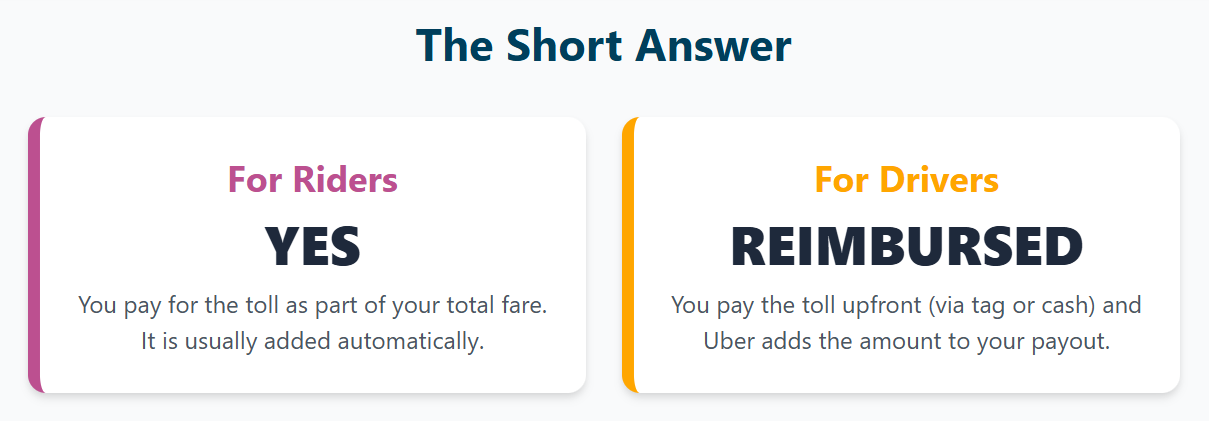
The system relies on GPS tracking and specific algorithms to move money from the rider’s wallet to the driver’s account. However, strict rules regarding “active trips” and electronic transponders make this complicated. This guide breaks down exactly where your money goes in 2026.
- The "Who Pays What?" Cheat Sheet
- The Rider’s Bill: You Pay for the Route, Not Just the Ride
- The Driver’s Reality: Reimbursement Rules You Must Know
- The Express Lane Trap: Don't Get Burned
- Regional Nightmares: State-Specific Rules for 2026
- Airport Surcharges: The Hidden Fees
- Managing the Cash Flow: The Uber Pro Card
- Taxes and The 1099-K Problem
- Driver Survival Checklist
- Frequently Asked Questions (FAQ)
- The Final Verdict: Watch Your Wallet
The “Who Pays What?” Cheat Sheet
Before we dive deep, here is the quick breakdown of who is actually liable for the cost. Memorize this table if you want to protect your wallet.
| Expense Type | Who Pays? | Is it reimbursed? |
| Active Trip Toll (Passenger in car) | Rider (Upfront) | Yes (Driver gets paid back) |
| Deadhead Toll (Empty car) | Driver | No (100% Driver cost) |
| Optional Express Lane | Driver | No (Unless HOV rules apply) |
| Airport Access Fee | Rider | No (Pass-through to Airport) |
| Return Toll (e.g., NYC to NJ) | Rider | Yes (Added to fare) |
The Rider’s Bill: You Pay for the Route, Not Just the Ride
Do you think that upfront price is just a random guess? It’s actually a highly specific calculation. When you type in your destination, Uber’s algorithm looks at the map, sees the toll booth, and bakes that cost directly into your guaranteed price.
You aren’t handing cash to the driver for the bridge. The app charges you the estimated toll amount automatically. However, this system isn’t perfect.
Why Your Upfront Price Might Change
Uber calls its pricing model “predictive,” but real life is messy. If you ask your driver to take a shortcut that includes an extra toll tunnel, the app will recalculate your fare. You will see a notification or a changed final receipt because the GPS realized the car took a more expensive path.
Conversely, if the driver avoids a toll road that the app anticipated, you might see a refund. But don’t count on it. Often, the system assumes the fastest route was taken regardless of the specific lane.
The Commercial Rate “Gotcha”
Here is a detail that frustrates many savvy riders. You might pay a higher toll rate than the driver actually pays. Uber’s official policy allows them to charge riders the “commercial” or cash rate for a toll, even if the driver pays a discounted electronic rate.
This difference creates a small revenue buffer for the platform. You might see a $16 charge for a bridge crossing on your receipt, while your driver’s E-ZPass statement only shows a $13 deduction. IMO, it feels a bit sneaky, but it is entirely legal within the Terms of Service.
The Driver’s Reality: Reimbursement Rules You Must Know
Driving for a living requires you to watch your margins like a hawk. Tolls are the fastest way to destroy your hourly earnings if you don’t understand the rules. The most critical rule in the 2026 handbook is simple: No passenger, no payment.
The “Active Trip” Mandate
Uber only reimburses tolls incurred during an “active trip”. This means the meter is running only when specifically transporting a rider. If you cross a $9 bridge to pick someone up, that cost comes entirely out of your pocket.
We call these “deadhead” miles. If you drop someone off in a remote suburb and have to pay a toll to get back to the city, that is also your financial responsibility. You must calculate whether a long pickup is worth the bridge toll before you hit accept.
The Electronic Transponder Requirement
Do not use cash lanes. I repeat, do not use cash lanes. Uber reimburses drivers at the lowest available electronic rate (like E-ZPass, SunPass, or FasTrak).
If a bridge costs $10 cash but only $6 with a tag, Uber will pay you $6. If you pay cash, you just lost $4 of your own money. In 2026, owning a transponder is not optional for a serious driver; it is a mandatory business tool.
The Express Lane Trap: Don’t Get Burned
You see the traffic jammed in the regular lanes. You see the empty Express Lane next to it. Do you take it?
Unless you want to lose money, the answer is usually no.
Optional vs. Mandatory Tolls
Uber’s algorithm distinguishes between a “mandatory” toll (like a bridge you must cross) and an “optional” toll (like an Express Lane to skip traffic). The app reimburses mandatory tolls. It strictly does not reimburse optional Express Lanes.
If you jump into the Express Lane to save 10 minutes, you pay that dynamic toll yourself. The rider does not get charged for your impatience. The only exception involves high-occupancy vehicle (HOV) discounts in specific states, but even those are tricky to navigate correctly.
The HOV Dilemma
In places like California or Virginia, you might get a discount for having three people in the car (HOV 3+). However, Uber’s system assumes you are paying the standard rate unless you have a specific transponder set to “HOV mode.”
If you screw up the switch settings on your FasTrak Flex, you get charged the full amount. And since the algorithm might not charge the rider the full dynamic price, you could end up eating the difference. It’s a gamble.
Regional Nightmares: State-Specific Rules for 2026
Every state handles its infrastructure differently. The decentralized nature of American transit authorities means a driver in Miami faces different problems than a driver in New York. Let’s look at the major hotspots.
Virginia: The Dynamic Pricing of I-66 & I-495
The Capital Beltway region is brutal for the unprepared. Interstate 66 uses aggressive dynamic tolling to manage rush hour traffic. The toll changes every few minutes based on congestion.
- The Trap: If you drive solo or with one passenger, you pay the dynamic rate, and Uber does not reimburse it because it’s considered an optional express route.
- The Fix: You need an E-ZPass Flex set to HOV mode, and you generally need 3+ people in the car to travel for free. If you don’t meet the HOV requirement, stay in the regular lanes or prepare to pay out of pocket.
Washington State: The SR 167 & Good To Go! System
Seattle drivers, listen up. The SR 167 HOT lanes are a premium bypass.
- The Cost: Solo drivers pay anywhere from $1 to $15 depending on traffic.
- The Rule: Uber considers this an optional lane. They will not pay for it. Unless you have the “Good To Go!” Flex Pass set to HOV mode (and enough passengers), stay out of these lanes.
Georgia: The Peach Pass Lanes
In Atlanta, the I-85 and I-75 Express Lanes require a Peach Pass. Just like Seattle and DC, these are optional bypass lanes. If you jump in them to beat the gridlock, you are eating that cost personally. The rider’s upfront fare assumes you are sitting in the traffic jam with everyone else.
New York & New Jersey: The Cross-Border Battle
Crossing the Hudson River is a financial minefield. Tolls are typically one-way (eastbound into NYC). To fix this, Uber adds a surcharge to trips leaving the city.
- NYC to NJ: If you drive a rider from NYC to NJ, Uber charges the rider a $20 surcharge. This money goes to you to help cover your empty trip back across the bridge.
- NJ to NYC: Conversely, if you take a rider from NJ into NYC, Uber adds a $7.50 driver surcharge on top of the toll the rider pays.
Without these specific surcharges, drivers would lose money on almost every cross-river trip. Also, remember the $1.50 Congestion Fee for Manhattan trips south of 60th Street—that is a pure tax passed to the MTA, so don’t expect to keep a penny of it.
Massachusetts: The $34.48 Minimum Wage Guarantee
Big changes hit Massachusetts in 2026. Drivers now have a guaranteed earnings floor of $34.48 per hour of active time. But here is the critical accounting detail: Tolls do not count toward this minimum.
Toll reimbursements are legally treated as separate “pass-through” expenses. This means Uber cannot use your toll reimbursement to artificially inflate your hourly pay to meet the $34.48 requirement. You get your wage guarantee plus your toll reimbursement.
California: The Bay Area Price Hike
As of January 1, 2026, the Bay Area Toll Authority raised rates on all seven state-owned bridges. The standard FasTrak rate is now $8.50. Furthermore, California now requires three people for a carpool discount (HOV 3+).
Chicago: The Skyway Standard
Drivers in the Windy City face a new baseline. The Chicago Skyway toll for standard two-axle vehicles increased to $8.10 in 2026. Since this is a fixed rate, the app predicts this cost accurately, so reimbursements should be seamless.
Florida: The End of the Rebate Era
Bad news for the Sunshine State. The popular Toll Relief Program, which gave frequent drivers a 50% credit, expired back in 2025. Now, Florida drivers pay the standard SunPass rate. This hurts. Those long, deadhead trips across Miami-Dade or Orlando are significantly more expensive now.
Airport Surcharges: The Hidden Fees
Have you ever noticed your airport ride costs $5 more than a normal ride of the same distance? That isn’t just surge pricing. Airports charge Uber a specific “access fee” for every pickup and drop-off. Neither the driver nor Uber keeps this money. It is a “pass-through” fee that goes directly to the airport authority.
- LAX: Charges about $4.00 per pickup.
- Atlanta (Hartsfield-Jackson): Adds a $3.85 surcharge for security costs.
- New York (JFK/LGA): Port Authority fees are tacked on top of the fare.
Managing the Cash Flow: The Uber Pro Card
Paying tolls requires cash on hand. If you drive a lot, you might spend $50 a day just on bridges. Waiting for a weekly deposit is impossible for many workers.
Instant Payouts for Gas and Tolls
The Uber Pro Card is a debit card that links directly to your driver account. When you finish a trip, the fare (and the toll reimbursement) hits the card instantly. This is a lifesaver for toll management. You can use the card to automatically reload your E-ZPass or FasTrak account.
Taxes and The 1099-K Problem
Warning: This section is boring, but it saves you money. When tax season hits, you will receive tax forms (Form 1099-K) from Uber.
The “Gross Receipts” Trap
Your 1099-K shows your Gross Receipts. This number includes everything the rider paid, including the tolls and airport fees. If you earned $50,000 driving, and $5,000 of that was toll reimbursements, your tax form will show $55,000.
Deducting Tolls on Schedule C
You must treat tolls as a business expense. On your IRS Schedule C, you deduct that $5,000 as a “Toll Expense.” This lowers your taxable income back down to the reality of what you actually kept. Keep your monthly transponder statements!
Driver Survival Checklist
Before you hit “Go Online,” run through this list to stop losing money.
- Check Transponder Balance: Ensure your E-ZPass/SunPass/FasTrak has funds. A declined tag means a cash fine.
- Update HOV Settings: If you have a flex switch, make sure it is set correctly for the number of people in the car before you enter the lane.
- Review Airport Queue Rules: Know the specific waiting zones. Leaving the geo-fence usually resets your place in line.
- Audit Your Earnings Daily: Check your trips at the end of every shift. You only have 10 days to dispute a missing toll!
Frequently Asked Questions (FAQ)
Does Uber reimburse drivers for gas?
No. Gas is considered a vehicle operating expense and is the driver’s responsibility. However, the Uber Pro Card offers cash back at gas stations.
Can I ask the rider to pay cash for a toll?
Absolutely not. Asking a rider for cash violates Uber’s Terms of Service and can get you deactivated. All payments must happen through the app.
What happens if I don’t have an E-ZPass or Transponder?
You will likely pay a higher “Cash” or “Pay-by-Plate” rate. Uber will only reimburse you for the lower electronic rate, so the difference comes out of your pocket.
Do I get paid for tolls on the way to pick up a passenger?
No. Tolls incurred during the pickup phase (deadhead miles) are not reimbursed.
The Final Verdict: Watch Your Wallet
So, does Uber pay for tolls? Yes, but the mechanics matter.
For riders, the system works seamlessly you pay for convenience. For drivers, the system works only if you play by the strict rules of the “active trip” and the electronic transponder.
Drivers: Get a tag, check your statements, and deduct your expenses.
Riders: Watch your route, and don’t be afraid to dispute a weird charge.
The gig economy is a game of margins. Make sure you aren’t leaving your money at the toll booth.

Disclaimer: I am not a CPA or a lawyer. Tax laws and Uber policies change constantly, so always consult a professional for financial advice.

Pavithra Vinoth is the founder of nytollsinfo.com, where she simplifies U.S. toll systems through expert insights and custom-built calculators. Her research-driven tools help drivers avoid costly mistakes and make smarter car decisions.