

Ever sailed through a toll gantry only to realize your transponder stayed as silent as a mime at a funeral? If you’re seeing a “V-Toll” on your statement instead of a standard read, your battery is likely gasping its last breath.
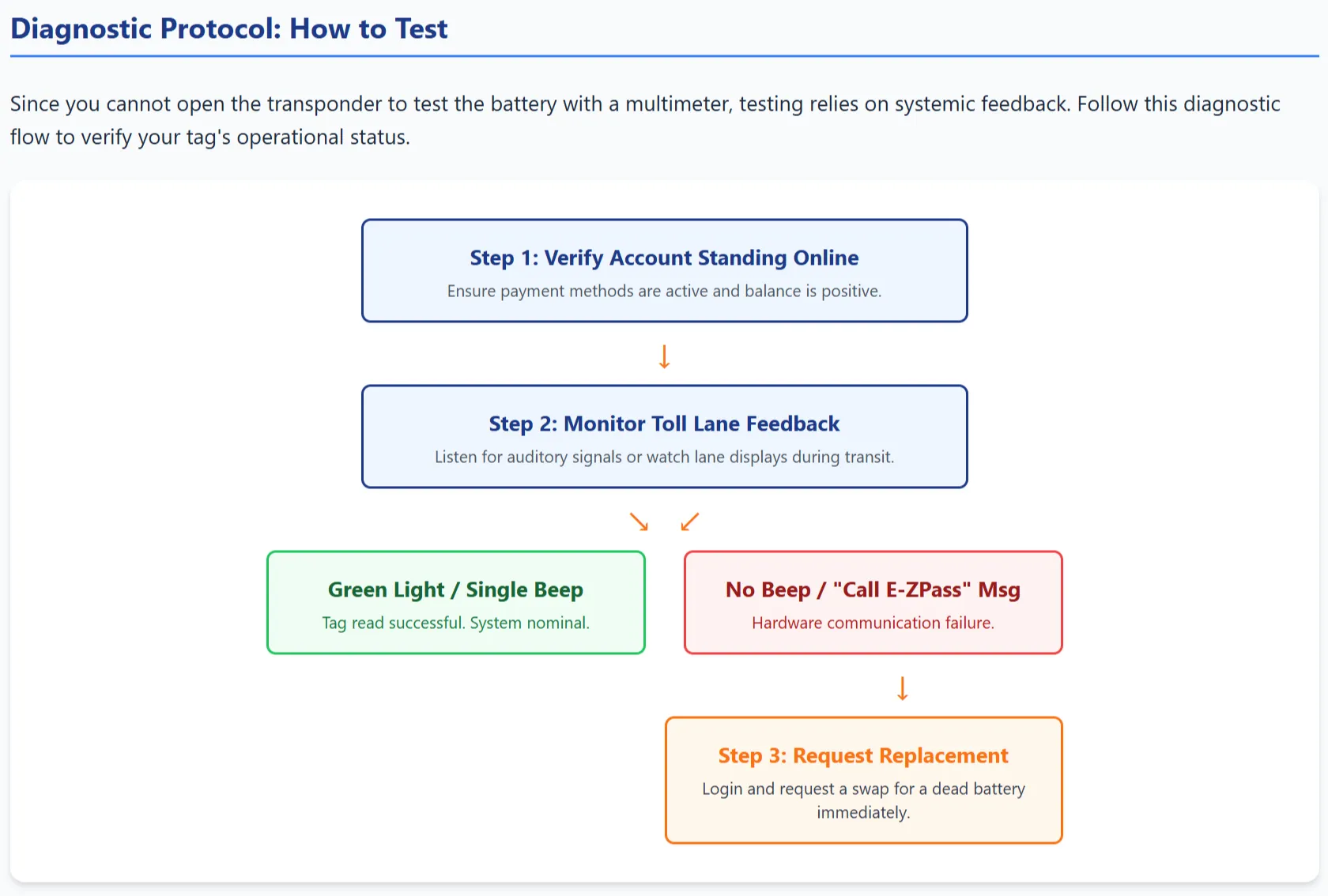
You can test your E-ZPass by checking your account for “V-Tolls” (video tolls) or visiting a local AAA branch or E-ZPass Customer Service Center to use a physical 915 MHz signal tester. These specialized pads give you an immediate green or red light on your hardware’s health.
- Your E-ZPass Health Checklist
- The Digital Paper Trail: Spotting a Failure Before It Happens
- Physical Testing at Service Centers
- The Sticker Tag Revolution: Testing Without Batteries
- Is it Your Transponder or Your Fancy Windshield?
- The Motorcycle Dilemma: Tips for Riders
- Mounting Excellence: Doing It Right the First Time
- Regional Breakdown: What Failure Costs You in 2026
- What to Do When the Test Fails
- Looking Ahead: Tolling 2.0
- The High Cost of Procrastination
Your E-ZPass Health Checklist
| Action Item | How Often? | Why? |
| Check Mobile App | Weekly | To spot “V-Tolls” indicating low battery. |
| Inspect Mounting | Monthly | Ensure it hasn’t slipped or peeled off. |
| Verify License Plate | Every 6 Months | So V-Tolls still get the discounted rate. |
| Physical Tester Check | Every 3 Years | To confirm battery voltage is still within range. |
| Toggle Flex Switch | Every 6 Months | Avoid the $10 “Inactivity Fee” in Virginia. |
The Digital Paper Trail: Spotting a Failure Before It Happens
The easiest way to test your tag doesn’t even require you to leave your couch. Open up your Tolls NY or PA Toll Pay app and look closely at your recent activity.
Do you see a bunch of entries labeled as “V-Toll”? This happens when the gantry misses your radio signal but snaps a photo of your license plate instead. While it still charges you the E-ZPass rate for now, it’s a giant neon sign saying your transponder is failing.
Why V-Tolls Aren’t Your Friend
- The Courtesy Limit: Many agencies only match plates as a courtesy. After 3–5 “misses,” they may stop matching them entirely, leading to full-price “Toll by Mail” bills.
- Account Delinquency: Consecutive V-Tolls can trigger a “Hardware Delinquent” status on your account, which is a total nightmare to clear up with customer service.
- Hidden Fees: Some states, like Virginia, monitor these misses. If you’re a “V-Toll Frequent Flyer,” they might mandate a replacement or hit you with administrative surcharges.
Physical Testing at Service Centers
Sometimes you just want a definitive answer from hardware rather than guessing based on an app. If you suspect your Kapsch G5 is ghosting the gantries, head over to an E-ZPass Customer Service Center or a participating AAA location.
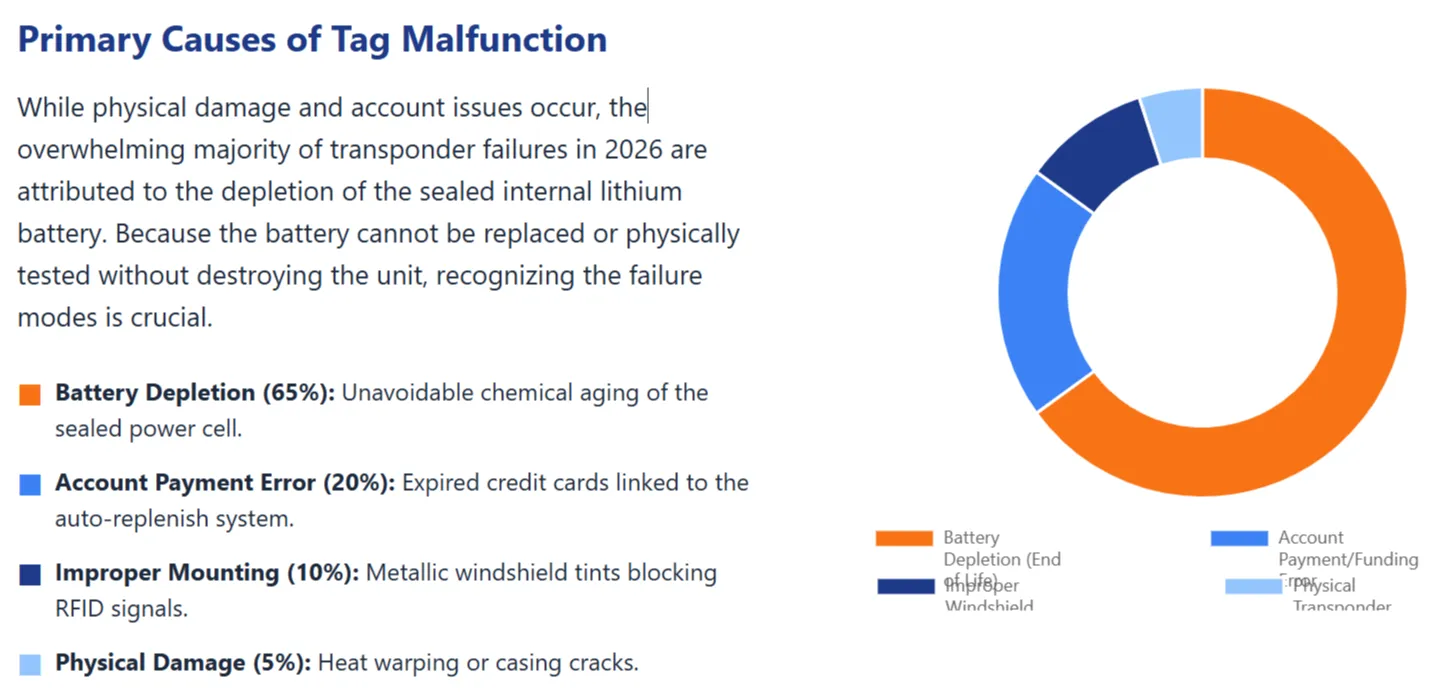
These spots have specialized testing pads that simulate the “wake-up” signal from a toll gantry. You place your tag on the pad, and it tells you instantly if the internal lithium-thionyl chloride battery still has enough juice.
What to Look for During a Physical Test
- Green Light: Your transponder is “waking up” correctly and sending its 256-bit packet. You’re good for another season of road trips.
- Red Light: The unit is responding, but the signal is weak. It’s “dying,” and you should swap it now before it fails on a high-speed bridge.
- No Response: The battery is toast. The unit is officially a piece of decorative plastic.
The Sticker Tag Revolution: Testing Without Batteries
Are you using one of those new 6C sticker tags? If you’re in Massachusetts or Illinois, you probably moved away from the hard-case units to save a few bucks.
Since these stickers are “passive”, meaning they don’t have a battery and just reflect the gantry’s energy, they theoretically last forever. However, “forever” is a long time for a piece of plastic stuck to a hot windshield.
How to “Test” Your Sticker Tag
- Physical Inspection: Check for any peeling at the edges or visible cracks in the “squiggle” antenna inside the sticker.
- Account Monitoring: Since there’s no “beep,” check your account daily. If your last five trips are all plate-reads, your sticker is broken.
- Heat Check: Extreme summer heat can sometimes warp the adhesive, shifting the antenna just enough to miss a read. If it looks “bubbly,” replace it.
Is it Your Transponder or Your Fancy Windshield?
Sometimes the tag is perfectly healthy, but your car is acting like a lead-lined bunker. Have you ever wondered why your E-ZPass works in your old clunker but fails in your brand-new Mustang Mach-E?
Modern luxury cars and EVs often use “athermal” or metallic-coated glass to keep the cabin cool and reflect IR rays. This coating acts as a Faraday cage, effectively suffocating your transponder’s 915 MHz signal.
Finding Your Car’s “Clear Window”
- The Frit Pattern: Look for a black-dotted area (the “frit”) near your rearview mirror. This is where the metallic coating is usually omitted to let signals through.
- Distance Matters: Ensure the tag is at least one inch away from the metal frame of the roof.
- External Alternatives: If your windshield is a total signal-killer, you’ll need a license-plate-mounted external tag. These are waterproof but only last 2–3 years due to road salt and weather.
The Motorcycle Dilemma: Tips for Riders
Riding a bike through a toll gantry is always a bit of a gamble. Since motorcycles don’t have a standard windshield, you have to get creative, but creativity can lead to missed reads.
Best Practices for Motorcycles
- License Plate Tags: These are the gold standard for bikes. They mount directly to the plate frame and are designed for the “exposed” life.
- The “Jacket Pocket” Fail: Avoid keeping the tag in your pocket. Your body is essentially a giant bag of water that absorbs the 915 MHz signal.
- Magnetic Tank Bags: This is a 50/50 shot. If the bag has too much metal or thick shielding, it will kill the read.
- The Helmet Trick: Some riders swear by putting the tag in their helmet liner, but this is a safety risk and a bit too “sci-fi” for most of us.
Mounting Excellence: Doing It Right the First Time
A huge chunk of “failed” transponders are actually just mounted by people who didn’t read the instructions. I know, reading the manual is for people with too much free time, but it matters here.
The Perfect Placement Checklist
- Surface Prep: Clean the glass with alcohol. If it’s below 50°F, use your defroster to warm the windshield so the adhesive actually sticks.
- Vertical Alignment: Keep it at least one inch below the top edge of the windshield.
- Horizontal Alignment: Place it one inch to the right or left of the center mirror support.
- Orientation: The label MUST be right-side up and facing you. The internal antenna is directional; flip it, and you’re basically whispering to the gantry.
Regional Breakdown: What Failure Costs You in 2026
The price of a dead tag depends entirely on which state you’re driving through. In 2026, the gap between E-ZPass rates and “Toll by Plate” is wider than ever.
New York and the Port Authority
New York is brutal. If your tag fails on a Port Authority bridge, you’re looking at a jump from roughly $15 to over $23. Check the latest Port Authority Toll Schedules to see just how much failure hurts your wallet.
Pennsylvania and the Turnpike
The PA Turnpike is now 100% Open Road Tolling. If your tag doesn’t read, the “Toll by Plate” rate is literally double the E-ZPass price. For the most common trips, you’re paying $3.88 instead of $1.94. You can manage your hardware through the PA Turnpike E-ZPass Portal.
Virginia and the Flex Fee
Virginia drivers have it unique. If you have an E-ZPass Flex for the HOV lanes but it fails to read, you don’t just lose the toll—you might get hit with a $10 maintenance fee for an “inactive” unit. Check the Virginia E-ZPass FAQ to avoid these surprise charges.
What to Do When the Test Fails
So, your tag is officially a brick. What now? Whatever you do, don’t just throw it in the kitchen trash.
Proper Disposal & Deactivation
- Sever the Link: Log into your account and “deactivate” that specific device ID first. You don’t want someone finding your old tag in a bin and racking up charges.
- The Mail-Back: Most states (NY, VA, NJ) want you to mail the old tag back in a foil-lined or shielded envelope. Check the Thruway Authority guidelines for the correct return address.
- E-Waste Centers: If you can’t mail it, take it to a lithium battery recycling center. These things are fire hazards in standard garbage trucks.
Looking Ahead: Tolling 2.0
As we move through 2026, the E-ZPass system is feeling a bit like “legacy” technology. Why are we still sticking plastic boxes to our windows anyway?
The Future of the Gantry
- Smartphone Tolling: Pilots by the Washington State Transportation Commission are using GPS and apps to track tolls without any hardware at all.
- V2X Communication: Next-gen “connected” cars will eventually talk directly to the highway infrastructure via 5G, making transponders as obsolete as the CD player.
- Blockchain Payments: We’re seeing moves toward “digital wallets” for cars to prevent the billing errors and “unauthorized use” headaches that plague current systems.
The High Cost of Procrastination
Is it really worth the effort to test your tag? In 2026, the answer is a resounding “yes” unless you enjoy lighting money on fire.
The 50%+ difference between E-ZPass and Toll by Plate rates across the East Coast means a dead battery can result in hundreds of dollars in lost savings over just a few months. It’s the most expensive $10 failure you’ll ever encounter.
Take a quick peek at your transaction history tonight. If you see those dreaded V-Tolls, do yourself a favor and request a replacement before your next road trip.

Pavithra Vinoth is the founder of nytollsinfo.com, where she simplifies U.S. toll systems through expert insights and custom-built calculators. Her research-driven tools help drivers avoid costly mistakes and make smarter car decisions.