

Got a surprise E-ZPass violation notice in the mail? I feel your pain. There’s nothing quite like that little jolt of frustration, knowing you have the pass and seeing a bill for a hefty fine anyway. Before you angrily pay it just to make it go away, take a breath. You absolutely can, and often should, fight it.
I’ve waded through this bureaucratic swamp myself, and trust me, a well-crafted dispute letter is your golden ticket. The system isn’t perfect, and errors happen all the time. So, let’s get you ready to fight back and win.
Before we get into the detail, if you’re in a mad dash, here are the big contact numbers:
- New Jersey E-ZPass: 1-888-AUTO-TOLL (288-6865)
- New York E-ZPass: 1-800-333-8655
- Virginia Toll Violations: 1-888-860-9361
For everyone else, stick with me. Knowing how to approach this is everything.
- Your Secret Weapon: The 2026 Dispute Letter Template
- How to Write Your Winning Dispute Letter
- Why Did You Even Get This Violation?
- Don't Panic! Your Pre-Dispute Checklist
- Choosing Your Weapon: How to Submit Your Dispute
- So, You've Sent the Letter... Now What?
- They Said No?! How to Escalate (The Right Way)
- The Best Defense: How to Avoid This Headache in the Future
- Final Thoughts
Your Secret Weapon: The 2026 Dispute Letter Template
No need to reinvent the wheel. I’ve created a fill-in-the-blanks format you can use right now. Just swap out the bracketed info with your own details.
[Your Full Name]
[Your Street Address]
[Your City, State, Zip Code]
[Your Phone Number]
[Your Email Address]
E-ZPass Account #: [Your E-ZPass Account Number]
Date: [Date]
E-ZPass Violations Processing Department
[Full Mailing Address from Violation Notice]
Subject: DISPUTE OF VIOLATION NOTICE # [Violation_Notice_Number], License Plate: [Your_License_Plate]
Dear E-ZPass Team,
I am writing to formally dispute Violation Notice # [Violation_Notice_Number], dated [Date_on_Notice]. A copy is attached for your reference as Exhibit A. This notice claims my vehicle (License Plate: [Your_License_Plate]) had a violation on [Date_of_Violation] at [Location_of_Violation].
I believe this violation was issued in error for the following reason:
(Choose the paragraph that fits your situation and delete the others)
Option 1: Account in Good Standing. At the time of this alleged violation, my E-ZPass account #[Your_E-ZPass_Account_Number] was in good standing with a positive balance sufficient to cover the toll, and my transponder was properly mounted in my vehicle. Please see my E-ZPass account statement attached as Exhibit B.
Option 2: Vehicle Was Sold I sold this vehicle on [Date_of_Sale], before the violation date of [Date_of_Violation]. Attached you will find a copy of the Bill of Sale (Exhibit C) as proof of my non-ownership. The vehicle was removed from my E-ZPass account on [Date_Removed].
Option 3: Duplicate Charge My account was already correctly charged for this exact toll transaction. This violation notice appears to be an erroneous duplicate charge. My attached account statement (Exhibit B) clearly shows the original charge for this passage.
Option 4: Transponder/Reader Malfunction. My account was fully funded and my transponder was correctly mounted. I believe my transponder may have malfunctioned, or the tolling equipment failed to read it correctly. I request that the base toll amount be charged to my account and that all administrative fees be waived.
Based on the evidence provided, I respectfully request that Violation Notice # [Violation_Notice_Number] be dismissed in its entirety, and that any associated administrative fees be waived.
Thank you for your time and consideration of this matter. I look forward to your prompt response confirming the dismissal of this violation.
Sincerely,
(Signature if mailing)
[Your Typed Full Name]
Enclosures:
- Exhibit A: Copy of Violation Notice # [Violation_Notice_Number]
- Exhibit B: E-ZPass Account Statement
- (List any other exhibits you included)
How to Write Your Winning Dispute Letter
Whether you’re mailing a letter or typing into a web form’s text box, you need to present your case clearly and professionally. This is your official record of the dispute.
The Anatomy of a Killer Letter
Stick to a standard business letter format.
- Your Contact Info & The Date: Your full name, address, phone, email, and your E-ZPass account number.
- Recipient Info: The agency’s full violation processing address, which you’ll find on the notice.
- A Crystal-Clear Subject Line: Make it impossible for them to misplace. Include the Violation Notice Number, date of violation, your license plate, and E-ZPass account number.
- Opening Statement: Get straight to the point. “I am writing to formally dispute Violation Notice #…”
- The Factual Story: Calmly and chronologically explain why the violation is an error. Refer to your evidence by labeling it “Exhibit A,” “Exhibit B,” etc. This makes you look organized and makes your proof impossible to ignore.
- Your Requested Action: Clearly state what you want. “I respectfully request that this violation be dismissed in its entirety, including all administrative fees.”
- Closing and Signature: A polite “Thank you for your time” and “Sincerely,” followed by your typed name.
- Enclosures List: At the very bottom, list every exhibit you’ve included.
Tone is Everything: Be Polite, But Firm
I know you’re probably fuming, but an angry, sarcastic rant will get your letter sent straight to the bottom of the pile.
- Be Factual, Not Emotional: Stick to the what, when, and where.
- Be Organized: Use short paragraphs and clear language.
- Be Professional: Use proper grammar and spelling.
- Be Firm: You’re not apologizing. You’re confidently stating that an error was made and you have the proof.
Why Did You Even Get This Violation?
So, what went wrong? You have the little white box on your windshield, you hear the beep (most of the time), and yet, here we are. More often than not, the culprit is something surprisingly simple.
Here are the usual suspects:
- Your transponder is playing hide-and-seek. It might not be mounted correctly on your windshield, and yes, it really matters. Waving it frantically as you pass through the gantry is a recipe for a missed read.
- The transponder itself is the problem. These things have a battery life of roughly 8 to 10 years for standard models and sometimes considerably longer, though the E-ZPass Flex model typically lasts 9 to 12 years. If yours is ancient, it might be on its last legs. A quick call to customer service can usually get you a free replacement.
- Your account has run dry. A negative or insufficient balance is a super common reason for a violation. This often happens if the credit card linked to your account has expired.
- You got a new car or new plates. This is a classic! If you forget to add your new license plate to your E-ZPass account, and the transponder fails to read for any reason, they have no way to link the car to your account.
- The toll reader had a bad day. Let’s be real, sometimes their equipment just malfunctions. It’s less common, but it’s a valid reason for a dispute.
Recognizing the “why” is the first step, because it tells you exactly what proof you need to gather.
Don’t Panic! Your Pre-Dispute Checklist
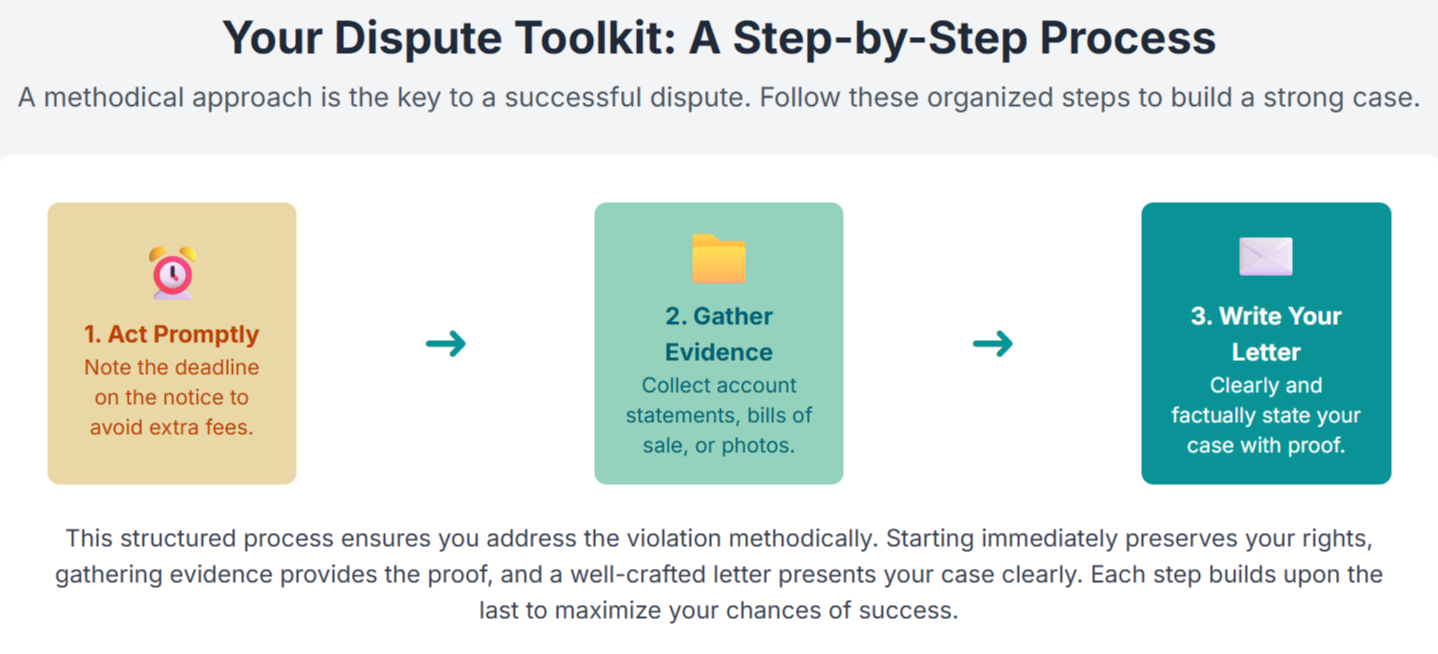
When that notice arrives, the clock starts ticking. Ignoring it will only lead to more fees and bigger headaches, like a potential suspension of your vehicle’s registration in some states. So, let’s get organized.
Gather Your Intel
The violation notice is your treasure map. Carefully pull these key pieces of information from it and keep them handy:
- Violation Notice Number
- Date and Time of the violation
- Location of the violation (the exact toll plaza)
- License Plate Number on the notice
- Your E-ZPass Account Number
Do a Deep Dive on Your Account
Next, log in to your E-ZPass account online. You’re looking for proof that you were in the right.
- Check your balance. Was your account positive on the date of the violation?
- Verify your payment methods. Was your linked credit card still valid?
- Confirm your vehicles. Was the car and its license plate correctly listed on your account at the time?
- Scan your transaction history. Is the charge missing? Or, even better for your case, is it a duplicate charge where you were already billed for it?
Build Your “Paper Trail”
Evidence is the heart of a successful dispute. You need to build an undeniable case. Never send your original documents; always send copies.
Depending on your situation, gather these:
- A copy of the Violation Notice itself
- E-ZPass Account Statements from the time of the violation, highlighting a positive balance or a duplicate charge
- If you sold the vehicle, a copy of the Bill of Sale and proof you removed the plate from your account. This is crucial!
- If your transponder was lost or stolen, the report you filed with the E-ZPass agency
- For an incorrect vehicle class charge, a copy of your vehicle’s registration
Honestly, this preparation phase is the most critical part. A well-organized file makes you look serious and makes it easy for the reviewer to rule in your favor.
Choosing Your Weapon: How to Submit Your Dispute
You’ve got your evidence. Now, how do you actually send it? You generally have three options, and the best one depends on the agency and your case.
The Online Portal: Quick and Easy?
Most agencies, like those in Pennsylvania and New Jersey, push you toward their online dispute portals.
- Pros: It’s fast and you can upload your evidence directly. You’ll usually get an instant confirmation number.
- Cons: Some of these websites look like they were designed in 1999. They can be clunky.
- My Pro Tip: Screenshot every single step, especially the final confirmation page. This is your non-negotiable proof that you submitted the dispute on time.
Snail Mail: The Old-School Power Move
In an age of instant everything, sending a physical letter feels almost revolutionary, doesn’t it? For some things, like a notarized form required by Virginia E-ZPass, it’s your only option.
- Pros: It creates a powerful paper trail, especially if you send it via certified mail with a return receipt requested. This way, they can never claim they didn’t get it.
- Cons: It’s obviously slower and there’s a small chance it could get lost if you don’t use a trackable method.
The Phone Call: For the Brave and Patient
Calling customer service can sometimes work for very simple, first-time mistakes where a friendly agent might waive a fee as a courtesy.
- Pros: You might get an immediate resolution.
- Cons: Get ready for some quality time with their hold music. More importantly, a phone call creates no paper trail. If you go this route, take meticulous notes: date, time, agent’s name or ID, and a summary of what they promised.
So, You’ve Sent the Letter… Now What?
You’ve done your part. Now comes the waiting game. Don’t expect an answer tomorrow; a full review can take several weeks or even a couple of months. If you haven’t heard anything after 4-6 weeks, it’s appropriate to make a polite follow-up call. Have your violation number ready.
Eventually, you’ll get a decision in writing:
- Accepted: Success! The violation is dismissed.
- Rejected: They didn’t accept your dispute. The notice should say why.
- Partial Acceptance: They might waive the fees but still require you to pay the toll.
They Said No?! How to Escalate (The Right Way)
If your dispute is denied, don’t give up. The rejection notice itself should outline the process for an appeal. In some states, like New York, there’s even an Office of the Toll Payer Advocate you can contact if you’ve hit a wall with the normal customer service channels. Think of them as your special forces for fighting an unfair toll.
Ignoring a final notice is the worst thing you can do. The debt can be sent to a collection agency, and some states can even suspend your vehicle’s registration for unpaid tolls. It’s serious business.
The Best Defense: How to Avoid This Headache in the Future
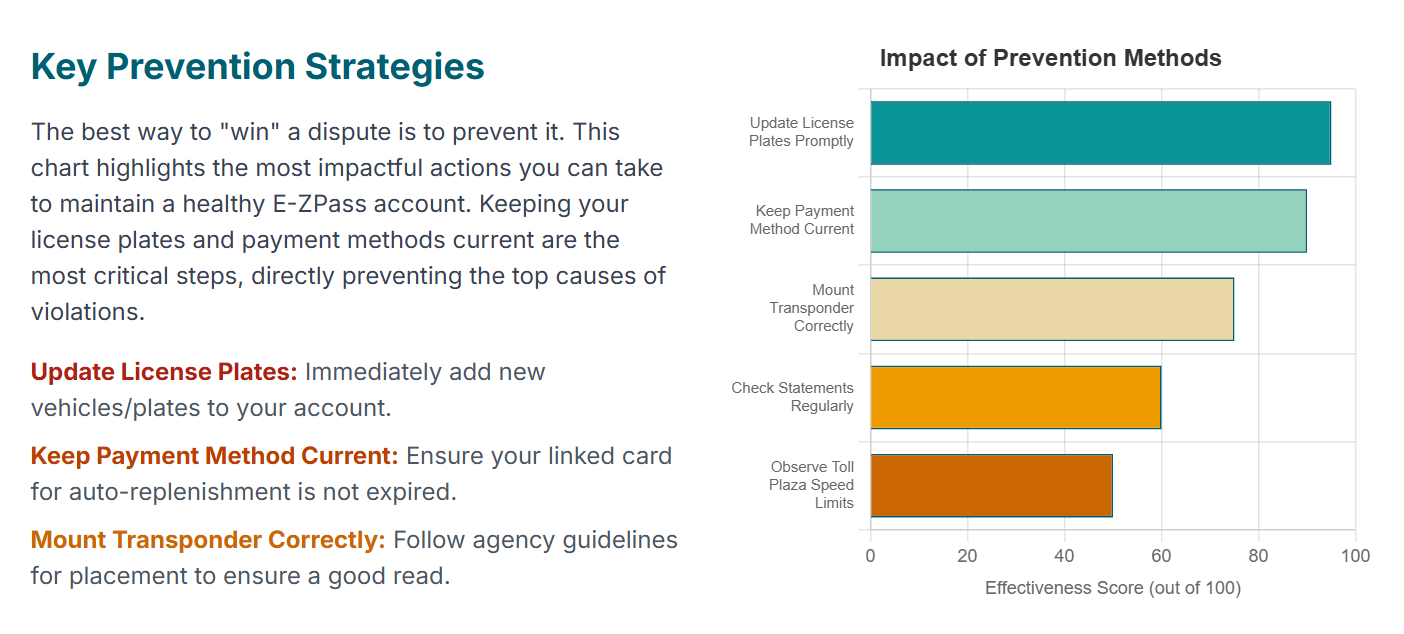
The ultimate win is never getting a violation in the first place. A little “account hygiene” goes a long way.
- Set up auto-replenishment. This is the #1 way to avoid a low balance.
- Update your payment info the second you get a new credit card.
- Update your license plates immediately when you sell a car or get a new one.
- Mount the transponder correctly! Follow the agency’s instructions—usually, it’s centered behind the rearview mirror.
- Check your statements once in a while to catch any errors early.
Final Thoughts
Challenging an E-ZPass violation feels like a David vs. Goliath battle, but it’s a fight you can win. It all boils down to being prompt, organized, professional, and persistent. You have rights, and the system has processes for correcting its own mistakes.
Now you have the knowledge and the tools. Go get that violation dismissed. You’ve got this!

Pavithra Vinoth is the founder of nytollsinfo.com, where she simplifies U.S. toll systems through expert insights and custom-built calculators. Her research-driven tools help drivers avoid costly mistakes and make smarter car decisions.