


Planning a long road trip and wondering if your E-ZPass will actually be useful? Here is the quick answer: it depends entirely on your route. Knowing that upfront can save you serious money and a lot of confusion at toll plazas.
- What Is E-ZPass in 2026?
- Where E-ZPass Works in 2026
- The Best Transponder for Cross-Country Trips
- How Much Will Tolls Actually Cost?
- The E-ZPass Flex for HOV Lanes
- Rental Cars and Toll Traps to Avoid
- Account Fees and Replenishment Rules
- E-ZPass Plus: Parking and Airports
- National Park Fees in 2026
- The Full Pros and Cons Breakdown
- Your Pre-Trip Checklist
- The Future of Transponders
- Ready to Roll
What Is E-ZPass in 2026?
E-ZPass is an electronic toll collection system that lets you cruise through toll lanes without stopping for cash. You load money into an account, stick a transponder to your windshield, and the system handles the rest automatically.
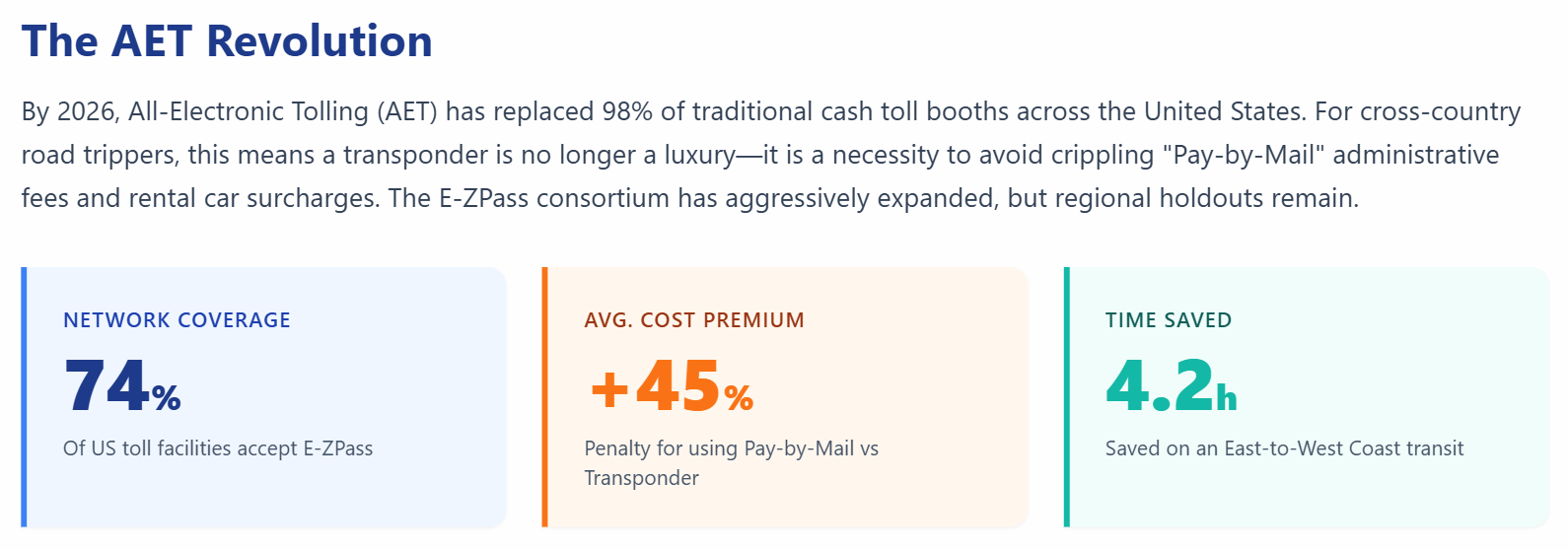
The E-ZPass Interagency Group (IAG) has grown from a small Northeast coalition into a network covering over 40 agencies across 20 states. That said, the system still does not cover the entire country, which matters a lot for road trippers heading west.
The good news? The landscape changed significantly in 2026. Florida now fully accepts E-ZPass, which is a huge win for anyone driving the I-95 corridor from Maine to the Florida Keys.
Where E-ZPass Works in 2026
Understanding coverage is the single most important step before any long trip. Using the wrong tag in the wrong state can cost you more than you expect.
States That Accept E-ZPass
E-ZPass currently works in 20 states, covering the Northeast, Mid-Atlantic, Midwest, and now Florida:
| Region | States |
|---|---|
| Northeast | Maine, New Hampshire, Vermont, Massachusetts, Rhode Island, Connecticut, New York, New Jersey |
| Mid-Atlantic | Pennsylvania, Delaware, Maryland, Virginia, West Virginia, North Carolina |
| Midwest | Ohio, Indiana, Illinois, Minnesota |
| South | Florida, Georgia |
Sources: E-ZPass Network Map
States Where E-ZPass Does Not Work
Head into the Central or Western United States and your standard E-ZPass becomes useless. These regions use entirely different systems:
- Texas uses TxTag, TollTag, and EZ TAG (not the same as E-ZPass)
- California uses FasTrak
- Colorado, Kansas, and Oklahoma use their own regional systems
If your route takes you through any of these states, you will need a different payment method or a smarter tag. More on that below.
The Best Transponder for Cross-Country Trips
Not all transponders are created equal. If you are planning a true coast-to-coast trip, a standard state-issued E-ZPass tag is actually not your best option.
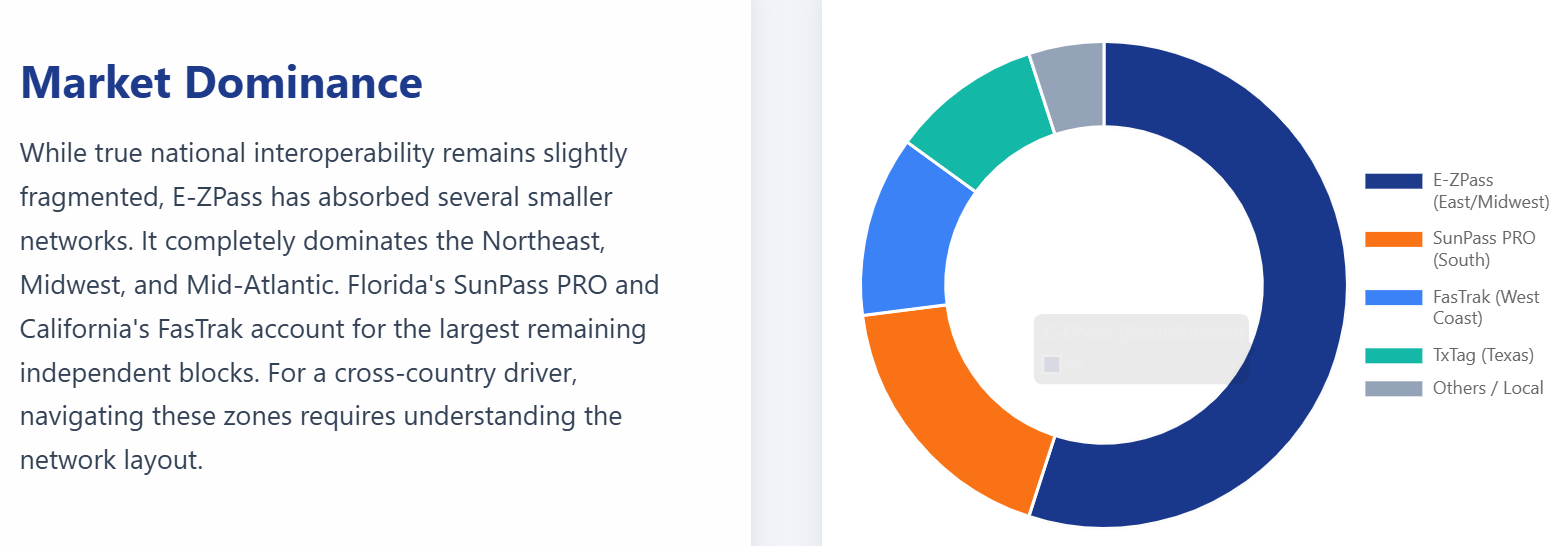
Two transponders stand out as the top choices for maximum coverage in 2026.
SunPass PRO
The SunPass PRO is a portable, suction-cup mounted transponder that works in 23 states. It is accepted on E-ZPass roads in the Northeast and Midwest, plus Florida, Georgia, North Carolina, and most Texas toll roads through the CUSIOP interoperability agreement.
Key advantages:
- Works across the E-ZPass territory and Southern networks
- Portable design means you can move it between vehicles and rental cars
- No destructive adhesive, so you will not ruin your windshield sticker when switching cars
Uni (by Central Florida Expressway Authority)
The Uni covers 19 states and is especially popular for its sleek design and the E-PASS Toll App integration, which gives you real-time account management from your phone.
Key advantages:
- Clean, low-profile look with a black design option
- Strong app support for managing plates and balances
- Wide coverage, including E-ZPass and Florida networks
Which Should You Get?
If you are heading south or into Texas, the SunPass PRO is the stronger choice. If you are staying in the Eastern corridors and want better app support, the Uni is excellent. Either way, both beat a standard single-state E-ZPass tag for long-distance travel.
How Much Will Tolls Actually Cost?
The cost of your trip depends heavily on your route, your transponder type, and whether you have the right tag for each state. Here is what you need to know.
Transponder vs. Cash Rates
Electronic rates are consistently cheaper than cash or plate-billing rates. The gap has grown significantly in 2026, because toll agencies have shifted more administrative costs onto drivers who do not use transponders.
| State | E-ZPass Rate | Cash or Plate Rate | Savings |
|---|---|---|---|
| Illinois | Standard rate | 2x the E-ZPass rate | Up to 50% |
| New York Thruway | In-state E-ZPass rate | Higher for out-of-state accounts | 10 to 30% |
| Virginia Express Lanes | Dynamic rate | Higher dynamic rate | Varies |
Sources: Illinois Tollway and NY Thruway Calculator
Estimated Toll Costs by Route
These are rough estimates for a standard passenger car using a transponder:
- I-95 from Maine to Florida: $60 to $100 total
- I-80 from New York to San Francisco: $30 to $55 in tolled sections (mostly Ohio and Indiana)
- I-40 from North Carolina to California: Minimal tolls overall
Use TollGuru to map your specific route and calculate exact costs before you leave.
Watch Out for “Mid-Tier” Surcharges
The Port Authority of New York and New Jersey introduced a third pricing tier in July 2025. This “Mid-Tier” rate applies when your tag is not properly mounted and the system has to read your license plate instead.
In practice, this means an improperly positioned transponder can cost you more money even if your account is active. Always check your mounting position before entering busy toll corridors.
The E-ZPass Flex for HOV Lanes
If your trip takes you through Virginia or Maryland, this one tip alone could save you a significant amount of money.
What Is E-ZPass Flex?
The E-ZPass Flex is a standard E-ZPass transponder with a switch on the side. When you flip it to “HOV ON,” the system recognizes your vehicle as a High Occupancy Vehicle carrying three or more passengers.
On Virginia’s managed express lanes, HOV-3 vehicles travel for free during peak hours. A solo driver on the same I-66 corridor can pay as much as $25.00 for a single trip during peak congestion. A family of four with a Flex tag set to HOV ON pays nothing.
Where the Flex Works
- I-495 Express Lanes
- I-95 Express Lanes
- I-395 Express Lanes
- I-66 Inner and Outer Corridors
- Select lanes in Maryland and North Carolina
If you have three or more people in the car, the Flex tag pays for itself extremely quickly.
Rental Cars and Toll Traps to Avoid
Many cross-country travelers rent a car. The toll industry knows this, and rental companies have turned toll collection into a genuine profit center. Here is how to avoid the trap.
How Rental Companies Charge for Tolls
Most major agencies offer two options:
- Daily convenience fee ($5.99 to over $10.00 per day): This often kicks in for the entire rental period the moment you use a single toll road, even on days you never touch a toll.
- Plate-billing model: The agency receives a bill from the toll authority and passes it on to you with added administrative fees.
Both options are significantly more expensive than using your own transponder.
The Three-Step Strategy for Rental Cars
Expert travelers in 2026 follow a specific protocol to avoid rental company fees entirely:
- Shield the rental transponder. Most rental cars have a built-in transponder box. Make sure it stays closed and shielded so the rental company account is never activated.
- Mount your personal portable tag. Use a suction-cup transponder like the SunPass PRO on your own account.
- Register the rental car’s plate to your account. Add the rental plate to your personal E-ZPass or SunPass account with the correct start and end dates. This creates a backup in case the RFID read fails, routing the bill to your account instead of the rental company.
This three-step approach ensures you pay only the standard electronic toll rate with zero rental surcharges.
Source: Hola Car Rentals Rental Toll Guide
Account Fees and Replenishment Rules
Setting up an account the right way from the start can prevent surprise charges later in your trip.
What It Costs to Open an Account
Starting balances and fees vary by state. Some states charge no annual fee at all, while others charge a small maintenance fee.
| State | Deposit Required | Annual Fee |
|---|---|---|
| New York | Varies by plan | None for personal accounts |
| New Jersey | Varies by plan | Small fee for some plans |
| Virginia | Varies by transponder count | None |
| Maryland | Varies by plan | None for standard plans |
Check E-ZPass Costs by State for current figures before opening an account.
Auto-Replenishment Can Sneak Up on You
Most states use a dynamic replenishment system. Virginia, for example, sets the initial low-balance threshold at $10.00. But if your usage increases during a long trip, the system automatically raises the replenishment amount to $35.00 or more.
This is not a charge, just an automatic top-up. But it can feel surprising if you are not watching your balance. Set up low-balance alerts in your account before you leave.
E-ZPass Plus: Parking and Airports
The usefulness of your E-ZPass extends beyond highways. If you are flying out of a major Northeastern airport before or after your road trip, this feature is worth knowing about.
The E-ZPass Plus program lets you pay for airport parking using your toll account. Your account must have automatic replenishment enabled via credit card for this to work.
Participating locations include several major airports in New York, New Jersey, and Maryland. It is a convenient way to consolidate travel payments into a single account.
National Park Fees in 2026
Many cross-country road trips end at a national park. The entry fee structure changed significantly on January 1, 2026, so it is worth planning ahead.
Current Fee Structure
| Visitor Type | Annual Pass | Surcharge Parks (per person) |
|---|---|---|
| U.S. Residents | $80.00 | Standard entry included |
| International Visitors | $250.00 | Additional $100.00 per person |
The “surcharge parks” include popular destinations like the Grand Canyon, Yellowstone, and Yosemite. Without an annual pass, international visitors pay significantly more for entry to these eleven parks.
Source: National Park Service Nonresident Fees
Digital Passes Are Now Standard
The NPS has moved to a digital-first system through the Recreation.gov app. You can link your pass to your phone and skip physical ticket lines at the gate. This matches the same philosophy as electronic tolling: pre-validate, then move faster.
The Full Pros and Cons Breakdown
Now that you have all the details, here is a clean summary to help you decide if E-ZPass is the right setup for your trip.
Pros
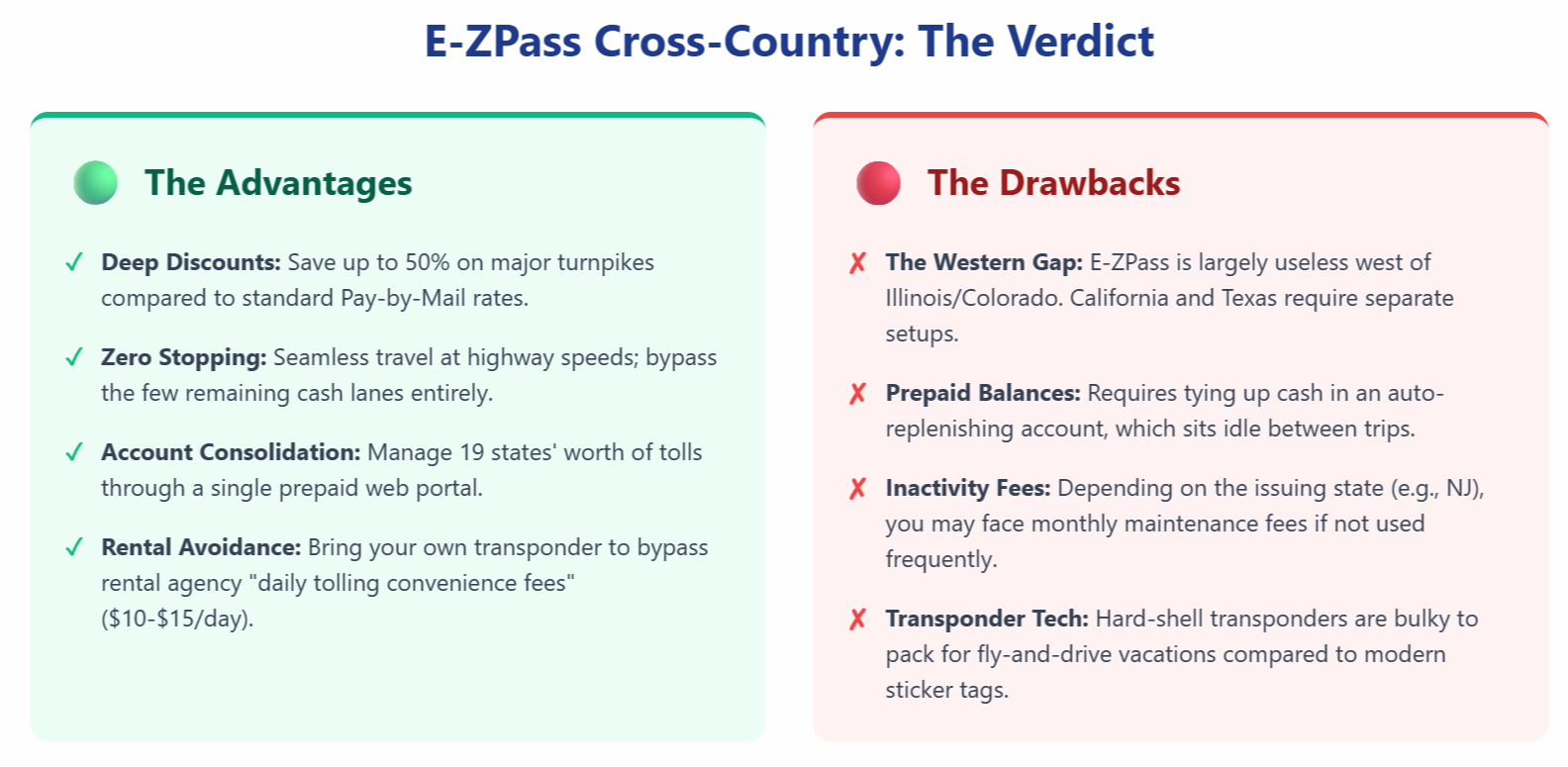
- Massive time savings. Express lanes move significantly faster than cash lanes, especially in heavy Northeast traffic.
- Consistent cost savings. Electronic rates run 25 to 50 percent lower than cash or plate-based alternatives across most states.
- Florida coverage added. The entire I-95 corridor from Maine to the Florida Keys is now accessible with E-ZPass.
- Airport parking integration. E-ZPass Plus consolidates parking and highway payments into one account.
- Reliable back-office accuracy. Modern AI-powered billing systems have reduced charge errors to very low levels.
Cons
- Texas and the West remain gaps. A standard E-ZPass does not work in Texas, California, or most of the Western and Central United States.
- Local accounts get better rates. New York and other states give their own residents lower rates than out-of-state E-ZPass holders.
- Mounting matters more than ever. Improperly positioned tags trigger “Mid-Tier” surcharges at PANYNJ facilities.
- Rental car toll traps are real. Without the right strategy, rental car toll fees can easily exceed what you would have paid in tolls directly.
Your Pre-Trip Checklist
Before you hit the road, run through this quick list to make sure you are set up correctly.
Transponder Setup
- [ ] Choose the right tag for your route (SunPass PRO or Uni for multi-region trips)
- [ ] Test your transponder at a local toll plaza before departing
- [ ] Check that the tag is positioned correctly on a clean, non-metallic area of your windshield
- [ ] Verify your payment method is current and active
Account Management
- [ ] Check your current balance and set a low-balance alert
- [ ] Download your account’s official app (Tolls NY, E-PASS Toll App, or SunPass app)
- [ ] Note the replenishment rules for your home state
Route Planning
- [ ] Map your toll costs using TollGuru or TollSmart
- [ ] Identify which states on your route do not accept your tag
- [ ] Plan a backup payment method for non-E-ZPass territory
If Renting a Car
- [ ] Shield the rental vehicle’s built-in transponder box
- [ ] Bring a portable personal transponder
- [ ] Register the rental plate to your personal account before your first toll
The Future of Transponders
The physical transponder may not be around forever. A pilot program involving Volvo, Mastercard, and the North Carolina Turnpike Authority is currently testing in-vehicle tolling through the Android Automotive operating system. In this system, the car uses GPS geofencing to detect toll gates and pays automatically through a linked cloud account.
Europe is already further along. Lithuania launched a fully smartphone-based national tolling system in February 2026. North America is expected to follow a similar path over the 2026 to 2035 period, gradually shifting from fixed gantry readers to satellite-based distance tolling.
For now, a good portable transponder is still the best tool for any road trip. But it is worth knowing that the hardware itself has an expiration date.
Ready to Roll
E-ZPass is one of the smartest investments for any road trip through the Eastern United States. The coverage is wide, the savings are real, and the Florida expansion makes the full I-95 corridor finally accessible with a single account.
The key is knowing its limits. A standard E-ZPass tag will not carry you through Texas or California. A SunPass PRO or Uni will get you much further. Add a Flex tag if you are driving through Virginia with passengers, register your rental plate before your first toll, and download your account’s app before you leave home.
Do the prep work, and the open road genuinely takes care of itself.

Pavithra Vinoth is the founder of nytollsinfo.com, where she simplifies U.S. toll systems through expert insights and custom-built calculators. Her research-driven tools help drivers avoid costly mistakes and make smarter car decisions.
Hi, my sister and I will be leaving April 5, 2026 from CA, driving eventually through NC, VA, MD, PA & NY, then possibly into New England, and home via NY & PA again, OH, IN & IL.
Would it be worth it to purchase an EZ Pass (Flex?) and if so, which state would be best? VA looks pretty good, but I’m not sure if there are residency requirements for it or any of the passes.
Thanks in advance!
Thanks for sharing your route, that sounds like an amazing road trip!
Yes, it’s definitely worth getting an E-ZPass for that journey. You’ll be passing through several toll-heavy states like Virginia, Maryland, Pennsylvania, and New York, and having one will save you both time and money by avoiding cash lanes and higher pay by plate fees.
The great part is that E ZPass works across all those states, so the issuing state doesn’t matter too much. Many travelers choose Virginia if they want the Flex option for HOV or Express lanes, while Maryland is a popular choice because the transponder is free and there is no monthly fee.
There are usually no strict residency requirements, so you can pick whichever option is most convenient for you.
If you don’t plan on using HOV or Express lanes, a standard E ZPass will work perfectly fine and you don’t need the Flex version.
Safe travels and enjoy the trip, that’s a fantastic route