

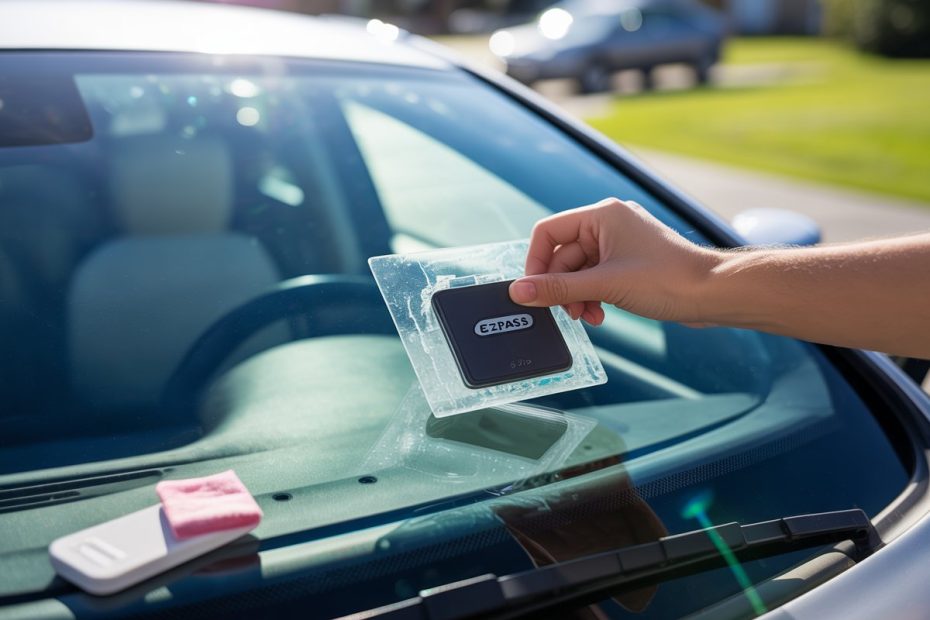
Ripping that old E-ZPass off your windshield in 2026 requires more than just a metal scraper and sheer willpower. You need a hair dryer, a foot of dental floss, plastic razor blades, and Isopropyl Alcohol to get the job done without destroying your car’s expensive safety sensors.
I recently stared down this exact problem when my local tolling agency finally forced the switch to the new paper-thin RFID stickers. My clunky plastic box had baked into the glass for eight years, leaving behind a concrete-like adhesive.
Let me show you exactly how to cleanly remove the old mounts or the new self-destructing stickers without scratching your delicate modern automotive glass.
TL;DR: What You Need in 30 Seconds
- The Goal: Safely remove E-ZPass adhesive without destroying your ADAS cameras or HUD coatings.
- The Tools: Hair dryer (heat), dental floss (shear), plastic razor blade (scrape), and Isopropyl Alcohol (clean).
- The Rule: NEVER use metal razor blades or spray harsh chemicals directly onto the glass near windshield sensors.
- The 2026 Toll Shakeup: Why Everything Changed
- Your Windshield is Basically a Computer Now
- The Arsenal: What You Actually Need for the Job
- How to Remove the Old Hard-Case E-ZPass (The Velcro Strips)
- Defeating the Anti-Tamper 2026 RFID Sticker
- The Solvent Showdown: Picking the Right Chemical
- The "Sticker Shield" Loophole
- Don't Get Fined: What to Do with the Old Transponder
- Frequently Asked Questions (FAQ)
- The Clear View Ahead
The 2026 Toll Shakeup: Why Everything Changed
Ever wondered why agencies suddenly demanded you scrape off a perfectly good transponder? The answer always comes down to simple economics.
For decades, we relied on those bulky, battery-powered hard cases to get us through the fast lanes.
The Hidden Cost of Old Transponders
Those traditional active transponders cost the state anywhere from $6.00 to $7.15 each to produce. They also house an internal lithium-ion battery that typically dies after about eight years of roasting in the hot sun.
When that battery fails, the whole unit becomes expensive electronic waste.
Replacing millions of dead transponders annually drained toll agency budgets. They needed a cheaper, permanent solution.
The Shift to Passive RFID Stickers
Fast forward to today, and massive networks like the Illinois Tollway and Massachusetts have aggressively transitioned to passive RFID sticker tags. These new paper-thin stickers lack a battery completely.
Overhead toll gantries shoot a radio signal that temporarily powers up the sticker just long enough to read your account number. Because they lack heavy batteries and plastic shells, these modern stickers cost agencies roughly a dollar to make.
Yes, the toll authority saved millions on hardware, but they kindly passed the manual labor of upgrading directly to you.
Your Windshield is Basically a Computer Now
Before you grab a butter knife and start hacking away at that old adhesive, we need to talk about the glass itself. Cars manufactured today feature incredibly advanced, highly sensitive windshields.
Beware the ADAS Cameras
Look right above your rearview mirror. You will likely see a cluster of forward-facing cameras pressed against the glass.
These Advanced Driver Assistance Systems (ADAS) control your emergency braking, lane keep assist, and adaptive cruise control. ADAS cameras require an absolutely flawless, mathematically perfect line of sight through the glass.
Even a microscopic scratch from a metal tool or a hazy smear of leftover glue will violently refract incoming light. This unintended refraction causes the car’s computer to hallucinate obstacles and suddenly slam on the brakes on an empty highway.
RIP to your pristine driving record.
WARNING: Spraying liquid solvents directly onto the glass near the camera housing is a massive mistake.
Capillary action will suck the liquid into the microscopic gaps, permanently ruining the internal optical hardware. Spray your towel, never the glass!
Heads-Up Displays and Delicate Coatings
Additionally, modern windshields utilize advanced optical nanocoatings on the interior. If your car projects speed and navigation onto the glass, you have a Heads-Up Display (HUD).
To make this projection visible even when you wear polarized sunglasses, manufacturers apply incredibly thin p-polarized reflective layers and cold mirror films to the inner glass. Using harsh industrial chemicals or metal blades near these treated zones will instantly strip the optical coating.
Once you ruin that nanocoating, your HUD projection will look blurry, permanently distorted, and utterly unreadable.
The Arsenal: What You Actually Need for the Job
You must absolutely abandon the old-school metal razor blade. Instead, you need a highly specific set of tools that break down the adhesive’s chemical bonds without inflicting collateral damage on the glass.
- A Solid Heat Source: Grab a standard consumer hair dryer or a commercial heat gun. Heat lowers the shear strength of the hardened glue.
- High-Tensile String: Heavy-duty waxed dental floss or basic monofilament fishing line works perfectly. You will use this to slice the adhesive.
- Plastic Razor Blades: This is your secret weapon. You want blades made from block copolymer polypropylene. They are softer than your glass coatings but harder than the glue.
- Chemical Solvent: Pick up a bottle of 70% or 90% Isopropyl Alcohol (IPA).
- Microfiber Towels: You need clean, lint-free towels to wipe away the chemical residue.
How to Remove the Old Hard-Case E-ZPass (The Velcro Strips)
The legacy interlocking plastic strips, often called Velcro by mistake, use a highly durable, viscoelastic acrylic adhesive. After years of baking in extreme summer cabin temperatures, this acrylic literally bonds with the microscopic pores of your windshield.
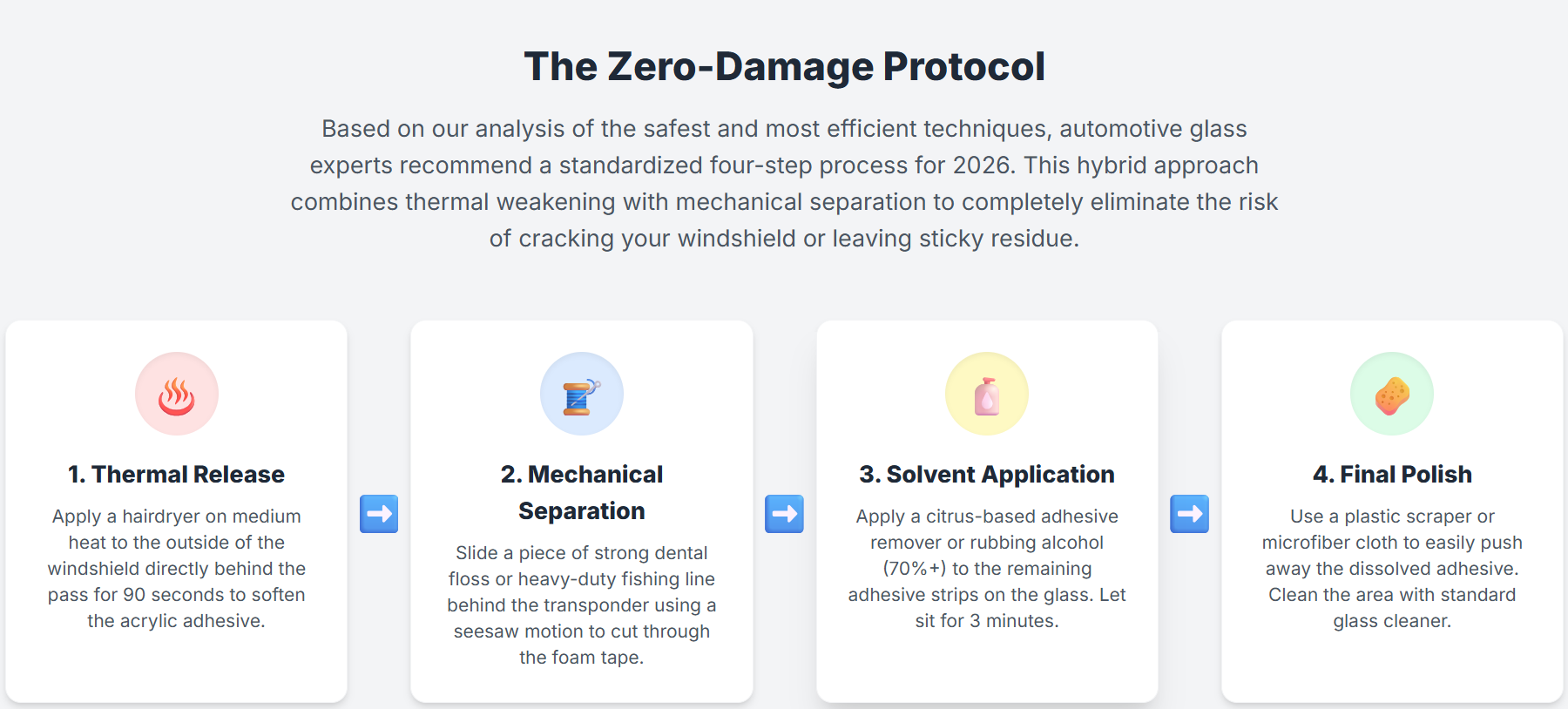
Phase 1: Detachment and Shearing
- Detach the Hardware First: Take the heavy plastic transponder off the mounting strips. Never attempt to pry the strips while the heavy box remains attached. The bulky unit creates mechanical leverage that can easily crack your entire windshield under pressure.
- Apply Indirect Heat: Turn your hair dryer to a medium setting. Hold it outside the vehicle, pointing directly at the windshield area where the strips sit. Move the dryer continuously for about 60 seconds. You want the interior strips to feel distinctly warm to the touch, but not scalding hot.
- The Floss Saw Technique: Wrap a 12-inch piece of dental floss tightly around your index fingers. Slip the string directly behind the top edge of the plastic strip, flat against the glass. Pull the string back and forth in a smooth, continuous sawing motion until it cleanly severs the plastic strip from the windshield.
- PRO TIP: Wear nitrile gloves when using the floss method. Pulling high-tensile string tight enough to cut through hardened acrylic glue can easily slice into your bare fingers.$$Insert Video Embed: Close-up of safely sawing through E-ZPass adhesive with dental floss$$
Phase 2: Chemical Breakdown and Cleanup
- Chemical Saturation: You now have an ugly square of naked adhesive stuck to the glass. Dab a heavy amount of an orange-based solvent (like d-Limonene) onto a towel and press it against the glue. Let it sit there for five full minutes.
- Scrape and Polish: Take your plastic razor blade and push it at a shallow, 30-degree angle. The softened adhesive sludge will lift right off. Finally, spray your Isopropyl Alcohol onto a fresh microfiber cloth and wipe the glass aggressively to remove any lingering oily residue.
Defeating the Anti-Tamper 2026 RFID Sticker
Tolling agencies specifically designed the new 2026 stickers to prevent theft and toll evasion. They utilize a permanent pressure-sensitive adhesive embedded with a highly fragile metallic antenna.
If you try to peel this sticker off to swap it into your spouse’s car, the mechanical stress immediately shatters the internal antenna. These new stickers are built to self-destruct like a bad spy movie trope.
This intentional destruction leaves you with a stubborn mess of torn plastic and high-tack glue.
Phase 1: Triggering the Tamper Destruct
- Warm the Substrate: Just like the old strips, apply heat from the exterior of the windshield for roughly 45 seconds. This warms up the pressure-sensitive adhesive and makes the top plastic layer pliable.
- Lift and Shatter: Use a fresh plastic razor blade to gently pry up one corner of the sticker. Slowly pull the sticker backward. Expect the internal antenna to audibly snap and the base layer to tear. This means the security feature works exactly as intended.
Phase 2: Dissolving the Base Layer
- Soak the Remains: You are now left with a torn, highly porous base layer stuck flat to the glass. Soak a cloth in Isopropyl Alcohol and hold it firmly against the torn substrate. Because you ripped off the protective top layer, the alcohol easily penetrates the base layer and attacks the glue.
- Shear and Clear: Grab your plastic razor blade again. Slide it firmly underneath the softened base layer, shearing the entire matrix off the glass. Follow up with rapid, circular wipes using your alcohol-soaked towel until the glass feels completely smooth.
The Solvent Showdown: Picking the Right Chemical
Mechanical action rarely finishes the job. The microscopic pores of the silica glass will hold onto trace amounts of sticky polymer film.
You absolutely need a chemical solvent to melt those molecular bonds, but picking the right one matters immensely.
| Solvent Type | Effectiveness | Safety on Glass / ADAS | Residue Left Behind |
| Isopropyl Alcohol (IPA) | High (Swells polymer matrix) | Excellent (Safe if kept off rubber seals) | None (Evaporates rapidly) |
| Citrus Terpenes (Goo Gone) | Very High (Melts legacy acrylics) | Moderate (Keep away from sensors) | Heavy/Oily (Requires IPA cleanup) |
| Aliphatic Hydrocarbons (WD-40) | High (Dissolves heavy rubber) | Low (Refractive oil distorts cameras) | Very Heavy (Massive cleanup needed) |
Why Isopropyl Alcohol Wins
I always reach for Isopropyl Alcohol first. Professional auto detailers use it constantly because its zero-residue trait makes it the only safe chemical when cleaning the critical glass areas directly in front of your ADAS camera housings.
It attacks the glue structure fast and flashes off the glass cleanly.
The Danger of Oily Solvents (Goo Gone & WD-40)
While Goo Gone and WD-40 easily obliterate organic polymer bonds, they are notoriously oily. If that highly refractive oil seeps onto the internal camera lens, you face a massive dealership repair bill.
If you must use them for the heavy lifting, you must perform a secondary cleaning session with IPA to cut through that lingering grease.
The “Sticker Shield” Loophole
The loss of portability really frustrated families who historically passed a single hard-case transponder between multiple vehicles or rental cars. In response, a massive aftermarket industry popped up practically overnight.
Bypassing the Tamper-Proof Design
Many drivers now buy transparent, low-tack static cling films. You stick the permanent RFID tag directly onto this secondary film, and then press the cling film against your windshield.
This entirely circumvents the toll authority’s anti-tamper destruction mechanism. You can easily peel the static cling off and move the working tag to a rental car in seconds.
What If It’s Already Stuck?
Unfortunately, this trick only works for brand new installations. If you already applied the tag bare to the glass, you cannot save it.
You must follow the chemical removal protocols above to get it off, and then order a replacement sticker for your new vehicle.
Don’t Get Fined: What to Do with the Old Transponder
You cannot simply toss the old plastic E-ZPass box into your kitchen trash can. Agencies maintain strict return policies because they technically own that hardware.
If you fail to return the old unit when upgrading to a sticker, they will automatically dock your prepaid account balance.
The E-Waste Hazard
Remember that aging lithium-ion battery inside the shell? When compacted inside a garbage truck, those batteries easily trigger thermal runaway fires.
If your state agency explicitly allows you to dispose of the old unit yourself, please do it responsibly. Use the Earth911 recycling database to locate a certified electronic waste facility near you that handles volatile batteries safely.
Agency Penalty Breakdown
If you live in a state that requires a physical return, prepare to ship it out quickly. Here is what happens if you hold onto it:
- New York and New Jersey: The Port Authority aggressively enforces a $25 penalty for every unreturned tag. You must mail them back to specific PO Boxes, like the primary facility dedicated to E-ZPass New York return guidelines.
- Pennsylvania: The Pennsylvania Turnpike tolling options clearly state one of the steepest penalties in the consortium, charging a hefty $35 for an unreturned or lost transponder.
- Massachusetts: They charge a more reasonable $10 fee. You can easily handle the swap through the Massachusetts EZDriveMA portal or drop it off at a local AAA branch.
- Virginia: Virginia operates a massive network and requires you to wrap the old transponder completely in aluminum foil before mailing it. Check the official Virginia E-ZPass FAQ for the latest mailing address. The foil blocks the radio signal, so toll gantries do not charge your account while the device rides inside a mail truck.
Frequently Asked Questions (FAQ)
Can I use Windex to remove E-ZPass glue?
No. Standard glass cleaners rely heavily on ammonia, which struggles to break down thick acrylic polymers. Windex works great for cleaning the glass after the glue is gone, but it won’t melt the actual adhesive block.
Will plain white vinegar work?
Yes, but bring a lot of patience. Vinegar is mildly acidic and incredibly safe for your car’s interior.
However, it requires massive dwell times (5 to 10 minutes per application) and serious elbow grease compared to Isopropyl Alcohol.
Does the toll agency track if my new RFID sticker breaks?
Yes, they do. The metallic inlay inside the sticker literally functions as the radio antenna.
Once the sticker peels and the antenna fractures, overhead gantries can no longer read the microchip. You will eventually receive a toll violation in the mail if you try to tape a broken sticker back up.
The Clear View Ahead
The national push toward passive sticker tags streamlined the entire highway infrastructure and saved incredible amounts of tax money. It also forced us to rethink how we treat our cars.
You simply cannot treat a 2026 windshield like a sheet of cheap glass. Advanced optical coatings and autonomous driving sensors demand respect.
Leave the razor blades in the toolbox. Grab a cheap plastic scraper, some dental floss, and a bottle of rubbing alcohol.
Follow the steps outlined here, and you will easily preserve the flawless optical clarity of your windshield while staying completely legal in the fast lane.

Pavithra Vinoth is the founder of nytollsinfo.com, where she simplifies U.S. toll systems through expert insights and custom-built calculators. Her research-driven tools help drivers avoid costly mistakes and make smarter car decisions.