

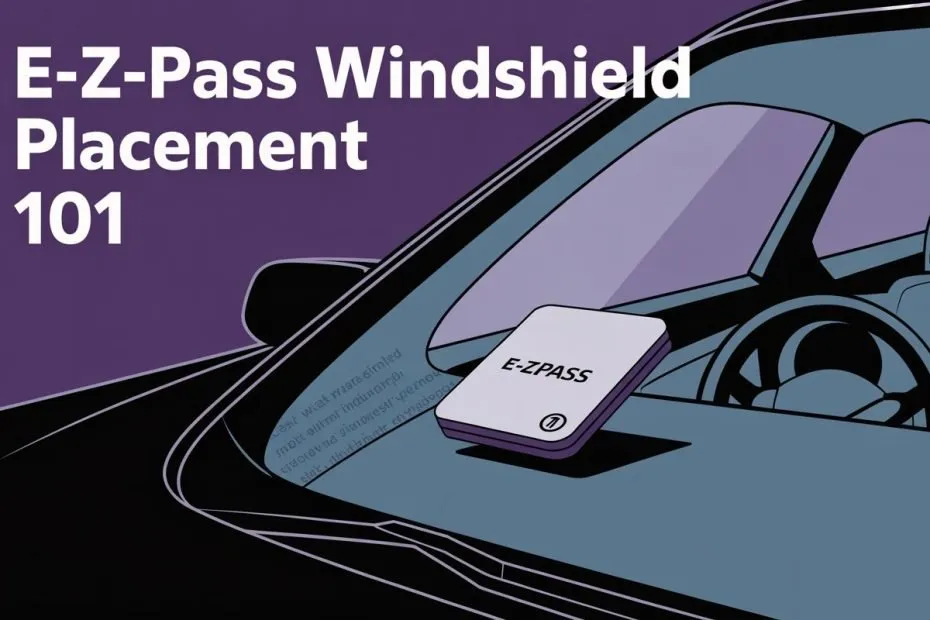
Missing a toll read in 2026 can cost you double the standard rate thanks to “Toll-by-Plate” surcharges that hit your wallet harder than a premium gas station snack. To save your hard-earned cash, mount your transponder in the top center of your windshield, at least one inch below the roofline and one inch away from the rearview mirror post.
I remember the first time I ignored these instructions and ended up with a $5.00 bill for a $2.00 bridge crossing. It felt like I was paying a “laziness tax” to the state. Don’t be like past-me; getting this right takes exactly thirty seconds.
- The 2026 E-ZPass Placement Cheat Sheet
- Why Placement Matters More in the Era of Open Road Tolling
- The Standard Mount: Windshield Placement 101
- Choosing Your Hardware: Stickers vs. Flex Tags
- Navigating the ADAS Camera Conflict
- Dealing with Metallized and Athermal Glass
- The "Green Pass" Savings Trap
- Troubleshooting: Why Am I Getting Billed by Plate?
- Final Thoughts on Hitting the Open Road
The 2026 E-ZPass Placement Cheat Sheet
If you’re in a hurry to get on the road, follow this quick breakdown for your specific vehicle type. Toll gantries scan from above, so your car’s “eye” needs the best possible view.
| Vehicle Type | Ideal Mounting Location |
| Standard Sedans & SUVs | Top center, passenger side of the mirror post. |
| Subaru (EyeSight) | Far upper-right corner, outside the camera sweep. |
| Tesla (Model 3/Y) | Directly to the right of the camera housing. |
| Heavy Trucks & RVs | Center-bottom of the windshield (2-3 inches up). |
| Motorcycles | Center of the fairing or a specialized RAM mount. |
Why Placement Matters More in the Era of Open Road Tolling
The days of slowing down for a toll booth are officially over, replaced by overhead gantries that scan your car while you cruise at 70 mph. These sensors need a clear line of sight to your tag to complete a radio frequency handshake in milliseconds. If you hide your tag in the glovebox or hold it up with your hand, you’re basically asking for an expensive invoice in the mail.
Did you know that the Pennsylvania Turnpike now charges nearly 100% more for plate-based billing than E-ZPass? That is a massive gap for such a simple mistake. When you hit a gantry at high speed, the physics of signal transmission don’t leave much room for error.
The Standard Mount: Windshield Placement 101
For about 95% of cars on the road, the “Golden Zone” is right behind your rearview mirror. This spot keeps the tag out of your vision while giving the gantry the best possible angle to read the signal. I always tell my friends to think of it as giving your car a little digital eye that needs to look up at the sensors.
- Keep it horizontal: Your rectangular tag must sit sideways, not vertical.
- Mind the roofline: Give it at least one inch of breathing room from the metal roof to avoid signal interference.
- Right-side up: Make sure the labels are facing you and the logo isn’t upside down.
Prep the Surface Properly
I’ve seen tags fly off and hit passengers because someone tried to stick them onto a dusty windshield. Use a little bit of isopropyl alcohol to clean the glass first. Avoid those blue window cleaners because they leave a slippery film that makes adhesives fail in the summer heat.
Once the glass is dry, press the tag firmly against the glass for about 30 seconds. This pressure activates the bond in the 3M Dual-Lock strips. If the glass feels like an ice cube or a frying pan, wait for a mild day so the glue can actually set.
Choosing Your Hardware: Stickers vs. Flex Tags
By 2026, many agencies like the Illinois Tollway have switched to thin sticker tags. These are great for the environment, but they come with a “one and done” rule. If you peel that sticker off to move it to a new car, you’ve just killed it.
On the other hand, the E-ZPass Flex is a bulkier, hard-shell unit with a sliding switch. You need this specific model if you want to use HOV lanes in Virginia or Maryland for free. I personally keep a Flex unit in my daily driver because that “HOV ON” switch saves me a fortune on my morning commute.
Navigating the ADAS Camera Conflict
Modern cars are smart, but they’re also crowded with sensors that hate sharing space. Many 2026 models feature Advanced Driver Assistance Systems (ADAS) with cameras housed in a big plastic box behind your mirror. If you block these cameras, your adaptive cruise control might just quit on you mid-trip.
The Subaru EyeSight Struggle
If you drive a newer Subaru, you know the EyeSight system is pickier than a toddler at dinner. Placing your E-ZPass in the “exclusion zone” between the two cameras can disable your pre-collision braking. I’ve seen many owners move their tags to the top passenger-side corner to keep the safety systems happy.
Tesla Vision and the Model 3/Y
Tesla owners often run into issues because the “Tesla Vision” camera array occupies the prime real estate. For a Model 3 or Model Y, I recommend sticking the tag to the right of the camera housing, as high as it will go near the headliner. Some people try putting it on the center screen shelf, but that’s a gamble that often leads to missed reads.
Dealing with Metallized and Athermal Glass
Luxury cars and EVs often use “Solar Ray” or heat-reflective glass that contains a microscopic layer of metal. This is great for keeping your cabin cool, but it acts like a shield against RFID signals. If your car has this, your interior tag is essentially invisible to the toll gantry.
Check your owner’s manual for a “cut-out” or a “black dot matrix” area. Manufacturers usually leave a small window near the mirror untreated so signals can pass through. If you don’t have one, you’ll need to switch to an external license plate mount.
A Warning on Ceramic Tint
Even if your glass isn’t metallized from the factory, that fancy aftermarket ceramic tint you just bought could be a problem. While ceramic isn’t metal, the high concentration of carbon in some dark tints can still degrade the 915 MHz signal. I always suggest testing your tag with a bit of painter’s tape before you commit to a permanent spot over a new tint job.
The “Green Pass” Savings Trap
I love the Port Authority Green Discount, but there’s a catch that catches people out every single day. You can’t just drive an EV and expect the discount to happen automatically. You must request a specific “Green” transponder, which is usually a different color, and link it specifically to your vehicle’s VIN.
If you use a standard white tag in your Tesla, you’ll pay the full peak rate at the Holland Tunnel. It’s a frustrating quirk of the system, but getting that specific hardware can save you over $5.00 per trip. Ever wondered why some people’s tags look different? That little green or blue shell is literally a badge of savings.
Troubleshooting: Why Am I Getting Billed by Plate?
If your tag is mounted perfectly but you’re still seeing those “Image” tolls on your statement, run through this quick checklist:
- Is your card expired? Agencies like E-ZPass DE now offer auto-update features to prevent this, but check your settings anyway.
- Is the tag too old? Active G4 units have an 8-10 year battery life. If yours is a decade old, it’s probably dead.
- Is your plate registered? Always link your license plate to your account. This acts as a safety net, so you get charged the lower rate even if the tag fails to beep.
Final Thoughts on Hitting the Open Road
Getting your E-ZPass placement right is the easiest way to keep your travel budget under control in 2026. Stick it high, keep it center, and stay clear of those expensive ADAS cameras. Once you’ve confirmed your car doesn’t have a metallized “shield” blocking the signal, you can cruise through those gantries without a second thought.
By sticking to these simple standards, you’re not just saving money; you’re making the highway system run smoother for everyone. Plus, you get the satisfaction of knowing you aren’t paying a cent more than necessary to get where you’re going. Safe travels out there!

Pavithra Vinoth is the founder of nytollsinfo.com, where she simplifies U.S. toll systems through expert insights and custom-built calculators. Her research-driven tools help drivers avoid costly mistakes and make smarter car decisions.