


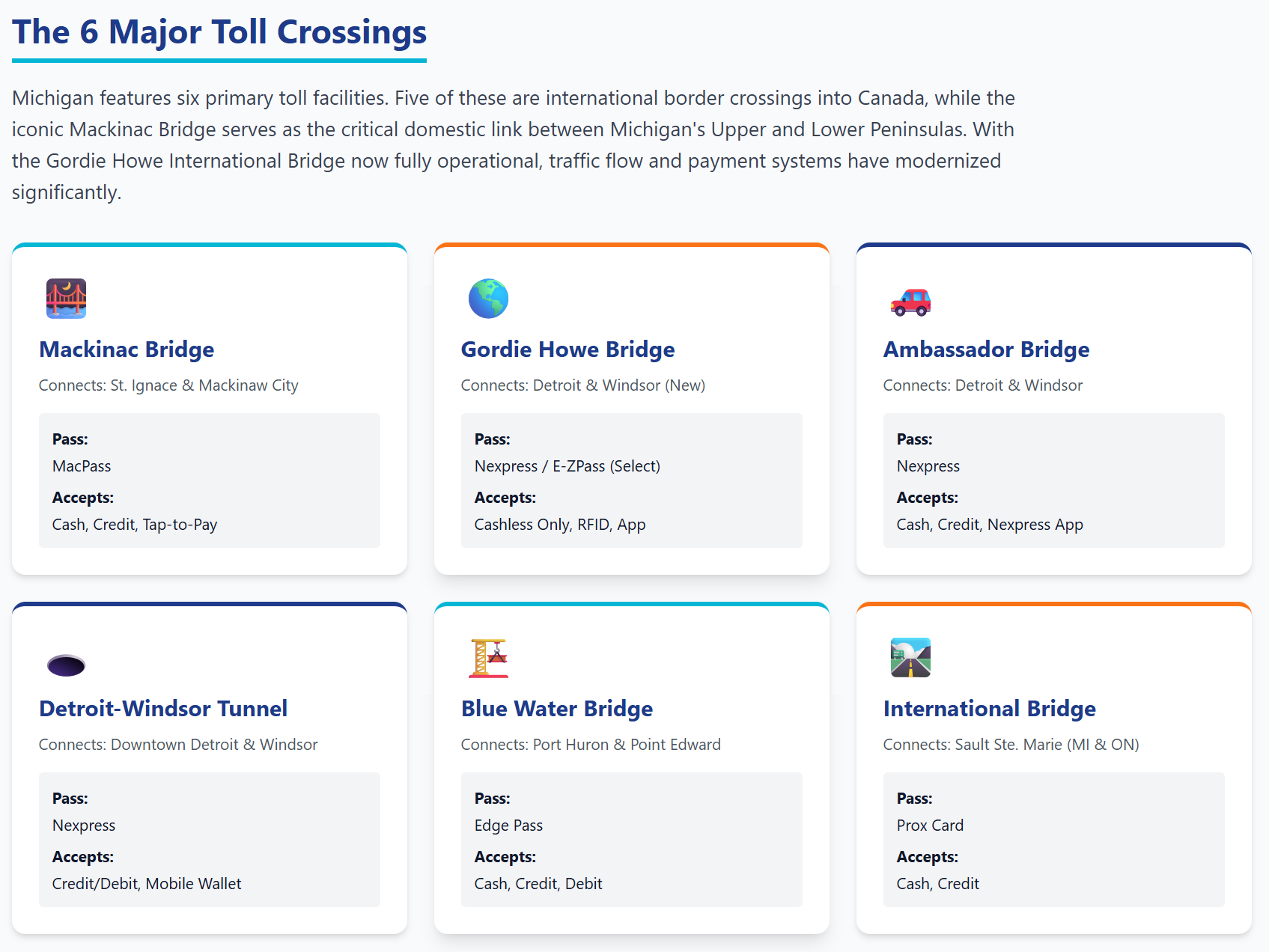
Michigan has exactly six toll facilities, and none of them sit on your everyday interstate commute. Every dollar you pay goes toward one specific bridge or tunnel, not a statewide highway system and knowing exactly where those six spots are saves you from a very awkward moment at the booth.
Here is everything you need to know before you hit the road in 2026.
- Does Michigan Even Have Toll Roads?
- Every Michigan Toll Facility in 2026
- MacPass: The Mackinac Bridge Transponder Explained
- The Big 2026 Story: Gordie Howe International Bridge
- Does Michigan Have E-ZPass?
- Mackinac Bridge: Special Services Worth Knowing
- Crossing into Canada: What the Toll Does Not Cover
- Michigan vs. Neighboring States: A Fair Comparison
- Ready to Roll: The Complete 2026 Cheat Sheet
- Ready to Cross Michigan Without Surprises?
Does Michigan Even Have Toll Roads?
Surprisingly, no. Michigan runs one of the most toll-friendly freeway systems in the entire Midwest. You can cruise I-75, I-94, and I-96 for hundreds of miles and never once slow down for a toll plaza. That makes Michigan a pretty refreshing contrast to Ohio, Indiana, and Illinois, which charge you per mile on their major corridors.
The six tolls Michigan does charge sit at specific geographic pinch points: bridges and tunnels that cross major bodies of water or international borders. Think of it less like a turnpike system and more like a small collection of specific crossings you pay to use. Plan around those six spots and you are good to go.
Every Michigan Toll Facility in 2026
1. Mackinac Bridge
The Mackinac Bridge is the one most Michigan travelers know. It stretches nearly five miles across the Straits of Mackinac, connecting the Lower Peninsula to the Upper Peninsula, and it’s genuinely one of the most beautiful drives in the country. The Mackinac Bridge Authority manages the crossing and sets rates through its self-sustaining toll model.
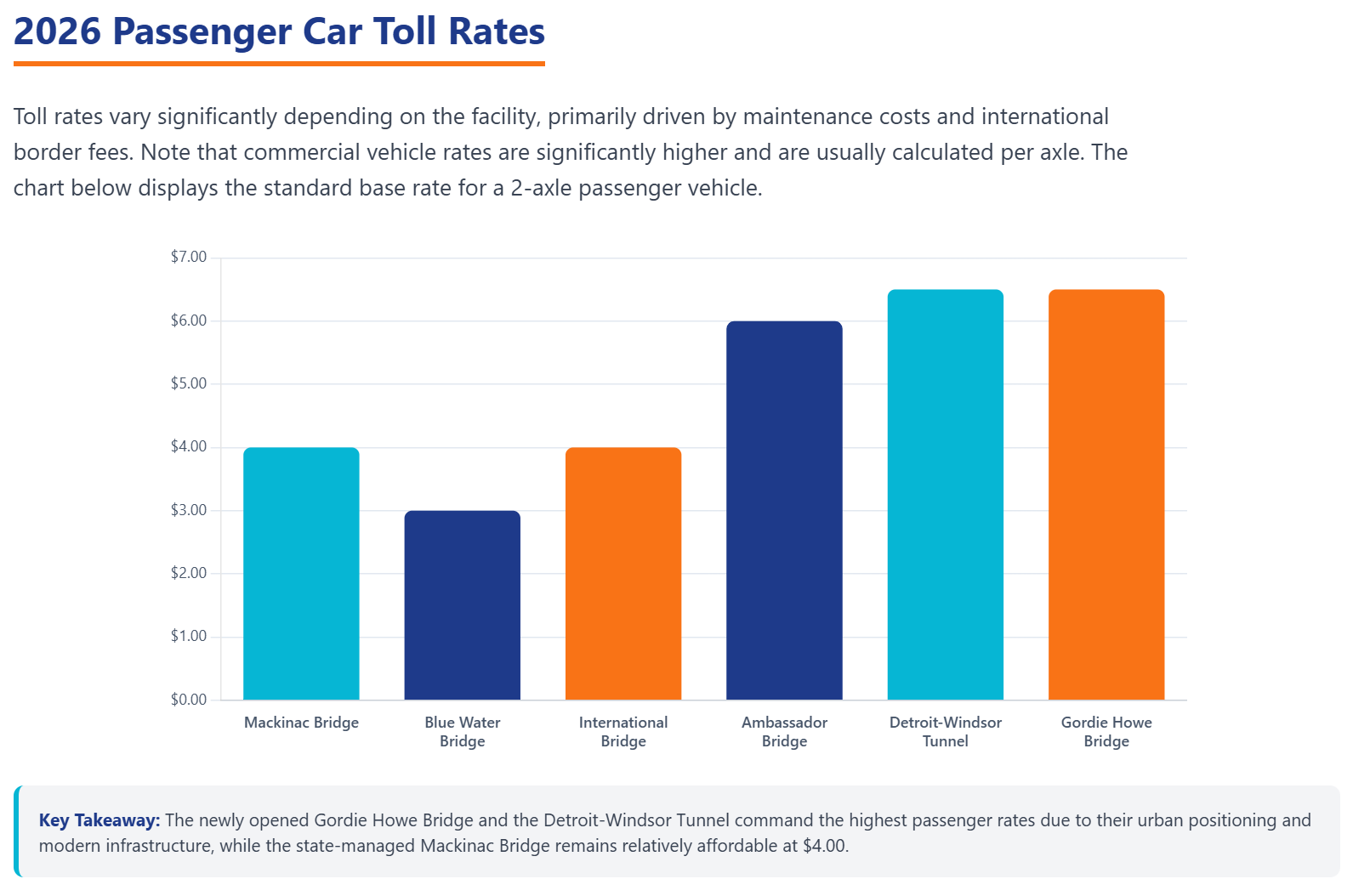
2026 base rate for a standard passenger vehicle: $4.00.
If you pay by credit card, a 2.3% convenience fee applies, adding about $0.09 to your total. The authority introduced this fee in 2025 after paying $341,761 in card processing fees the prior year. Also worth noting: American Express is no longer accepted at the Mackinac Bridge as of 2025.
Here is the full rate breakdown:
| Vehicle Type | Cash / MacPass Rate | Credit Card Rate |
|---|---|---|
| Passenger Vehicle (Car, SUV, Van, Pickup) | $4.00 | $4.09 |
| Motorcycle | $4.00 | $4.09 |
| Commercial Truck / Bus / RV | $5.00 per axle | $5.00 + 2.3% per axle |
| Towed Trailer (behind passenger vehicle) | $2.00 per axle | $2.00 + 2.3% per axle |
2. Ambassador Bridge
The Ambassador Bridge connects Detroit to Windsor, Ontario, and carries more US-Canada trade than any other land crossing on earth. Around $323 million worth of goods crosses daily, including $50 million in automotive parts. It is privately owned and operated by the Detroit International Bridge Company.
Effective January 1, 2026, the passenger toll is $10.00 USD regardless of payment method. That includes the new E-ZPass option, credit card, cash, and the existing Premier Card program. In Canadian dollars, the cash rate is $14.00 CAD.
Here is the 2026 rate schedule:
| Vehicle Category | Payment Method | 2026 Rate (USD) | 2026 Rate (CAD) |
|---|---|---|---|
| Autos, Buses, Motorcycles | E-ZPass / Credit / Cash | $10.00 | $14.00 |
| Autos with Trailer | E-ZPass / Credit / Cash | $20.00 | $28.00 |
| Commercial (per axle, valid account) | A-Pass / E-ZPass | $15.00 | Variable |
| Commercial (per axle, no account / cash) | Cash | $20.00 | Variable |
The big 2026 news here is that the Ambassador Bridge now accepts E-ZPass, making it the first Michigan toll facility to join the national interoperability network. If you already have an E-ZPass from Ohio, New York, or anywhere else in the 20-state network, it works right at the Ambassador Bridge booth.
3. Blue Water Bridge
The Blue Water Bridge in Port Huron crosses the St. Clair River into Sarnia, Ontario. It actually consists of two separate spans sitting side by side, one handling each direction of travel. MDOT manages the American side while the Federal Bridge Corporation Limited oversees the Canadian side.
Critical update for 2026: the Blue Water Bridge is completely cashless. Since April 1, 2025, cash is no longer accepted in either direction. You need a credit card, debit card, Apple Pay, Google Pay, or a prepaid discount pass. Showing up with only cash means turning around, so plan ahead.
2026 passenger toll rates:
| Direction | Operator | 2026 Passenger Rate | Discount Program |
|---|---|---|---|
| Eastbound (US to Canada) | MDOT | $5.00 USD | EDGE Pass ($0.50 discount) |
| Westbound (Canada to US) | FBCL | $7.00 CAD | ConneXion ($2.50 CAD discount) |
The toll itself increased by $1.00 in December 2024 and another $1.00 in December 2025, bringing the eastbound rate to its current $5.00 after 14 years of static pricing. Commercial vehicles are billed at $5.25 per axle eastbound for the 2026 calendar year.
4. Detroit Windsor Tunnel
The Detroit Windsor Tunnel runs beneath the Detroit River, connecting downtown Detroit to Windsor in an underwater passage that sits 75 feet below the surface at its deepest point. The tunnel is approximately one mile long and handles about 12,000 vehicles per day, with passenger cars making up around 95% of that traffic.
As of 2026, the tunnel is also completely cashless. You pay by credit card, the Nexpress transponder program, or the DWT Mobile App. No cash booths remain open.
2026 toll rates:
| Payment Method | Detroit to Windsor (USD) | Windsor to Detroit (CAD) |
|---|---|---|
| Credit / Debit Card | $9.00 | $8.25 |
| Nexpress (pre-paid transponder) | $6.75 | $5.90 |
| DWT Mobile App (round trip) | $8.50 outbound | $5.00 equiv. return |
The standard credit card rate increased by $0.75 on January 5, 2026. If you use the Nexpress program, you save $2.25 per crossing compared to the standard card rate. The initial Nexpress account deposit is $75.00. Alternatively, the DWT Mobile App lets occasional users pre-purchase a round trip at a slight discount without committing to a full transponder account.
One important restriction: motorcycles, scooters, bicycles, and pedestrians cannot use the tunnel. The physical clearance is also limited to 12 feet 8 inches, which effectively rules out most large freight trucks. Use the Ambassador Bridge if either of those situations applies to you.
5. Sault Ste. Marie International Bridge
Fewer Michigan travelers know about this one, and that is honestly a shame. The Sault Ste. Marie International Bridge crosses the St. Marys River at the northern end of Interstate 75, connecting to Highway 17 in Ontario. It’s operated by the joint American-Canadian Sault Ste. Marie Bridge Authority.
What makes this crossing particularly interesting is its currency equity policy. Canadian toll rates adjust twice a year, on October 1 and April 1, to stay within $0.05 of the US dollar benchmark based on the previous six months of exchange rates. That is a genuinely thoughtful approach to cross-border pricing that very few crossings bother with.
2026 passenger rates (cash / card):
- April through September 2026: $4.60 USD
- October through March 2027: $4.70 USD
The IQ Tag electronic pass offers tiered discounts based on how often you cross within a rolling 30-day window:
| Crossings in Last 30 Days | Discount | April 2026 Rate (USD) |
|---|---|---|
| 0 to 4 crossings | 10% | $4.14 |
| 5 to 8 crossings | 20% | $3.68 |
| 9 or more crossings | 35% | $2.99 |
If you live in the Sault and cross regularly, that 35% tier saves real money over a year. Check the full schedule at the Sault Ste. Marie Bridge Authority.
6. Grosse Ile Toll Bridge
The Grosse Ile Toll Bridge is the most locally-focused of the six. It crosses the Trenton Channel of the Detroit River, linking Riverview on the mainland to Grosse Ile Township.
In a notable ownership shift, Grosse Ile Township purchased the bridge from the private Smoke family on March 31, 2025 for $59.74 million, ending more than a century of private ownership.
Under township management, the bridge now runs a Bridge Pass RFID system alongside cash and card options:
| Vehicle Class | Bridge Pass (RFID) | Cash | Credit Card |
|---|---|---|---|
| Class 1 (Cars, SUVs, Motorcycles) | $3.00 | $3.50 | $4.50 |
| Class 2 (2-axle Trucks) | $6.00 | $7.00 | $9.00 |
| Class 4 (4-axle Trucks) | $12.00 | $14.00 | $18.00 |
Opening a Bridge Pass account costs $65.00 total, which breaks down as $40.00 in prepaid tolls and a $25.00 refundable deposit. One more thing: if you roll through without paying, cameras capture your plate and a bill gets mailed to you at rates significantly higher than any of the above options. Do not test that system.
Also worth knowing: Grosse Ile has a second bridge that is completely free. The Wayne County Bridge on West Jefferson provides an alternative route. Commuters and residents who live in the southern part of the island often use it to avoid the toll entirely.
MacPass: The Mackinac Bridge Transponder Explained
The Mackinac Bridge runs its own dedicated transponder program called MacPass. It is a proprietary RFID sticker system, meaning it is not interoperable with E-ZPass or any other national network. It works only at the Mackinac Bridge.
Setting up a MacPass account:
- Administrative fee: $7.00
- Sticker tag: $1.00 per vehicle
- Opening deposit: $40.00 (lowered from $80.00 in late 2024)
- Minimum refill amount: $20.00 (lowered from $50.00)
Each sticker is tied to a specific vehicle by license plate, make, model, color, and year. You cannot transfer a sticker between cars.
The biggest financial benefit of MacPass is the commuter round-trip discount. Complete a round trip across the Straits within a 36-hour window and your return crossing is free. So a $4.00 outbound toll effectively becomes a $2.00 per trip average for qualifying users. If you commute between peninsulas or visit the UP regularly, that adds up fast.
MacPass also lets you avoid the 2.3% credit card convenience fee entirely, since the pre-funded account draws from cash or an electronic check. And you get access to the dedicated express lane, which is a genuinely significant perk during peak summer weekends.
The Big 2026 Story: Gordie Howe International Bridge
Here is the most exciting development in Michigan transportation right now. The Gordie Howe International Bridge is a brand-new cable-stayed span connecting I-75 in Detroit to Highway 401 in Windsor, running parallel to but separate from the Ambassador Bridge corridor.
As of March 5, 2026, the Windsor-Detroit Bridge Authority announced that the bridge officially entered its testing and commissioning phase. This involves installation verification, individual system testing, and full network integration simulations covering crashes, severe weather, and peak traffic surges. Think of it as the bridge’s final exam before it opens to the public.
The opening hit some political turbulence in February 2026 when US President Donald Trump threatened to block it on social media, claiming the US had not been compensated for past contributions.
Canada funded the entire CA$6.4 billion construction cost, a fact that Canadian Prime Minister Mark Carney and Ontario Premier Doug Ford were quick to point out. Despite that noise, US Customs and Border Protection officially established the Gordie Howe Bridge as a Class A Port of Entry effective March 2, 2026, with CBP officers assigned and ready.
What we know about tolls and features:
- Toll rates will be competitive with the Ambassador Bridge (final 2026 rates not yet published)
- Tolls are collected at the Canadian Port of Entry for both directions
- The bridge includes a 1.5-mile multi-use pedestrian and cycling path, the first non-event legal pedestrian crossing of the Detroit River
- Walking and cycling across will be completely toll-free
- The path connects Ontario’s Trans Canada Trail to Michigan’s Iron Belle Trail
Watch the Gordie Howe Bridge official site for opening announcements and finalized toll rates.
Does Michigan Have E-ZPass?
For most facilities, no. The Ambassador Bridge is currently the only Michigan toll crossing that accepts E-ZPass, following its January 2026 integration. Every other facility uses a proprietary system.
Here is the full picture of which transponder works where:
- MacPass: Mackinac Bridge only
- E-ZPass: Ambassador Bridge only (new in 2026)
- EDGE Pass: Blue Water Bridge eastbound
- ConneXion: Blue Water Bridge westbound
- Nexpress: Detroit Windsor Tunnel only
- IQ Tag: Sault Ste. Marie International Bridge only
- Bridge Pass: Grosse Ile Toll Bridge only
Each authority maintains its own system partly to retain 100% of toll revenue locally rather than paying fees to a national interoperability network. That explains why your E-ZPass from Ohio works at the Ambassador Bridge now but still does not help you at the Mackinac Bridge. Maybe someday that changes, but today is not that day.
Mackinac Bridge: Special Services Worth Knowing
Fear of bridges is a real thing, and the Mackinac Bridge Authority takes it seriously. Got gephyrophobia (yes, that is the actual word for bridge fear)? A trained MBA staff member will drive your car across for you, 24 hours a day, for $10.00 plus the standard toll. That is genuinely one of the nicest services any toll authority offers anywhere.
Cyclists and pedestrians face a different situation. You cannot cross the bridge deck under your own power for safety reasons. Instead, a transport service carries you and your bike across for $15.00 per person. Snowmobiles and ATVs also get transport through designated vehicles, which is very useful given how popular those activities are in the UP.
Crossing into Canada: What the Toll Does Not Cover
Three of Michigan’s six toll crossings go directly into Ontario. The toll is honestly the quickest part of that process.
Bring a valid passport. A driver’s license alone does not qualify for either US or Canadian citizens crossing by land. Forget it and you turn around, full stop.
The NEXUS trusted traveler program speeds up land border customs significantly for frequent crossers. If you make three or more round trips to Canada per year, the application is worth your time. Dedicated NEXUS lanes move considerably faster during busy periods.
Consider the time of day. The Blue Water Bridge and Ambassador Bridge both see heavy commercial traffic from 6 AM to 10 PM on weekdays. Early morning and evening crossings typically flow much better. The US Customs and Border Protection wait times tool gives you real-time data before you leave.
Michigan vs. Neighboring States: A Fair Comparison
Just to put Michigan’s tolling in perspective, here is how it stacks up against its neighbors:
| State / Corridor | System Type | Cost Per Mile | 2026 Tech |
|---|---|---|---|
| Michigan | Bridge / Tunnel only | N/A (fixed fee per crossing) | MacPass, E-ZPass (Ambassador), Nexpress, EDGE, IQ Tag |
| Ohio Turnpike | System-wide | $0.05 to $0.12 | E-ZPass + Cash |
| Indiana Toll Road | System-wide | $0.06 to $0.16 | E-ZPass + Cash |
| Illinois Tollway | System-wide | $0.05 to $0.22 | I-PASS / E-ZPass |
| Wisconsin | Toll-free | $0.00 | N/A |
Michigan’s approach makes sense given its geography. As a peninsula, most traffic here is destination-oriented rather than passing through. Ohio and Indiana sit in the middle of everything and generate continuous pass-through traffic that justifies per-mile tolling. Michigan does not have that, so the facility-specific model fits.
Ready to Roll: The Complete 2026 Cheat Sheet
Before you leave for any Michigan toll crossing, run through this quick checklist:
Mackinac Bridge:
- Standard rate $4.00 cash; $4.09 by card (Visa / Mastercard / Discover only; no Amex)
- Apple Pay and Google Pay accepted
- MacPass express lane skips the wait and earns free return within 36 hours
- Staff will drive gephyrophobia sufferers across for $10 extra
Ambassador Bridge:
- $10.00 USD for passenger vehicles by any payment method
- E-ZPass now accepted (new in 2026)
- Allow extra time for customs on both sides
Blue Water Bridge:
- $5.00 USD eastbound, $7.00 CAD westbound
- Cashless since April 2025; no cash accepted whatsoever
- EDGE Pass saves $0.50 USD eastbound; ConneXion saves $2.50 CAD westbound
Detroit Windsor Tunnel:
- $9.00 USD by card; $6.75 with Nexpress transponder
- Completely cashless
- No motorcycles, no bikes, no vehicles over 12 feet 8 inches
Sault Ste. Marie International Bridge:
- $4.60 to $4.70 USD by cash or card depending on time of year
- IQ Tag earns up to 35% off for frequent crossers
Grosse Ile Toll Bridge:
- $3.50 cash or $4.50 card for passenger vehicles
- Bridge Pass drops that to $3.00
- Free alternative route available via the Wayne County Bridge
Ready to Cross Michigan Without Surprises?
Michigan’s toll setup is genuinely one of the most manageable in the country once you understand the full picture. Six specific crossings, each with its own payment system, and a freeway network that costs you absolutely nothing outside of those six spots.
Set up a MacPass if the Mackinac Bridge is in your regular life. Look into Nexpress if the Detroit Windsor Tunnel is your regular Canada route. Grab the EDGE Pass before your next Port Huron crossing. And for the love of everything, do not show up at the Blue Water Bridge with only cash.
Beyond those specifics, Michigan roads are open, beautiful, and free. That is a better deal than most states in the country offer.
Sources:
- Mackinac Bridge Authority
- MacPass Program Details
- Ambassador Bridge Toll Rates
- Blue Water Bridge Toll Rates
- Detroit Windsor Tunnel Toll Rates
- Sault Ste. Marie Bridge Authority Rate Schedule
- Gordie Howe International Bridge
- US CBP Border Wait Times
- MDOT 2026-2030 Five-Year Transportation Program

Pavithra Vinoth is the founder of nytollsinfo.com, where she simplifies U.S. toll systems through expert insights and custom-built calculators. Her research-driven tools help drivers avoid costly mistakes and make smarter car decisions.