

Maine’s toll roads handled a record 96.1 million transactions in 2025, pulling in roughly $185 million in revenue. If you’re driving the Maine Turnpike without an E-ZPass in 2026, you’re leaving real money on the table. Here’s everything you need to know before you hit the road.
- The Short Answer First
- How Maine's Toll System Actually Works
- E-ZPass in Maine: Your Best Friend on the Road
- 2026 Toll Rates: The Exact Numbers
- Pay By Plate: The Casual Visitor Option
- NextPass: The Transponder-Free Alternative Worth Knowing About
- Cash Tolls in Maine: Still Around, But Barely
- What Happens If You Miss a Toll?
- Renting a Car in Maine? Read This Before You Go
- Why Maine Hasn't Gone All-Electronic (And Why That's Smart)
- Managing Your E-ZPass Account
- Quick Tips for Toll-Free (or Toll-Light) Travel in Maine
- Hit the Road With Confidence
The Short Answer First
E-ZPass is the smartest way to pay tolls in Maine. It costs less per trip, unlocks volume-based rebates for frequent drivers, and works across more than 40 tolling agencies in the eastern U.S. Visiting once and don’t want a transponder? NextPass or Pay By Plate have you covered. Cash lanes still exist at select plazas but are slowly disappearing. Now let’s get into the details.
How Maine’s Toll System Actually Works
Maine’s tolls are managed primarily by the Maine Turnpike Authority (MTA), a self-funded, quasi-public agency that operates the Maine Turnpike (I-95 and I-495). The Turnpike runs roughly 109 miles from the New Hampshire border up to Augusta, and it’s the most toll-heavy stretch of road in the state. Importantly, the MTA operates entirely without state tax dollars or fuel tax revenue. About two-thirds of its revenue comes from out-of-state visitors, which is actually a pretty sweet deal for Maine residents.
Beyond the Turnpike, you’ll also encounter the Piscataqua River Bridge on I-95 at the Maine/New Hampshire border. That’s basically the gateway toll for anyone entering Maine from the south.
Maine uses Open Road Tolling (ORT) at its plazas. Overhead gantries read your transponder or license plate as you drive through at highway speed. No stopping, no fumbling for quarters. Pretty slick, right?
The Two Main Toll Corridors
- Maine Turnpike (I-95 and I-495): Multiple toll points from Kittery to Augusta
- Piscataqua River Bridge: A border crossing toll on I-95 between Maine and New Hampshire
If your trip stays off I-95 and I-495, you’ll likely avoid tolls entirely.
E-ZPass in Maine: Your Best Friend on the Road
Let’s be real. E-ZPass is the gold standard for toll payment in Maine. The MTA offers it directly, and it links to a network of more than 40 tolling agencies across the eastern United States. Got an E-ZPass from Massachusetts, New York, or New Hampshire already? It works perfectly here.
How to Get an E-ZPass for Maine
Two solid options:
- Sign up directly with the Maine Turnpike Authority at ezpassmaineturnpike.com. You can order online and have a transponder mailed to you.
- Use an existing E-ZPass from any participating state. No need to get a new one if you already have one.
When you open a personal account, here’s what to expect:
- Interior windshield transponder: $10.00
- Exterior license plate-mounted transponder: $17.00
- Minimum opening balance: $20.00 for one tag, $40.00 for multiple tags
- Up to four tags per personal account
The account runs on a prepaid model. Funds are deducted as you travel. Set up auto-replenishment from day one so you never have to think about it.
The Volume Discount Program: Where the Real Savings Are
Here’s where E-ZPass gets genuinely impressive for regular drivers. The MTA runs a Volume Discount Program for Class 1 (passenger vehicle) E-ZPass holders that automatically calculates rebates at the end of each month based on total trips:
| Monthly Trips | Discount |
|---|---|
| 1 to 29 | Standard E-ZPass rate |
| 30 to 39 | 20% rebate on total monthly tolls |
| 40 or more | 40% rebate on total monthly tolls |
Think about what that means in practice. A commuter making 40 trips at the York E-ZPass rate of $2.40 per trip effectively pays just $1.44 per trip after the 40% rebate kicks in. That’s a legitimate saving that stacks up fast over a year.
One important catch: image-based tolls (where your tag wasn’t read correctly) do not count toward your monthly trip total. So keep that transponder properly mounted behind the rearview mirror.
2026 Toll Rates: The Exact Numbers
Enough with the approximations. Here are the actual 2026 toll rates for a Class 1 passenger vehicle (standard car, pickup, van, or motorcycle):
| Plaza Location | Cash Rate | E-ZPass Rate |
|---|---|---|
| York (Mainline) | $3.00 | $2.40 |
| New Gloucester (Mainline) | $2.25 | $1.80 |
| West Gardiner (Mainline) | $1.75 | $1.40 |
| Wells Northbound (Side) | $1.50 | $1.20 |
| Gray Southbound (Side) | $1.50 | $1.20 |
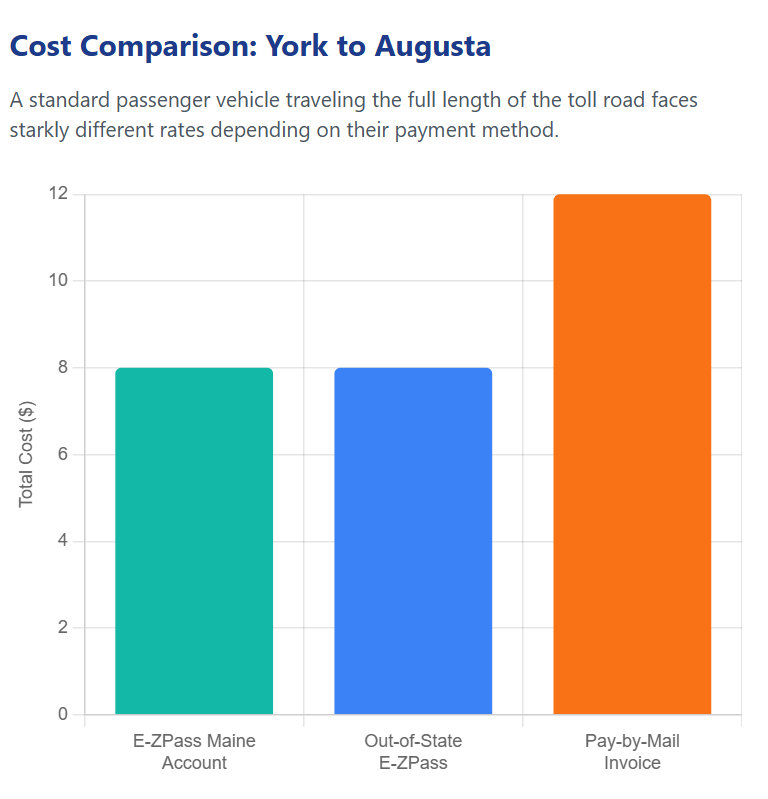
| Full Length (York to Augusta) | $7.00 | $6.05 |
At roughly 4.9 cents per mile, Maine’s toll rates are among the lowest in the Northeast. For context, North Carolina’s Triangle Expressway runs about 24 cents per mile, and New Jersey/New York bridges can run far higher. Maine is genuinely a bargain.
Always verify current rates at the official MTA toll rates page before your trip, since rates are subject to periodic adjustment.
What About Larger Vehicles?
Maine classifies vehicles into eight classes based on axle count and tire configuration:
- Class 1: Passenger cars, pickups, vans, motorcycles (2 axles, 4 tires)
- Class 2: Buses, motor homes, dual-wheel pickups (2 axles, 6 tires)
- Class 3 through 6: Three to six-axle combinations
- Class 5: Standard tractor-trailer (5 axles) — a full-length cash trip runs $28.00
- Classes 7 and 8: Class 1 vehicles with trailers or specialized recreational setups
The more axles you have, the higher your toll. The MTA’s toll calculator on their site handles all vehicle types when you plug in your details.
Pay By Plate: The Casual Visitor Option
No transponder? No problem. Maine’s Pay By Plate system (also called toll by mail) captures your license plate via overhead cameras and mails a bill to the registered vehicle owner. It’s seamless for visitors, though “seamless” might be generous given that you’re essentially getting an unexpected envelope weeks after your trip.
Key Pay By Plate Details
- Bills typically arrive a few weeks after travel
- Pay By Plate rates are higher than E-ZPass rates at all plazas
- You can also pay proactively online at maineturnpike.com if you know you’ll be transponder-free
Pay By Plate works fine for a one-time visit. Just don’t be surprised by the bill timing.
NextPass: The Transponder-Free Alternative Worth Knowing About
New in the mainstream for 2026, NextPass is a smartphone app-based toll payment option that uses license plate recognition instead of a physical transponder. It’s a genuinely interesting option for travelers who don’t want to deal with hardware.
Here’s how it works:
- Register your vehicle and a payment method in the NextPass app
- Toll gantries capture your plate, and the charge posts to your NextPass account within 3 to 30 days
- No activation fees, no minimum balance, no monthly subscription. You only pay for tolls you actually incur.
One critical thing to know: if your vehicle is currently linked to an E-ZPass or other tolling account, you must remove it before using NextPass to prevent billing conflicts. Check out NextPass for the full setup guide.
Got a Commercial Fleet? Bestpass Has You Covered
If you manage a fleet of trucks running through Maine, Bestpass is the tool for you. It provides unified billing and advanced analytics across the national toll network, specifically designed for Class 5 through 8 operators on multi-state routes. More at Bestpass.
Cash Tolls in Maine: Still Around, But Barely
Maine is steadily phasing out cash payment, following the national trend toward cashless roads. A handful of cash lanes still operate at select plazas as of 2026, but the footprint keeps shrinking.
Call the MTA road conditions line at 1-800-675-7453 to confirm cash lane availability before your trip. Showing up to a fully cashless plaza with nothing but a $20 bill is not a fun experience.
What Happens If You Miss a Toll?
Driving through a toll without a valid transponder or payment triggers a violation notice mailed to the registered vehicle owner. Here’s how the process escalates under Maine Title 23, Section 1980:
- The system first searches all active E-ZPass accounts for a matching plate. If found, the toll is deducted automatically (called V-Tolling). No notice, no drama.
- If no match is found, a violation notice goes in the mail.
- Unpaid tolls are classified as traffic infractions. Persistent non-payment can escalate to criminal Class E charges with fines up to $500.
- The MTA can also flag your registration with the DMV, blocking renewal until tolls are cleared.
The MTA does offer a one-time toll payment option for drivers who accidentally use an E-ZPass lane without a transponder. Mail the payment to MTA headquarters in Portland with the date, time, and plaza details. This is available for non-rental vehicles only.
Renting a Car in Maine? Read This Before You Go
Rental cars are a toll trap for the unprepared. Most major rental companies (Hertz, Avis, Dollar, Budget) offer programs like PlatePass that handle tolls automatically. Convenient, sure. But these programs often charge $3.00 to $10.00 per day in administrative fees, even on days you don’t use a toll road. That adds up fast on a week-long trip.
Here are your smarter options:
Bring Your Own Transponder (BYOT)
Professional travelers swear by this approach. Here’s the exact protocol:
- Mount your personal E-ZPass on the rental’s windshield behind the rearview mirror
- Temporarily add the rental’s license plate to your E-ZPass account. This way, if the tag fails to read, the toll gets V-Tolled to your personal account instead of the rental agency
- Check for a built-in transponder box in the rental. Many vehicles have a shielded box with a built-in device. Make sure that box is closed while you use your own tag, or you risk being charged twice
Use NextPass for Rentals
NextPass lets you input the rental vehicle’s plate and set the exact rental start and end dates. It’s a clean software-based solution that completely bypasses the rental agency’s hardware and their fee schedule.
Why Maine Hasn’t Gone All-Electronic (And Why That’s Smart)
You might be wondering why Maine still has cash lanes at all when most of New England is moving toward All-Electronic Tolling (AET). The MTA actually studied this extensively, and the findings are worth knowing.
At the York plaza, E-ZPass accounts for about 64% of traffic. Of the remaining 36% paying cash, only 37% are Maine residents. The MTA lacks efficient mechanisms to collect plate-based tolls from out-of-state non-E-ZPass users, with estimates suggesting a 10% revenue leakage rate at York under a full AET model.
To stay revenue-neutral under AET, the MTA would need to add a $3.00 video surcharge at York, which studies estimate could divert 3,400 to 5,500 vehicles per day onto local Route 1. That’s not a great outcome for anyone. So the hybrid model stays, at least for now.
Managing Your E-ZPass Account
Your Maine E-ZPass account lives at ezpassmaineturnpike.com. From the portal, you can:
- Check your balance and add funds or configure auto-replenishment
- Review your full trip history with dates, plaza locations, and amounts
- Update vehicle information when you buy a new car
- Enroll in the Volume Discount Program
- Order replacement transponders
For account support, contact the MTA’s E-ZPass Customer Service Center:
- Phone: 1-888-MTA-PASS (1-888-682-7277)
- Address: 2360 Congress Street, Portland, ME 04102
- Hours: Monday through Friday, 8:00 AM to 5:00 PM (phone lines open until 6:00 PM for certain personal account inquiries)
- Road Conditions: 1-800-675-7453
- AM Radio Updates: 1610 AM while on the Turnpike
The Customer Service Center handles everything from tag replacement to violation resolution in person.
Quick Tips for Toll-Free (or Toll-Light) Travel in Maine
Not every road in Maine costs you money. A few alternatives worth knowing:
- Route 1 runs parallel to I-95 along the coast and is completely toll-free. Slower, yes, but one of the most scenic drives in New England
- I-295 between Portland and Brunswick is toll-free. A solid alternative for that specific stretch
- Most of northern and inland Maine is toll-free once you get past Augusta
If you’re not on a deadline, skipping the Turnpike for certain stretches saves a few dollars and adds serious scenery to your trip.
Hit the Road With Confidence
Paying tolls in Maine is genuinely simple once you know the system. Get an E-ZPass if you drive through more than once, especially if you’ll hit 30 or more trips a month and want that rebate. Use NextPass or Pay By Plate for one-time visits. Bring your own transponder in a rental car and add the plate to your account. And if you do miss a toll, deal with the notice quickly before it escalates.
Maine’s Turnpike funds itself, invests in real infrastructure, and keeps its per-mile rates among the lowest in the Northeast. A little preparation means you spend your drive enjoying the scenery, not stressing about payment. Safe travels.

Pavithra Vinoth is the founder of nytollsinfo.com, where she simplifies U.S. toll systems through expert insights and custom-built calculators. Her research-driven tools help drivers avoid costly mistakes and make smarter car decisions.