


Forget fumbling for quarters at a toll booth. Kentucky runs a fully cashless tolling system, and in 2026 that means every crossing gets tracked electronically whether you’re ready for it or not.
The smart move? Set up a RiverLink transponder account before you drive, pay roughly $2.68 per crossing as a passenger car, and never think about it again. Skip that step and the same crossing costs you $5.36, billed by mail. Your call.
- What Kentucky's Toll System Actually Looks Like in 2026
- Which Bridges Are Tolled in Kentucky?
- 2026 Toll Rates: The Exact Numbers
- Payment Methods: Three Tiers, One Clear Winner
- E-ZPass in Kentucky: What Works and What Doesn't
- The Frequent User Discount: A Commuter's Best Friend
- What Happens If You Ignore a Toll Invoice
- No Bank Account? Retail Starter Kits Have You Covered
- Rental Cars and Kentucky Tolls
- What's Coming: Future Toll Roads in Kentucky
- Before You Cross That Bridge
What Kentucky’s Toll System Actually Looks Like in 2026
Kentucky’s toll network is highly concentrated. Unlike states with hundreds of miles of turnpike, Kentucky’s tolled roads focus almost entirely on the Ohio River crossings in the Louisville metro area, managed by the RiverLink system.
RiverLink is a bi-state collaboration between Kentucky and Indiana, established to fund the multi-billion dollar construction of two major bridges. It operates through high-speed cameras and RFID sensors with zero cash lanes anywhere. You either have an account, or you get a bill in the mail.
In January 2026, RiverLink announced a significant change: TransCore was named the new toll service provider under a $146 million contract running through September 2031. The transition covers back-office operations, including invoicing and customer service. If you’ve had account issues in the past, this change was specifically aimed at fixing those pain points.
Which Bridges Are Tolled in Kentucky?
The Louisville Ohio River Bridges
Three bridges in Louisville connect Kentucky to Southern Indiana. Two of them charge tolls. Here’s the full picture:
| Bridge | Route | Toll Direction |
|---|---|---|
| Abraham Lincoln Bridge | I-65 | Northbound only |
| John F. Kennedy Memorial Bridge | I-65 | Southbound only |
| Lewis and Clark Bridge | SR-265 / KY-841 | Both directions |
| Sherman Minton Bridge | I-264 | Free |
| George Rogers Clark Memorial Bridge | US-31 | Free |
The Abraham Lincoln and Kennedy bridges work as a directional pair through downtown Louisville, so a round trip on I-65 means one toll each way on separate bridges. The Lewis and Clark Bridge out east charges in both directions and handles a lot of freight and bypass traffic.
If you want a free Ohio River crossing, the Sherman Minton and Clark Memorial bridges are your friends. Just know the routes are different, and depending on where you’re headed, the detour may not be worth it.
The Mountain Parkway Extension
Eastern Kentucky’s Bert T. Combs Mountain Parkway Extension also carries tolls on certain segments, managed by the Kentucky Transportation Cabinet. The same cashless system applies, and rates are lower than the Louisville bridges.
2026 Toll Rates: The Exact Numbers
Rates adjust every July 1st based on either 2.5% or the Consumer Price Index, whichever is higher. The April 2025 CPI came in at 2.3%, which triggered the 2.5% minimum increase for the current fiscal cycle. Here are the current rates for the Louisville bridges:
| Vehicle Type | Transponder / E-ZPass | Prepaid Account (No Tag) | Pay-by-Plate (Invoice) |
|---|---|---|---|
| Small Vehicle (2 axles, under 7.5 ft) | $2.68 | $4.02 | $5.36 |
| Medium Vehicle (2-4 axles, over 7.5 ft) | $5.36 | $8.04 | $10.72 |
| Heavy Vehicle (5+ axles) | $13.40 | $14.68 | $16.01 |
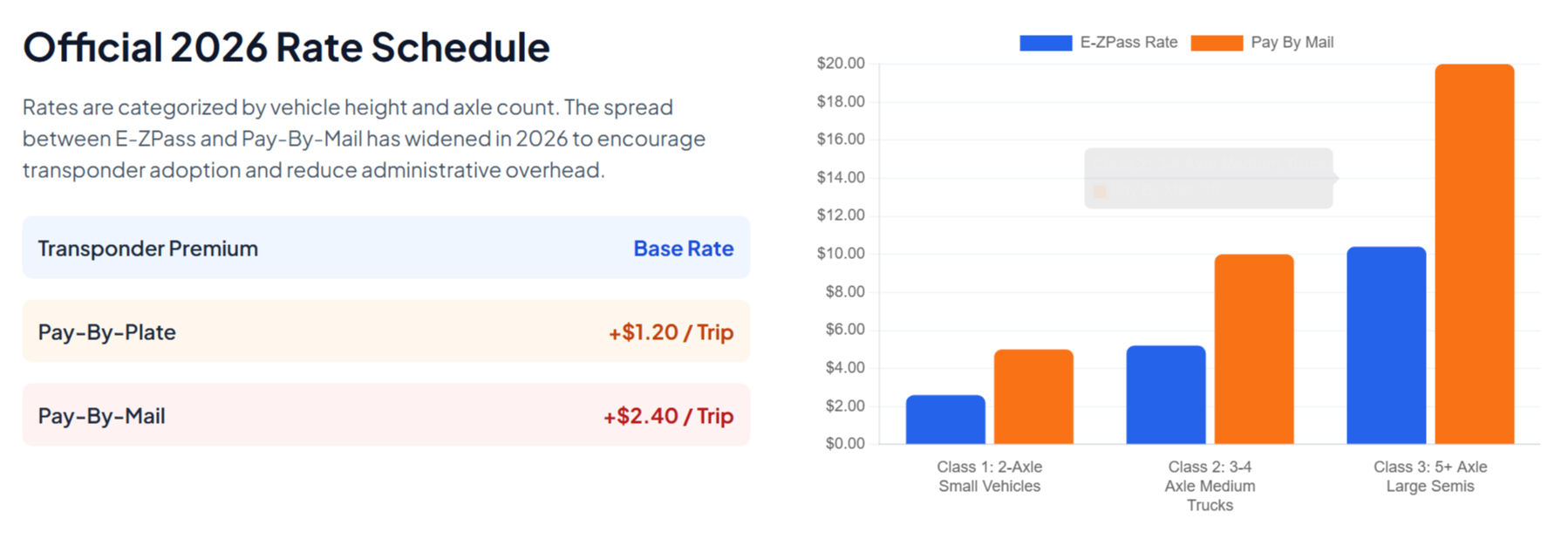
One thing worth paying attention to: vehicle height matters. Any cargo, roof rack, or equipment that pushes your vehicle over 7.5 feet tall automatically bumps you into the medium vehicle category, regardless of your axle count. That can double your toll. If you’re driving a van or a truck with gear loaded on top, check your height before assuming you’re in the small vehicle tier.
Payment Methods: Three Tiers, One Clear Winner
Tier 1: RiverLink Transponder Account (The Best Option)
A RiverLink account with a transponder gets you the lowest rates on every crossing. The transponder is an RFID tag that reads automatically as you roll through at full speed. RiverLink offers two types:
- Local RiverLink Transponder: A sticker-style tag provided at no cost for the first device per vehicle. It works exclusively on the three Louisville-area bridges and cannot be transferred between vehicles once applied.
- RiverLink E-ZPass Transponder: A portable hard-case tag available for a one-time $15 purchase. This one works across the entire E-ZPass network, covering 19+ states, so it’s the better choice if you travel regionally.
You can open an account, manage your balance, and order a transponder directly at RiverLink.com or by calling 1-855-748-5465.
Tier 2: Prepaid Account Without a Transponder
Not into physical tags? RiverLink offers a Prepaid Account Only option where cameras read your license plate and link it to a funded account balance. You avoid the highest invoice rates, though you’ll still pay more than the transponder rate because plate recognition requires additional processing.
This account requires a minimum initial balance of $20 and works best with auto-replenishment enabled. It’s a solid middle-ground option for visitors who cross infrequently.
Tier 3: Pay-by-Plate (Most Expensive, Least Effort)
No account, no problem… sort of. Cameras capture your plate, RiverLink queries state vehicle registration databases for your address, and an invoice shows up in your mailbox. For a small passenger car, that’s $5.36 per crossing compared to $2.68 with a transponder.
A daily commuter crossing twice a day pays $10.72 daily on invoices versus $5.36 with a transponder. Over a month, that gap becomes real money fast. So yes, pay-by-plate technically works, but it is objectively the worst financial decision of the three.
E-ZPass in Kentucky: What Works and What Doesn’t
The great news for out-of-state travelers: Kentucky accepts E-ZPass. Because RiverLink is an E-ZPass member agency, transponders from other states register at the discounted transponder rate on all three Louisville bridges.
Compatible passes include I-PASS from Illinois, Peach Pass from Georgia, and E-PASS from Florida. However, there’s one specific nuance to know: Florida’s SunPass PRO works on RiverLink, but the SunPass Mini does not, because the Mini doesn’t support the multi-protocol requirements of the broader E-ZPass network.
For a full list of compatible transponders from other states, check the RiverLink transponder compatibility page. A quick look before you travel saves the headache of an unexpected invoice landing at your door two weeks later.
The Frequent User Discount: A Commuter’s Best Friend
If you cross those Louisville bridges daily, RiverLink has a program specifically built for you. The Frequent User Discount is automatically applied to personal transponder accounts on standard two-axle passenger vehicles.
Here’s how it works:
- Your transponder must log at least 40 crossings in a single calendar month (that’s roughly 20 round trips)
- Once you hit 40 crossings, you receive a 50% credit applied to those 40 trips
- Every crossing after that in the same month is charged at 50% of the regular transponder rate
A few restrictions apply: your account needs to maintain a positive balance for crossings to count toward the threshold, out-of-state E-ZPass tags are ineligible, and medium or heavy vehicles don’t qualify. But for a regular Louisville commuter in a standard car, this discount is genuinely significant. Get full details at the RiverLink Frequent User Discount page.
What Happens If You Ignore a Toll Invoice
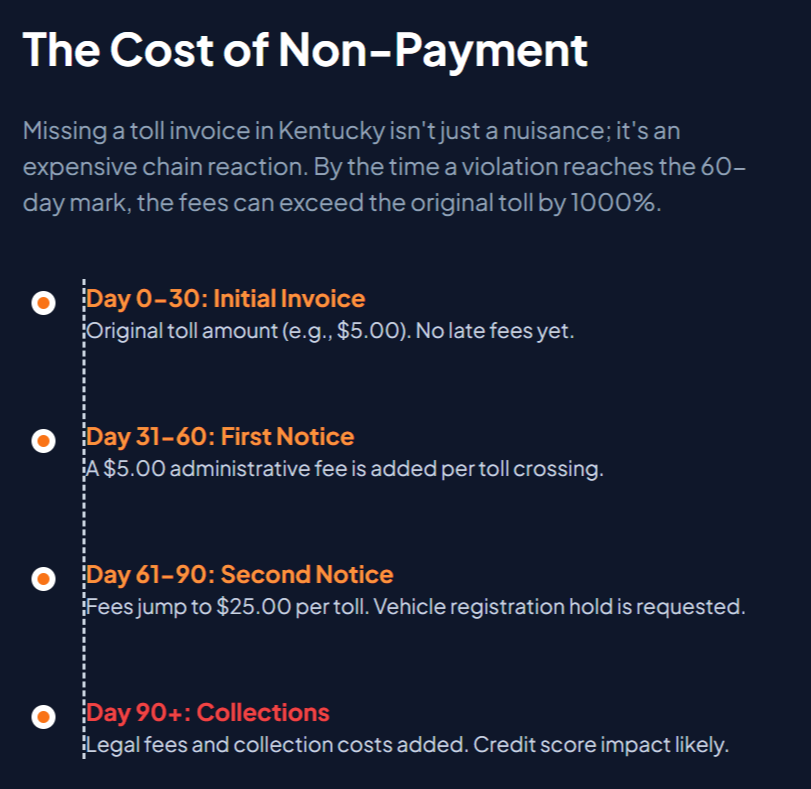
Here’s where things get serious. RiverLink runs a strict 135-day escalation process from the moment you cross a bridge without a funded account:
| Phase | Payment Window | Fee Added |
|---|---|---|
| First Invoice | 30 days | Toll amount only |
| Second Invoice | 20 days | $5.00 Administrative Fee |
| Violation Notice | 30 days | $25.00 Violation Fee |
| Collection Notice | 30 days | $30.00 Collection Fee |
After the collection notice, RiverLink places a vehicle registration hold in both Kentucky and Indiana. The Kentucky Motor Vehicle Licensing office and Indiana BMV cannot renew tags on any vehicle with an active hold. Critically, County Clerks and BMV branches cannot accept payment for toll debts. You have to pay RiverLink directly to clear the hold.
One important escape hatch: the Fee Forgiveness program. If you open a prepaid RiverLink account, you may qualify for a one-time offer to have your late fees waived and your outstanding tolls rolled back to the lower transponder rates. It’s worth checking at RiverLink.com/feeforgiveness before you let a small balance spiral.
You also have 60 days from the date of your first invoice to file a formal dispute for billing errors, vehicle theft, or prior vehicle sale. If denied, you have 30 days to request an administrative hearing through the Kentucky Public Transportation Infrastructure Authority in Frankfort.
No Bank Account? Retail Starter Kits Have You Covered
Setting up a RiverLink account online assumes you have a bank card or credit card handy. For folks who prefer cash transactions or simply want a quicker in-person setup, RiverLink starter kits are sold at retail locations including Kroger, Speedway, Thorntons, and FiveStar.
Each kit includes a local transponder and a reload card. You can load between $20 and $500 onto your account right at checkout. There’s a $3.00 activation fee and a small reload fee for subsequent top-ups, but it’s a practical option for unbanked residents and visitors who don’t want to deal with an online account. Find locations at RiverLink’s starter kit page.
Rental Cars and Kentucky Tolls
Rental cars and toll roads have always had a complicated relationship, and Kentucky is no exception. Most major rental companies handle toll billing in one of two ways: they bill you through their own toll program (often with a daily convenience fee whether you use it or not), or they charge your card after the fact once they receive the invoice.
The cleanest approach is to ask your rental company upfront exactly how they handle Kentucky tolls. Some allow you to bring your own E-ZPass transponder and update the license plate on your account for the duration of the rental. Check the Alamo toll FAQ as one example of how a major agency structures this. Either bring your own tag or be prepared to pay the invoice through RiverLink directly when it arrives.
What’s Coming: Future Toll Roads in Kentucky
I-69 Ohio River Crossing (Opening 2031)
The I-69 Ohio River Crossing connecting Henderson, Kentucky to Evansville, Indiana is under active construction and will operate as a tolled facility. In March 2026, the ORX Tolling Body approved initial rates with tolling scheduled to begin January 1, 2032. Projected rates mirror the anticipated Louisville bridge rates at that time:
| Vehicle Type | Transponder | Prepaid (No Tag) | Pay-by-Plate |
|---|---|---|---|
| Passenger Vehicle | $3.14 | $4.70 | $6.25 |
| Semi-Truck (5+ axles) | $15.49 | $17.02 | $18.62 |
The bridge section itself won’t break ground until spring 2027, funded in part by a $933 million TIFIA loan. Keep an eye on i69ohiorivercrossing.com for construction updates.
Brent Spence Bridge Corridor (No Tolls)
The $3.6 billion Brent Spence Bridge Corridor project in Northern Kentucky is being built entirely without tolls. A 2016 Kentucky law explicitly prohibits tolling on interstate bridges connecting Ohio and Kentucky, and that held firm despite the enormous price tag. The new companion bridge carries roughly 3% of U.S. GDP through its corridor daily. Construction is actively underway as of early 2026.
HB 802: Toll Relief Tax Credit
A bill currently in the Kentucky General Assembly proposes a Toll Relief Tax Credit for Kentucky residents. If passed, residents who pay tolls on the three Louisville bridges during 2026 could claim a nonrefundable state income tax credit for the actual toll amounts paid. It would not cover fines or late fees, and would require documentation like receipts or invoices. Worth watching for anyone who crosses those bridges regularly.
Before You Cross That Bridge
The single most important thing to take away: get a RiverLink transponder account set up before your first crossing. At $2.68 per crossing versus $5.36 by invoice, you recoup the effort of a ten-minute sign-up within a handful of trips. Daily commuters can further stack the Frequent User Discount on top of that and cut costs by another 50% once they hit 40 crossings a month.
Kentucky’s cashless toll system is actually one of the more straightforward ones in the country once you understand the tiers. No surprises at the road, no exact change required, and a clear escalation path if something goes wrong. Get your account sorted, keep the balance topped up, and drive. The road’s waiting.

Pavithra Vinoth is the founder of nytollsinfo.com, where she simplifies U.S. toll systems through expert insights and custom-built calculators. Her research-driven tools help drivers avoid costly mistakes and make smarter car decisions.