


You just drove through a New York toll gantry without an E-ZPass, and now you’re wondering what comes next. Here’s the short answer: a bill called a Tolls by Mail invoice will arrive within 30 to 45 days, and you’ll need to pay it before it snowballs into something far more expensive.
Good news is that the process is manageable. The bad news is that the pricing system is deliberately stacked against you the moment you operate outside of the E-ZPass ecosystem. This guide walks you through exactly what to do, what it will cost, and how to protect yourself from the nasty surprises that catch most drivers off guard.
- What Actually Happens When You Drive Without E-ZPass
- The Three Ways to Pay Your NY Tolls by Mail Invoice
- Quick Reference: Who to Contact for NY Toll Payments
- The Real Cost of Driving Without E-ZPass in 2026
- Manhattan Congestion Pricing: The Most Expensive Mistake You Can Make Without E-ZPass
- The Temporary Travel Account: Your Best Defense If You Don’t Have E-ZPass
- Renting a Car in New York: This Section Could Save You Real Money
- What Happens If You Don’t Pay: The Penalty Escalation
- Watch Out for Toll Scam Texts: A Growing and Targeted Threat
- How to Check for Outstanding NY Toll Balances Right Now
- Disputing a Toll Charge You Don’t Recognize
- Should You Just Get E-ZPass Already?
- Drive Smart, Pay Fast, Don’t Feed the Penalty Machine
What Actually Happens When You Drive Without E-ZPass
New York has gone fully cashless across every major toll facility, including the MTA Bridges and Tunnels, the New York State Thruway, the Port Authority crossings, and the Manhattan Congestion Pricing zone. No booth, no coin basket, no attendant. Just overhead cameras and sensors silently clocking your plate.
The moment your vehicle rolls under an Open Road Tolling (ORT) gantry, high-speed cameras capture multiple images of your license plate while sensors classify your vehicle by axle count and height. That data gets cross-referenced against your home state DMV records, and a Tolls by Mail invoice gets mailed to your registered address.
The billing cycle runs approximately 30 to 45 days after your travel date. That latency sounds forgiving, but it creates a critical vulnerability: if your DMV address is outdated, the bill goes to the wrong place, yet you remain fully liable for the toll and every late fee that accumulates afterward. Updating your DMV records costs nothing and takes five minutes. Do it now if you haven’t.
The Three Ways to Pay Your NY Tolls by Mail Invoice

Pay Online (Fastest and Recommended)
Head to the agency’s website listed on your invoice and pay by credit or debit card. Most portals confirm the payment instantly and fire off an email receipt. This is genuinely the fastest, safest option and takes less than two minutes once you have your invoice number.
You can also download the official Tolls NY mobile app, which lets you scan your invoice barcode directly for payment. The app also lets you search for unbilled trips using your plate number before the paper bill even arrives, supports Apple Pay and Google Pay, and lets you toggle between personal and business accounts. It’s worth grabbing if you drive through New York with any regularity.
Pay in Cash at a Retail Location
If you don’t have a bank account or prefer to pay in cash, New York’s VanillaDirect retail network has you covered. Bring your physical invoice (which includes a unique payment barcode) to a participating pharmacy, convenience store, or grocery chain. The clerk scans the barcode, takes your cash, and transmits the payment electronically to the tolling authority.
This physical-to-digital option exists specifically so the cashless toll system doesn’t lock out unbanked drivers. It’s a legitimate, official pathway and not a workaround.
Pay by Phone
Every agency maintains a toll-free customer service line for audio-guided payments. Grab your invoice, call the number printed on it, and follow the prompts. Phone lines run Monday through Friday during standard business hours. Don’t expect someone to answer at 10 pm on a Saturday, that’s all.
Pay by Mail (Slowest Option)
Yes, mailing a physical check is still an option in 2026. Write the check to the correct agency, include your payment coupon, and send it to the Tolls by Mail Payment Processing Center in Albany. Allow 7 to 10 business days for processing and keep your tracking number. Given the 30-day payment window, postal delays make this option genuinely risky.
Quick Reference: Who to Contact for NY Toll Payments
| Toll Authority | Phone | Website |
| E-ZPass NY / MTA Bridges & Tunnels | 1-800-333-8655 | e-zpassny.com |
| NY State Thruway | 1-800-847-8929 | thruway.ny.gov |
| Port Authority (GWB, Lincoln, Holland) | 1-800-221-9903 | patollsny.com |
| MTA Congestion Pricing (CBD Tolling) | 511 | congestionreliefzone.mta.info |
| NYS DMV (registration holds) | 1-518-486-9786 | dmv.ny.gov |
The Real Cost of Driving Without E-ZPass in 2026
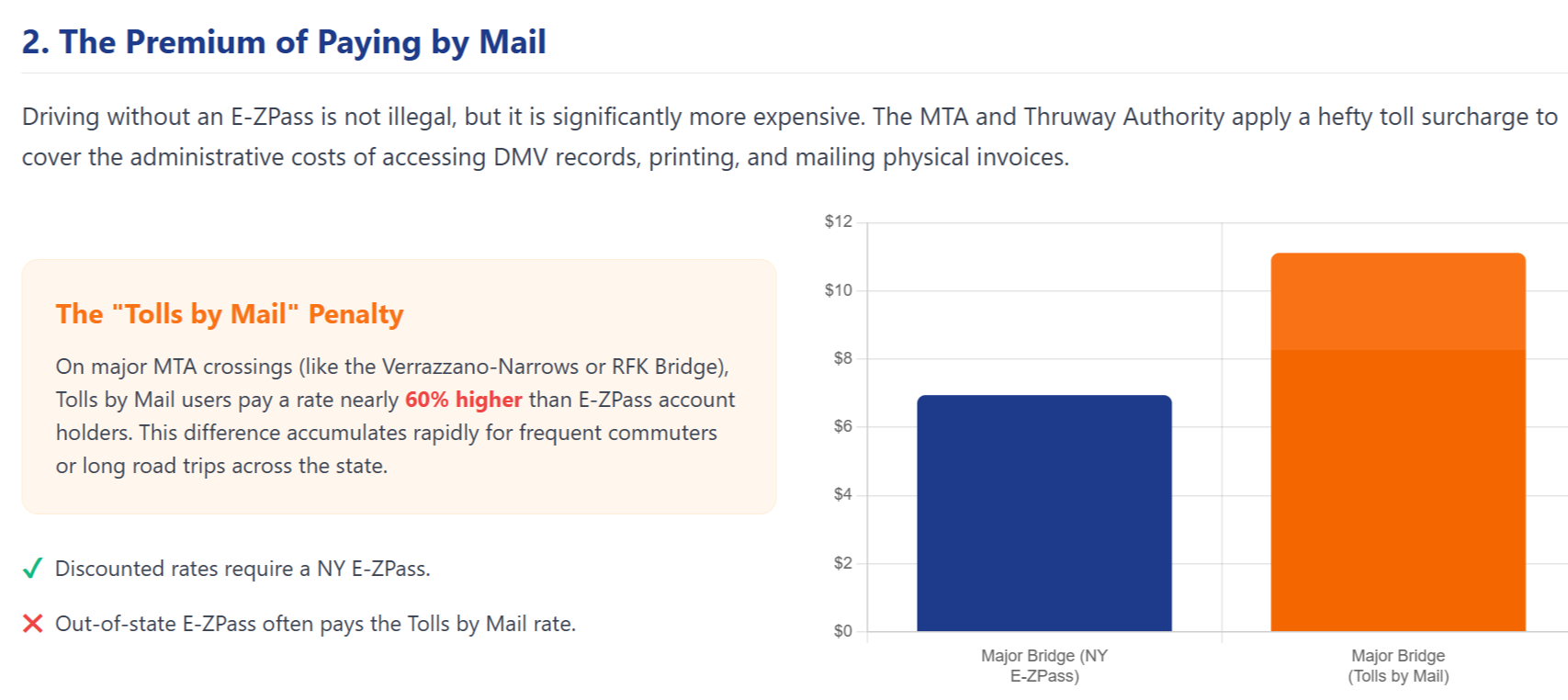
Here’s what most people don’t realize until it’s too late: Tolls by Mail rates are not the same as E-ZPass rates. New York uses a tiered pricing model where non-E-ZPass drivers pay the maximum rate at all times, regardless of when they cross or which direction they’re headed. The price gap is genuinely shocking.
MTA Bridges and Tunnels
The MTA implemented a scheduled 7.5 percent toll increase in early 2026 across all its facilities, covering crossings like the RFK Bridge, Throgs Neck, Whitestone, Queens Midtown Tunnel, Hugh L. Carey Tunnel, and the Verrazzano-Narrows Bridge. For standard two-axle passenger vehicles, here’s how the tiers break down:
| MTA Facility | E-ZPass (NY Tag) | Mid-Tier (Plate Read) | Tolls by Mail |
| Major Crossings (RFK, Whitestone, Throgs Neck, Queens Midtown, Hugh L. Carey, Verrazzano-Narrows) | $7.46 | $9.79 | $12.03 |
| Henry Hudson Bridge | $3.42 | $5.42 | $8.87 |
| Minor Crossings (Cross Bay, Marine Parkway) | $2.80 | $4.42 | $6.02 |
Source: MTA Bridges and Tunnels 2026 Toll Schedule
That’s roughly a 60 percent surcharge on the base rate simply for not having a transponder. On top of that, Tolls by Mail users are permanently locked out of residency rebate programs like the Staten Island Resident Program (which cuts the Verrazzano toll to an effective $2.75 for eligible E-ZPass holders) and the Rockaway Resident Program (which drops the Cross Bay toll to zero).
New York State Thruway
The Thruway runs a system it calls the Incentive Pricing Toll Schedule, which is about as friendly to non-E-ZPass drivers as the name suggests. If you cross without a transponder, you get charged the absolute peak rate at every single point, regardless of what time of day or night you actually crossed.
At the Governor Mario M. Cuomo Bridge, a standard two-axle passenger vehicle pays $7.25 with E-ZPass and $12.69 without it. That’s a $5.44 pure behavioral surcharge per crossing. Drive it twice a week for a month and you’ve handed over an extra $43 just for not having a transponder.
Port Authority (GWB, Lincoln Tunnel, Holland Tunnel)
Port Authority implemented a major toll revision on January 4, 2026. Tolls are collected eastbound only (into New York), and non-E-ZPass users get charged a flat “All Hours” maximum rate with no access to off-peak or overnight discounts available to E-ZPass holders.
| Vehicle Class (Eastbound Only) | E-ZPass Off-Peak | E-ZPass Peak | Tolls by Mail (All Hours) |
| Class 1: Two-Axle Passenger | $14.79 | $16.79 | $19.55 |
| Class 2: Two-Axle, Dual Rear Wheel | $43.34 | $45.34 | $48.34 |
| Class 3: Three-Axle Vehicles | $65.01 | $68.01 | $72.51 |
| Class 6: Six-Axle Commercial Trucks | $128.35 | $154.02 | $154.02 |
Source: Port Authority 2026 Toll Schedule
For commercial operators, the numbers get brutal fast. A six-axle truck without E-ZPass pays $154.02 per eastbound crossing, with each additional axle adding $25.67 on top.
Manhattan Congestion Pricing: The Most Expensive Mistake You Can Make Without E-ZPass
If you drive into Manhattan below 60th Street, you’re in the Central Business District Tolling Program (CBDTP), which launched on January 5, 2025. The program survived a serious political attack when a federal judge blocked the Trump administration’s attempt to revoke it in early 2026, calling the reversal attempt “arbitrary and capricious.” As of right now, congestion pricing is fully operational and going nowhere.
For E-ZPass users, the peak toll is $9.00 per day for passenger vehicles (charged once daily regardless of how many times you enter or exit), with a reduced overnight rate of $2.25. Tolls by Mail users pay a significantly higher rate on top of that.
But here’s the part that will genuinely ruin your afternoon: non-E-ZPass users cannot claim Crossing Credits. These credits reduce the congestion fee by $3.00 for passenger vehicles if you entered Manhattan through a tolled tunnel like the Lincoln, Holland, or Queens Midtown Tunnel. E-ZPass holders get the credit automatically. Tolls by Mail users don’t get it at all.
So if you cross the Holland Tunnel without E-ZPass, you pay the full Port Authority Tolls by Mail rate ($19.55) plus the full unmitigated congestion pricing Tolls by Mail rate with no credit to offset the overlap. That’s a genuinely expensive single trip into the city for no logical reason other than not having a $25 transponder.
Tolls by Mail users are also locked out of the Low-Income Discount Plan (50 percent off after the first ten monthly trips) and both the Individual and Organizational Disability Exemption Plans. Every single relief program requires a linked, funded E-ZPass NY account.
The Temporary Travel Account: Your Best Defense If You Don’t Have E-ZPass
If you’re visiting New York, driving a borrowed car, or just haven’t gotten around to opening an E-ZPass account yet, the Temporary Travel Account (TTA) is the smartest move you can make. Set it up at e-zpassny.com/ezpass/account-types before or immediately after you start driving.
Here’s how it works: you register your license plate and link a credit or debit card. When a gantry camera captures your plate, the system matches it to your TTA and charges your card directly on a weekly billing cycle. No paper bill. No DMV address lookup. No risk of the invoice going to an old address.
The TTA supports up to two vehicles simultaneously and can stay active for anywhere from 30 days to six months. You still pay the Tolls by Mail rate (not the discounted E-ZPass rate), but you eliminate the risk of late fees, violations, and administrative penalties. For rental car drivers, especially, this is a total game-changer vs. paying daily convenience fees to third-party processors like Verra Mobility.
Renting a Car in New York: This Section Could Save You Real Money
Rental cars and cashless tolls are where things get quietly expensive. When your rental vehicle passes a toll gantry, the invoice goes to the rental agency as the registered owner. Rather than handling it internally, major agencies outsource toll management to companies like Verra Mobility, which runs programs sold under names like e-Toll, TollPass, and PlatePass.
These programs charge a daily convenience fee on top of the actual toll, and that fee applies to every day of your rental, not just days you drove on toll roads. Here’s how the major agencies stack up in 2026:
| Rental Agency | Program Name | Daily Fee | Max Per Rental | Key Detail |
| Avis / Budget | e-Toll | $3.95/day | $16.75-$16.95 | Fee applies all days |
| Enterprise / National | TollPass | $3.95/day | $19.75 | $25 penalty for unregistered E-ZPass use |
| Alamo | TollPass Service | $4.95/day | $34.65 | Billed at maximum cash rate |
| Dollar | PlatePass | $21.49 flat/day | Unlimited tolls | $15 penalty per toll if opted out |
Source: NYC Comptroller Analysis of E-ZPass Rental Fees
Every one of these programs bills you at the maximum cash toll rate, not the discounted E-ZPass rate. So you’re paying inflated Tolls by Mail rates plus a daily service fee, plus any congestion pricing charges. Congestion tolls, by the way, are not covered by standard rental insurance.
The fix is simple: set up a Temporary Travel Account with the rental car’s plate the moment you pick up the keys. The tolling authority matches your plate to the TTA and charges your personal card directly, bypassing the rental agency’s entire third-party billing system. No convenience fees, no markups.
What Happens If You Don’t Pay: The Penalty Escalation
Ignoring a Tolls by Mail invoice is not a minor oversight. New York’s enforcement system escalates fast, and the per-transaction penalty structure makes small debts catastrophic almost immediately.
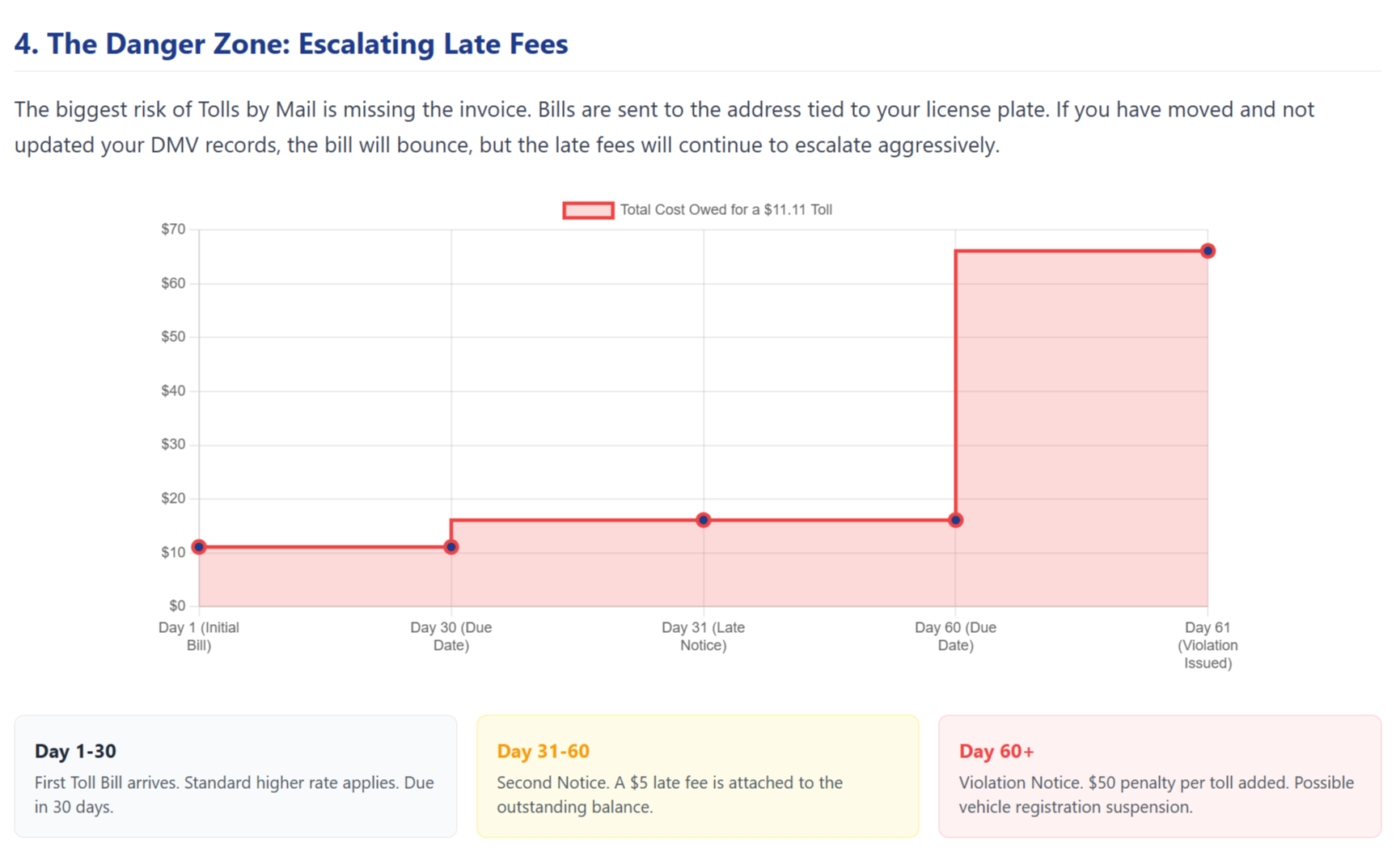
- Late Fee: The first unpaid invoice triggers a secondary bill with a flat $5.00 late fee added.
- Violation Status ($50 per toll): If the secondary bill remains unpaid 60 days after the original bill date, each individual toll escalates to a formal legal violation with a $50 fee attached. Miss five $3.00 tolls and you suddenly owe $265.00 total.
- Collections and Registration Suspension: Unpaid violations go to private collection agencies and the tolling authorities can request the DMV to suspend your vehicle registration. Drive on suspended plates and a civil debt becomes a traffic violation.
Motorists facing registration suspension cannot use the Toll Payer Advocate program for mediation. Instead, they’re directed straight to the DMV Suspension Team, which is about as pleasant as it sounds.
There’s actually pending legislation, Assembly Bill A9070 (the Toll Payer Advocacy and Relief Act), that would cap penalty fees at 10 percent of the original toll amount and establish a 180-day statute of limitations on toll debt. A $3.00 toll’s penalty would be capped at $0.30 instead of $50. It’s currently in committee as of early 2026, so it hasn’t passed yet, but it’s worth following at nysenate.gov.
Watch Out for Toll Scam Texts: A Growing and Targeted Threat
Both the FTC and FCC flagged a massive coordinated wave of SMS phishing scams targeting New York toll users throughout 2025 and into 2026. These texts spoof local area codes and come from names like “NY Toll Services” or imitations of E-ZPass. They claim you have overdue charges and threaten immediate registration suspension if you don’t click their payment link right now.
That link leads to a fake portal designed to steal your credit card number, driver’s license info, and home address. The scam works because it casts a wide net over drivers who genuinely did pass through a toll recently and are waiting for a bill.
The official guidance is clear: real Tolls by Mail notifications never include direct payment links in unsolicited texts. Legitimate opt-in SMS alerts from the system tell you to log into the official app or website, not to click an embedded URL. If you get one of these texts, delete it and report it by forwarding to 7726 (SPAM) or via the FCC at fcc.gov/toll-scams.
How to Check for Outstanding NY Toll Balances Right Now
Don’t wait for the paper to arrive. You can search for unpilled trips and existing violations directly by plate number using these official portals:
- E-ZPass NY (plate or invoice lookup)
- NYS Thruway (outstanding tolls by plate)
- Port Authority toll resources
- NYS DMV (registration hold status)
Checking takes about two minutes. Finding out your registration is suspended at the DMV counter or during a traffic stop takes considerably longer.
Disputing a Toll Charge You Don’t Recognize
ALPR systems misread plates occasionally. If you receive a bill for a crossing you didn’t make, you have the right to dispute it. Act within 30 days of the invoice date for the best outcome.
- Gather your evidence: photos of your vehicle, receipts from where you actually were, and GPS data if available.
- Contact the issuing agency directly: use the number printed on your invoice, not a general search result.
- Submit a written dispute: most agencies accept disputes online or by mail.
- Keep copies of everything: disputes without documentation rarely succeed.
If you exhaust standard channels, the Toll Payer Advocate exists as a formal escalation option, provided your account isn’t already in violation or suspension status.
Should You Just Get E-ZPass Already?
If you drive through New York more than a handful of times a year, yes, absolutely. The math is overwhelming. Opening an E-ZPass NY account costs roughly $25 (applied toward future tolls, not a fee), and the transponder is usually free or heavily discounted. You immediately start paying the lower tier on every crossing.
Beyond cost savings, E-ZPass unlocks access to residency rebates, off-peak discounts, the Low-Income Discount Plan for the congestion zone, and crossing credits when entering Manhattan through a tunnel. None of those programs exist for Tolls by Mail users.
E-ZPass also works across 19 states throughout the Northeast, mid-Atlantic, and beyond, so one transponder handles everything from Maine to Illinois. Sign up at e-zpassny.com. If you’re just passing through New York once, Tolls by Mail is perfectly fine. But if you’re here regularly, the transponder pays for itself within weeks.
Drive Smart, Pay Fast, Don’t Feed the Penalty Machine
New York’s toll system in 2026 is efficient, comprehensive, and deliberately expensive for anyone outside the E-ZPass ecosystem. The Tolls by Mail system functions as the state’s revenue backstop, not a generous fallback option for unprepared drivers.
The core takeaways are simple: pay your invoice within 30 days, use the Temporary Travel Account if you’re renting or borrowing a car, download the official Tolls NY app to track trips in real time, and watch out for scam texts promising to help you avoid fees. They’re trying to steal your card number.
If you drive in New York even semi-regularly, open an E-ZPass account. The discounts, rebates, and credits available to transponder holders represent real money over time, and the peace of mind is worth every penny. Everything you need is right here in this guide. Now go drive, and don’t let the tolls win.

Pavithra Vinoth is the founder of nytollsinfo.com, where she simplifies U.S. toll systems through expert insights and custom-built calculators. Her research-driven tools help drivers avoid costly mistakes and make smarter car decisions.