


Stop lighting your money on fire. In 2026, driving without a transponder isn’t just inconvenient – it’s a financial trap.
With “cash” lanes largely extinct, sticking with Pay-by-Mail means paying markups between 35% and 115%. If you want to keep that cash in your pocket instead of funding administrative fees, you need a tag. Period.
Still skeptical? I used to be too, until I got hit with a $13.60 bill for a $6.30 trip.
Let’s break down exactly why the “cash” option is a scam in 2026 and how you can game the system to pay the absolute minimum.
- The "Cash" Myth: Welcome to the Age of Invoice Billing
- The Math Doesn't Lie: Base Rate Comparisons
- The Commercial Reality Check
- No Cash Allowed: The "Mandatory" Zones
- The Hidden Gotchas: Monthly Fees and "Rent"
- The "Out-of-State" Trap
- Pro-Tip: Read the Fine Print (Seriously)
- The Rental Car Rip-Off
- Mounting Mistakes That Cost You Big
- For the Commuters: Volume Discounts
- The Final Verdict: Stop Burning Money
The “Cash” Myth: Welcome to the Age of Invoice Billing
First, let’s clear up a major misconception. When we talk about “cash” in 2026, we aren’t talking about handing paper money to a human in a booth.
Those jobs are gone. As of January 2026, major arteries like the Atlantic City Expressway and the F.E. Everett Turnpike in New Hampshire have gone completely cashless.
The Port Authority of NY & NJ crossings? Cashless. The Pennsylvania Turnpike? Totally automated.
So, your “cash” option is actually Toll-by-Plate or Video Tolling. You drive through, a camera snaps your plate, and the state mails you an invoice.
Guess who pays for that stamp, the paper, and the labor? You do.
Agencies claim these markups cover “administrative costs.” IMO, it feels more like a fine for being a luddite. If you don’t have a transponder, you are paying a premium just to receive junk mail.
The Math Doesn’t Lie: Base Rate Comparisons
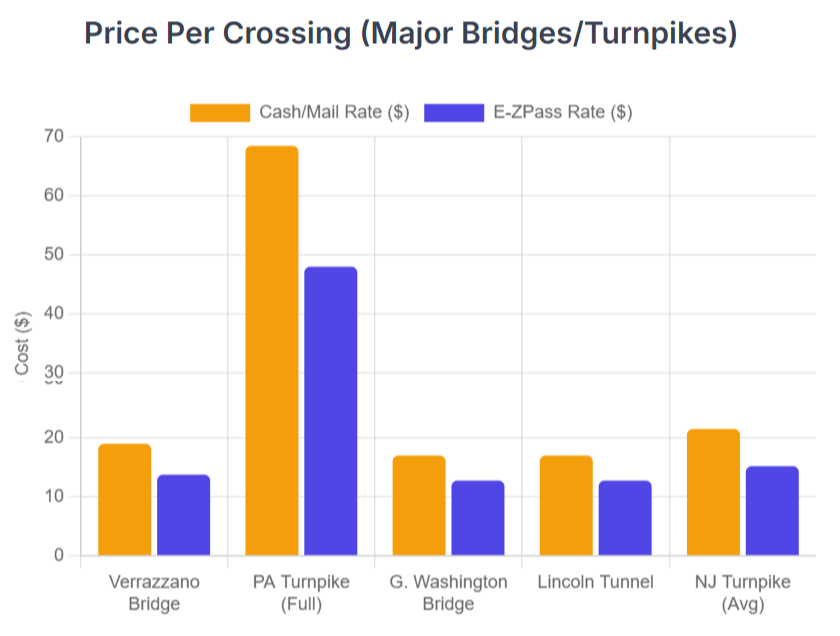
You want hard numbers? Let’s look at the scoreboard for 2026. The price gap between having a tag and paying by plate has widened into a chasm.
Take the Pennsylvania Turnpike. After their January 2026 rate hike, they made sure the math was simple.
E-ZPass users save exactly 50%. If a toll costs me $2.00 with my tag, it costs you $4.00 without one. That is a 100% markup just for lacking a piece of plastic.
The Ohio Turnpike isn’t much kinder. For a full westbound trip, I’m paying about $19.00 with my E-ZPass.
If you drive that same stretch and wait for the bill, you’re shelling out $27.75. That’s nearly a $9 difference for a single drive!
Multiply that by a return trip, and you’ve bought yourself a decent lunch just by having a transponder.
But the real shocker is the Atlantic City Expressway. As of this year, a full-length trip costs $6.30 with a tag.
The Toll-by-Plate rate? A staggering $13.60. That is a 115% premium. You are literally paying more than double.
2026 Price Breakdown by Authority
| Tolling Authority | E-ZPass Rate (Approx.) | Cash / Pay-by-Plate Rate | The “No-Tag” Penalty |
| PA Turnpike | Per-mile Base | 2x Base Rate | 100% Markup |
| Atlantic City Exp. | $6.30 (Full Trip) | $13.60 | 115% Markup |
| Mass Pike (MA) | $7.50 | $14.60 | ~95% Markup |
| Maryland MDTA | Base Rate | 1.5x Base Rate | 50% Markup |
| Ohio Turnpike | $19.00 (Westbound) | $27.75 | 46% Markup |
The Commercial Reality Check
If you drive a truck or manage a fleet, stop reading and order transponders right now. The math for commercial vehicles isn’t just bad—it’s catastrophic.
On the Ohio Turnpike, a Class 5 commercial vehicle pays $0.226 per mile with E-ZPass versus $0.284 with cash.
That might sound like pennies, but let’s look at a full westbound trip:
- With Tag: $58.75
- Without Tag: $74.00
That is a $15.25 loss per trip. If you run that route twice a week, you are throwing away over $1,500 a year just on one road.
Multiply that across a fleet, and you’re talking about the difference between profit and loss.
No Cash Allowed: The “Mandatory” Zones
In some places, it’s not even about saving money—it’s about being allowed on the road at all.
We are seeing more “Express Lanes” and congestion zones where cash/plate billing isn’t even an option.
- Georgia (Peach Pass/E-ZPass): The I-85 and I-75 Express Lanes are strictly electronic. No cash booths, no pay-by-mail option for entry.
- Washington State (SR 520): They use time-of-day pricing. During peak hours, a Good To Go! pass pays $4.90, while Pay By Mail is $6.90.
- NYC Congestion Pricing: Driving into Manhattan below 60th Street? That’s a $9.00 fee. You definitely want that hitting your E-ZPass automatically rather than dealing with invoices.
The Hidden Gotchas: Monthly Fees and “Rent”
“Okay, I get it, I’ll get an E-ZPass,” you say. Hold your horses! Not all E-ZPass transponders are created equal.
Since the E-ZPass Group is a hodgepodge of 39 different agencies, each one sets its own rules.
Some states treat their transponders like a subscription service, charging you monthly “maintenance fees” just for owning the device. It’s ridiculous, right?
- New Jersey & New York: They charge you $1.00 per month ($12/year). It doesn’t sound like much, but why pay rent on a device that saves the state money?
- Pennsylvania: Charges a $3.00 annual fee.
- Ohio: Charges $0.75 a month if you use it less than 30 times (a “punish the casual driver” fee).
If you are an occasional traveler, do not get a transponder from New York or New Jersey. You will bleed money in fees that might eat up your actual toll savings.
The “Transponder Arbitrage” Hack
Here is the pro tip that saves me serious cash: Get your E-ZPass from Massachusetts or North Carolina.
Why? Because Massachusetts (EZDriveMA) and North Carolina (NC Quick Pass) charge $0 monthly fees and $0 for the hardware.
You just load it with a prepaid toll balance (usually $20), and it sits in your glovebox costing you nothing until you use it.
I personally rock the NC Quick Pass sticker. It works everywhere E-ZPass does, plus it works in Florida (SunPass) and Georgia (Peach Pass).
It is the Swiss Army knife of toll tags, and it’s free to own.
The “Out-of-State” Trap
Now, there is a catch to my “get a Massachusetts tag” advice. While your tag will work in other states (the gate will go up), you might not get the best price.
States have started getting protectionist with their discounts. They want to subsidize their own voters, not tourists.
- New York Thruway: If you use a non-NY E-ZPass, you don’t get the cheap local rate ($0.049/mile). You pay the “commercial/out-of-state” rate ($0.086/mile).
- Massachusetts: If you use a NY tag on the Mass Pike, you pay $9.35 instead of the local $7.50.
So, what’s the strategy?
- Commuters: Get the tag for the state you drive in daily to get the commuter volume discounts.
- Road Trippers: If you rarely drive in NY, just get the free NC or MA tag. The convenience of not getting a bill outweighs the small discount loss.
Pro-Tip: Read the Fine Print (Seriously)
The agencies love hiding rules in the terms of service that can bite you if you aren’t careful. Here are three big ones I found for 2026:
- Ohio’s “24-Hour Rule”: If you enter the Ohio Turnpike and don’t exit within 24 hours, the system assumes you are gaming the tolls. It charges you the maximum possible fare to the furthest exit.
- Maryland’s “Use It or Lose It”: MDTA commuter plans are great (like $70 for 50 trips). But if you don’t use all 50 trips in 45 days, you lose them. They are non-refundable.
- The “Stolen Car” Loophole: Good news for New Jersey drivers – Assembly Bill A2335 is pushing to exempt you from admin fees if your car is stolen. Progress!
The Rental Car Rip-Off
Flying into Orlando or Newark and renting a car? Do not use the rental agency’s transponder.
Rental companies charge a “convenience fee” (often $5–$10 per day) just for the privilege of using their E-ZPass.
That means a $2.00 toll could end up costing you $12.00.
The Fix: Bring your own portable transponder (like the hard-case E-ZPass Flex). Keep it in a static shield bag when you fly, and mount it in the rental car when you arrive.
Just remember to take it with you when you return the car!
Mounting Mistakes That Cost You Big
This drives me crazy. I see people holding their transponder up to the windshield with their hand as they drive through the gantry. Stop doing that!
In 2026, agencies have lost their sense of humor about “misreads.” If the machine can’t read your tag and has to take a picture of your plate, they charge you.
- New Jersey: They have a $50 administrative fee per transaction if your tag doesn’t read properly. Fifty. Dollars.
- NY/NJ Port Authority: They have a “Mid-Tier” rate. If your tag doesn’t read, you don’t get the discount, and you don’t get the full mail rate.
Just mount the thing behind your rearview mirror. It comes with Velcro for a reason.
For the Commuters: Volume Discounts
If you drive the same route to work every day, you are the golden goose for tolling authorities.
They want your predictable revenue, so they offer massive volume discounts.
- Delaware: If you make 30 trips in 30 days on SR-1, you get 50% off.
- Maine: Hit 30 trips a month? Boom, retroactive 20% discount. Hit 40 trips? 40% discount.
- Kentucky (RiverLink): Cross the bridge 40 times? The price drops by 50%.
You literally cannot beat these rates with cash or pay-by-plate.
The Final Verdict: Stop Burning Money
Look, nobody likes paying tolls. It feels like highway robbery (pun intended). But in 2026, the system is rigged.
By refusing to get a transponder, you aren’t “sticking it to the man.” You are voluntarily paying a 50% to 115% markup to fund the printing of paper invoices.
My advice?
- Go online right now.
- Order a transponder (preferably a fee-free one like NC Quick Pass).
- Mount it properly.
- Set up auto-replenish.
Your bank account will thank you, and you won’t have to dread the mailbox anymore. FYI, spending that saved cash on coffee tastes way better than giving it to the Turnpike Commission.
Disclaimer: Toll rates and policies change faster than traffic on the I-95. The rates mentioned here are based on early 2026 data. Always check the official agency websites for the most current pricing.

Pavithra Vinoth is the founder of nytollsinfo.com, where she simplifies U.S. toll systems through expert insights and custom-built calculators. Her research-driven tools help drivers avoid costly mistakes and make smarter car decisions.