

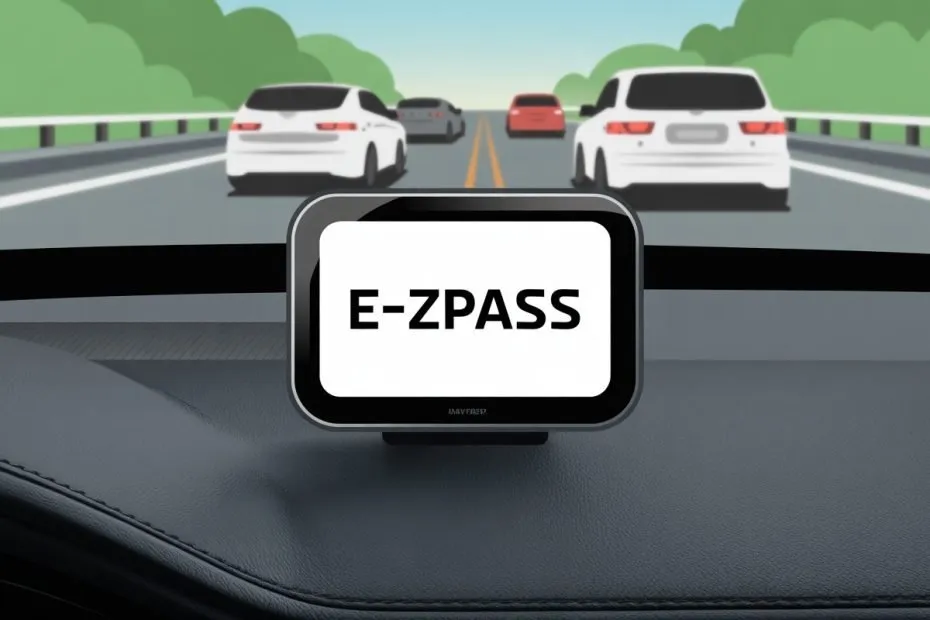
Your E-ZPass absolutely can sit on your dashboard. But here is the thing: in 2026, doing so could cost you over $1,400 a year in penalty surcharges and, in a crash, turn your transponder into a projectile flying at 200 mph straight at your face.
That changes the conversation a little, right?
This guide pulls from the latest technical data, NHTSA safety research, and 2026 tolling regulations so you can mount your transponder correctly and stop worrying about it.
- What Has Changed in 2026
- Why the Dashboard Creates Signal Problems
- The Safety Risk Nobody Talks About
- Your Windshield Might Block the Signal Too
- The Gold Standard Mounting Location
- Special Cases: Vehicles That Need Extra Attention
- Mounting Guide for Motorcycles
- What Happens When Your Tag Fails to Read
- How to Test Your Mounting Before It Counts
- Quick Reference: Mounting Locations Ranked
- What Is Coming Next: The End of Physical Tags
- Stop Guessing, Start Mounting It Right
What Has Changed in 2026
The E-ZPass world looks very different today compared to even two years ago. Understanding what changed will help you avoid costly mistakes.
The old bulky plastic transponders that ran on batteries are being phased out fast. States like New Jersey and Massachusetts are replacing them with thin, passive RFID sticker tags that require no battery at all.
These stickers bond to your windshield glass permanently, and that bond is not just for convenience. The glass itself acts as part of the antenna system.
Here is why that matters for you:
- Old battery units had enough power to push a signal through from almost anywhere
- New passive sticker tags rely on the windshield glass to boost their signal
- A sticker tag on your dashboard gets almost none of that boost
- The result is a much higher rate of failed reads at toll plazas
According to NJ1015 and the Port Authority of New York and New Jersey, drivers with improperly mounted tags face a “Mid-Tier” surcharge rate at every crossing. That adds up to more than $1,400 per year for a daily commuter.
Why the Dashboard Creates Signal Problems
Before you decide where to mount your transponder, it helps to understand the basic science. E-ZPass uses Ultra High Frequency (UHF) RFID technology. The toll gantry sends out a radio signal, your tag responds, and the whole transaction takes milliseconds.
When your tag is on the dashboard instead of the windshield, several things go wrong at once.
Signal Interference From Your Car’s Electronics
Modern dashboards are packed with electronic systems. Every one of them generates electromagnetic noise.
Interference sources on a typical 2026 dashboard include:
- 5G cellular integration modules
- GPS processors
- Advanced Driver Assistance Systems (ADAS) computers
- Infotainment system components
All of that electronic noise can drown out the weak signal from a passive sticker tag. According to RFID4U’s technical research, this is called electromagnetic interference (EMI), and dashboard placement puts your tag right in the middle of it.
Wrong Angle, Weaker Read
UHF antennas are polarized. They work best when aligned horizontally and parallel to the toll gantry reader overhead.
A tag resting flat on your dashboard points upward at the ceiling. That is exactly the wrong orientation. The effective reading range drops sharply, and at highway speeds of 65 mph or more, the gantry only has milliseconds to register your tag.
Physical Obstructions Block the Signal
Even the physical shape of your dashboard works against you.
Objects that block or absorb the signal include:
- The wiper blade assembly at the base of the windshield
- Defrost vent openings
- The curved glass edge near the dash
- Metal trim and hardware nearby
Any one of these can cause a failed read. Combined, they make dashboard mounting unreliable in a way that windshield mounting simply is not.
The Safety Risk Nobody Talks About
Signal problems are annoying. But the physical safety risk of dashboard mounting is genuinely serious. This is the part that should make you move your transponder right now.
The National Highway Traffic Safety Administration (NHTSA) classifies any unsecured object in the passenger compartment as a potential projectile during a collision.
What Happens During Airbag Deployment
Modern frontal airbags deploy in 20 to 30 milliseconds. They reach speeds of up to 200 mph as they expand.
A transponder sitting on the dashboard sits directly in the deployment path of the passenger side airbag. When the airbag inflates under or against the device, it launches that object with enormous force.
Documented injuries from objects propelled by airbag deployment include:
- Severe facial lacerations
- Eye injuries including globe rupture
- Dental fractures
- Cheekbone and nasal fractures
- Traumatic brain injury
A legacy hard case transponder weighs about 4 ounces (0.11 kg). That might not sound like much. At airbag deployment speeds, it carries enough kinetic energy to cause catastrophic injury.
Secondary Risks You Have Not Thought About
Beyond becoming a projectile, a dashboard transponder creates two more problems in a crash.
First, it can redirect the airbag away from the path it was engineered to follow. This leaves the occupant partially unprotected before the bag fully stabilizes.
Second, if the transponder housing shatters on impact, it releases plastic shards into the air. Legacy battery units can also suffer internal battery damage in that scenario. Emergency responders dealing with a crash scene already have enough to manage without plastic debris and potential battery hazards added into the mix.
Your Windshield Might Block the Signal Too
So you want to mount your transponder correctly on the windshield. Good. But first, check what kind of glass your car has. This is a step most people skip entirely.
Many vehicles produced in 2025 and 2026 use infrared reflective (IR) or solar control glass. These windshields contain microscopic layers of metal oxides, often silver or indium tin oxide, that reflect heat. That same metallic layer acts like a partial Faraday cage and blocks RFID signals.
How to Know If Your Windshield Blocks Signals
Check your owner’s manual for any of these terms:
- Solar control glass
- IR reflective glass
- Heated windshield
- Metalized coating
- UV protection coating
Vehicles commonly affected in 2026 include models from Tesla, BMW, Mercedes-Benz, Porsche, Land Rover, and Volvo.
Tesla’s owner’s manual specifically states that transponders should go to the right of the rearview mirror. If your windshield is fully metalized, no interior location will work at all. In that case, your tolling agency will issue a weatherproof external transponder designed for your front license plate.
The “Frit Zone” and Why It Exists
Manufacturers who use signal-blocking glass build in a solution. Look for a small rectangular or dotted clear area behind your rearview mirror. This is called the frit zone or clear zone.
It is specifically designed to let RFID signals pass through for toll tags and garage door openers. This is where your transponder belongs. The dashboard sits behind fully coated glass and gets no benefit from the frit zone at all.
The Gold Standard Mounting Location
Now that you understand the problems, here is the correct solution. The “Mirror Zone” is the universally accepted placement standard across all E-ZPass states.
Correct placement specifications:
| Measurement | Detail |
|---|---|
| Distance from roofline | 1 inch below the top of the windshield |
| Horizontal position | Slightly to the right of the rearview mirror post |
| Orientation | Front face of tag pointing forward toward the gantry |
| Zone type | Inside the frit zone / clear zone |
This placement satisfies legal requirements in every E-ZPass state. It maximizes signal strength. And it keeps the transponder outside the primary airbag deployment path.
Special Cases: Vehicles That Need Extra Attention
Subaru Eyesight 4 Owners
Subaru’s Eyesight system uses stereoscopic cameras mounted at the top of the windshield. These cameras power automatic emergency braking and adaptive cruise control.
Subaru officially prohibits placing any object, including toll tags within the camera’s field of view. Unfortunately, the standard E-ZPass placement location behind the mirror can overlap with the prohibited zone, depending on your specific model.
The best solution for Subaru owners in 2026 is to mount the tag in the upper corner of the passenger side near the A-pillar. This satisfies Subaru’s camera requirements while staying close enough to the frit zone to maintain reliable reads.
If you replace your windshield, ask the installer to mark the exact approved position before they apply any sticker tag. Many auto glass shops now use a product called Sticker Shield film to allow minor repositioning during this process.
Tesla Model Y and Model 3
Tesla windshields have significant UV and IR protection across most of the glass. The frit zone behind the mirror is your only reliable mounting spot. Do not guess. Check your owner’s manual and follow it exactly.
Commercial Trucks and Multi-Axle Vehicles
Commercial vehicles follow a different standard entirely. The tag must go at the bottom center of the windshield. For trucks with split windshields, place it to the right of the vertical center bar.
These vehicles often use Flex tags with a physical toggle switch for Toll and HOV modes. The tag must remain accessible to the driver and within the gantry’s line of sight.
Mounting Guide for Motorcycles
Motorcycles present a unique challenge because most lack a windshield large enough to support a sticker tag properly. The rules here are specific, and following them matters a lot in 2026 as agencies shift toward weaker passive tags.
Headlight Mounting (Recommended Method)
For sticker-based systems like E-ZPass MA and Georgia Peach Pass, official guidance from tolling authorities points to the headlight as the correct location.
Follow these steps:
- Clean the headlight lens surface thoroughly with an alcohol wipe
- Allow the surface to dry completely
- Apply the sticker horizontally, approximately 1 inch from the bottom of the lens
- Press firmly and hold for 30 seconds
- Do not mount on any metal surface as this grounds the antenna and kills the signal
Fairing and Tank Bag Alternatives
If you prefer not to apply a sticker to your headlight, a hard case transponder inside a plastic fairing works well. A clear map pocket on a tank bag also works. In both cases, orient the tag so the front face points upward toward the sky rather than toward the ground.
One method to avoid completely: Keeping the transponder in your jacket pocket. Human tissue absorbs UHF radio signals very effectively. Body-mounted tags are the leading cause of failed reads for motorcycle riders in 2026.
What Happens When Your Tag Fails to Read
Understanding the financial consequences makes proper mounting feel a lot more urgent. Here is exactly what occurs when your tag does not register at a toll plaza.
The Three-Tier Pricing System (PANYNJ)
The Port Authority of New York and New Jersey operates one of the strictest enforcement systems in the country at crossings, including the George Washington Bridge and Lincoln Tunnel.
| Scenario | Rate Applied |
|---|---|
| Tag reads correctly | Standard E-ZPass discounted rate |
| No E-ZPass account at all | Tolls By Mail rate (most expensive) |
| Account exists, butthe tag failed to read | Mid-Tier rate (penalty surcharge) |
That middle row is the trap. If you have an account but your dashboard-mounted tag failed to scan, you pay the Mid-Tier penalty. Every single time. Data from NJ1015 shows that this costs daily commuters more than $1,400 per year compared to a properly mounted tag.
Other States and Their Penalties
Different states use different enforcement tools, but the financial pain is consistent.
- New Jersey: High-speed open road tolling lanes are particularly unforgiving for dashboard-mounted passive tags due to low signal strength
- Pennsylvania: Toll by Plate reads charge a 50% premium over the standard E-ZPass rate per the PA Turnpike’s 2026 rate policy
- Virginia: State code allows administrative fees of up to $100 for persistent toll violations stemming from failed tag reads
How to Test Your Mounting Before It Counts
Once your transponder is in the right spot, do not just assume it works. Run a quick test before you rely on it.
Follow this sequence:
- Find a low-traffic toll lane (not an express lane)
- Drive through at normal speed, do not slow down
- Log in to your E-ZPass account within 24 hours
- Confirm the transaction posted correctly
- Repeat once more on a different day
Two clean successful transactions back to back mean you are good to go. If either fails, recheck your placement. Make sure the front face of the tag points toward the gantry. Make sure nothing metal sits between the tag and the glass.
Quick Reference: Mounting Locations Ranked
| Location | Signal Reliability | Safety Rating | Recommended |
|---|---|---|---|
| Mirror Zone (windshield, frit area) | Excellent | Safe | Yes, always |
| Upper corner near A-pillar (Subaru EyeSight) | Good | Safe | Yes, for specific models |
| Center dashboard near windshield base | Poor | Unsafe (airbag risk) | No |
| Low on the dashboard | Very Poor | Unsafe | No |
| Glovebox | Fails completely | N/A | Never |
| Body or jacket pocket (motorcycle) | Fails completely | N/A | Never |
| Headlight (motorcycle) | Excellent | Safe | Yes |
What Is Coming Next: The End of Physical Tags
It is worth knowing that physical transponders have a limited future. The industry is already moving past them.
Many 2026 and 2027 vehicles are being built with factory-integrated tolling modules. These use the car’s own telematics system and a roof-mounted antenna to communicate with toll gantries directly. No sticker. No plastic box. No mounting decisions at all.
Glass manufacturers AGC and Saint-Gobain are also developing what they call “smart glass” which is transparent to RFID signals while still blocking infrared heat. This technology, shown at CES 2026, will eventually allow toll tags to be embedded inside the windshield laminate during manufacturing. The mounting guide becomes a thing of the past.
For now though, the sticker on the windshield in the mirror zone is where you need to be.
Stop Guessing, Start Mounting It Right
Dashboard mounting your E-ZPass made sense years ago when battery-powered transponders blasted strong signals from anywhere in your car. In 2026, passive sticker tags changed that completely. The technology demands correct placement, the safety data demands it, and the financial penalties demand it.
Here is your action checklist:
- [ ] Check your owner’s manual for IR reflective or heated windshield warnings
- [ ] Identify the frit zone behind your rearview mirror
- [ ] Mount your tag 1 inch below the roofline, slightly right of the mirror post
- [ ] Confirm the front face of the tag points forward toward the gantry
- [ ] Register all license plates linked to your vehicle on your E-ZPass account
- [ ] Run two test transactions and verify them online
That is it. Five minutes of setup saves you hundreds of dollars and keeps you safe. The dashboard is for your phone, your coffee, and your sunglasses. Your E-ZPass belongs on the windshield.

Pavithra Vinoth is the founder of nytollsinfo.com, where she simplifies U.S. toll systems through expert insights and custom-built calculators. Her research-driven tools help drivers avoid costly mistakes and make smarter car decisions.