


Georgia’s toll roads are fully cashless in 2026, and the fastest, cheapest way to handle them is with a Peach Pass. No toll booths, no coins, no exact change panic at 70 mph. If you’re driving anywhere near Atlanta, this is the one thing you need to sort out before you hit the road.
Whether you’re a daily commuter, a first-time visitor, or someone who just realized they’ve been racking up invoice fees for months, you’re in the right place. Let’s get you sorted.
- What Is the Peach Pass and Why Does Everyone Use It?
- Georgia's Toll Roads in 2026: A Complete Breakdown
- How the HOV Carpool Exemption Actually Works in 2026
- How to Pay Georgia Tolls: All Your Options
- Toll Violations in Georgia: Don't Ignore That Envelope
- Watch Out: Toll Scam Texts Are Targeting Georgia Drivers
- Out-of-State Drivers: Using Your Existing Transponder
- Rental Cars and Georgia Tolls: Avoid the Expensive Trap
- Managing Your Peach Pass Account
- Quick Reference: Georgia Toll Payment Cheat Sheet
- Hit the Road Without Surprises
What Is the Peach Pass and Why Does Everyone Use It?
The Peach Pass is Georgia’s official electronic toll transponder, managed by the State Road and Tollway Authority (SRTA). It’s a small device that attaches to your windshield and automatically deducts toll charges from a prepaid account as you cruise through the lanes.
Think of it as an EZ-Pass with a Georgia accent. 🍑

Peach Pass Account Types: Which One Fits You?
Here’s something a lot of people miss. The Peach Pass isn’t one-size-fits-all. There are actually four account types depending on your situation:
- Personal Toll Account — The standard option. Requires a $20.00 minimum opening deposit and a linked credit or debit card. Auto-replenishes when your balance drops below your set threshold.
- BancPass Pay n GO! — Built specifically for cash users or anyone who doesn’t want to link a bank card to a government system. Starter kits are available at Kroger, CVS, and Walgreens, and you reload with cash at the same retailers.
- Corporate Account — Designed for businesses and fleet operators. Supports volume tracking and centralized billing.
- Peach Pass Plus — Includes everything in the standard account plus access to parking at Hartsfield-Jackson Atlanta International Airport (ATL). Worth it if you fly frequently.
The BancPass option is genuinely useful and doesn’t get enough attention. No bank account required, no credit check, full access to the express lanes.
Setting Up Your Peach Pass
Getting started is straightforward. Here’s how:
- Visit peachpass.com or a participating retail location
- Create an account with your personal and vehicle information
- Choose your account type and fund it
- Mount the transponder on your windshield per the instructions
- Download the Peach Pass GO! app for iOS or Android to manage everything on the go
The Peach Pass GO! app is the primary way to manage your account in 2026. It includes a real-time map showing live toll rates across the entire network, biometric login (fingerprint or facial recognition), and instant transaction history. It’s not a flashy app, but it’s a genuinely practical one.
Georgia’s Toll Roads in 2026: A Complete Breakdown
Before you pay anything, you need to know where tolls actually apply. Georgia has several distinct toll corridors, and they each work a little differently.
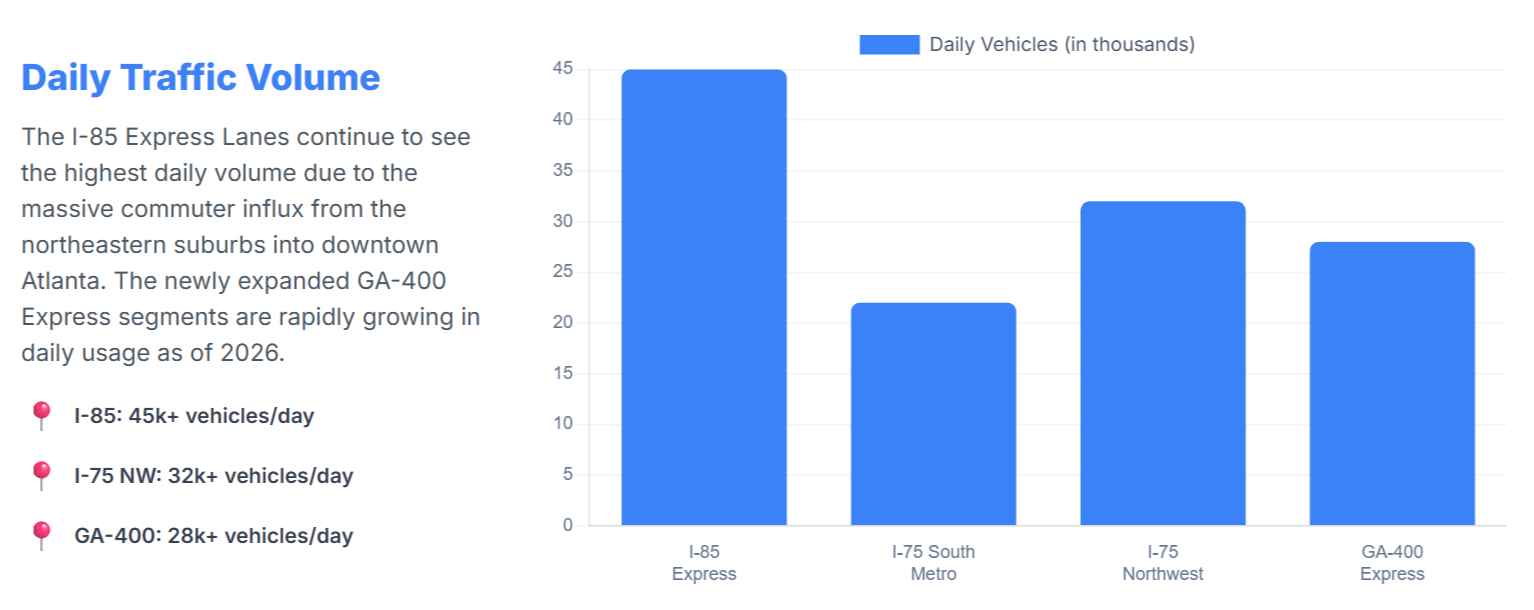
I-85 Express Lanes (HOT Lanes): Two Zones, Two Bills
The I-85 Express Lanes run for 25 miles total along I-85 northeast of Atlanta. What most people don’t realize is that this corridor now has two separate billing segments:
- 85A — The original 15-mile inner section from Chamblee Tucker Road to Old Peachtree Road
- 85B — The 10-mile extension from Old Peachtree Road to Hamilton Mill Road
These two segments are priced independently because congestion levels vary between them. When you move from one zone into the other, overhead gantry signs display a yellow “NEW TOLL RATES” banner, signaling that a new charge is starting. So a full run through the entire 25-mile corridor results in two separate charges on your account. Good to know before you check your statement and wonder what happened.
These are High Occupancy Toll (HOT) lanes. Vehicles with three or more occupants (HOV3+) travel free, but the process isn’t automatic anymore. More on that in a moment.
Northwest Corridor (I-75 and I-575): The Reversible Lane System
The Northwest Corridor Express Lanes are the most complex part of Georgia’s toll network. They span approximately 30 miles along I-75 and I-575, running from Akers Mill Road through to Hickory Grove Road and Sixes Road.
The key feature here is the reversible lane system. The direction of travel actually flips twice a day to maximize capacity in whichever direction traffic is heaviest. Here’s the current schedule for 2026:
| Day | Hours | Direction | Status |
|---|---|---|---|
| Sunday through Friday | 1:00 AM to 11:00 AM | Southbound | Open |
| Sunday through Friday | 11:00 AM to 1:30 PM | Transition | Closed |
| Sunday through Friday | 1:30 PM to 11:00 PM | Northbound | Open |
| Sunday through Friday | 11:00 PM to 1:00 AM | Night Reset | Closed |
| Saturday | 1:00 AM to 11:00 AM | Southbound | Open |
| Saturday | 11:00 AM to 1:30 PM | Transition | Closed |
| Saturday | 1:30 PM to 11:00 PM | Northbound | Open |
| Saturday Night | 11:00 PM to 1:00 AM | Night Reset | Closed |
Important note: GDOT can adjust these reversal times during major incidents, special events, or emergency evacuations. Don’t rely purely on the schedule during hurricane season or a big event weekend.
I-75 South Metro Express Lanes
The South Metro Express Lanes run 12 miles along I-75 from State Route 155 to State Route 138, serving the heavy commuter traffic between Henry and Clayton Counties. Like the Northwest Corridor, these lanes are reversible and follow a similar schedule designed around the morning and afternoon commute flow.
I-285 Top End Express Lanes
This corridor covers the northern segment of I-285 and connects with the Northwest Corridor lanes. It’s a newer addition to the network and a genuine lifesaver for anyone navigating the top end of the Atlanta perimeter during peak hours.
GA-400 Express Lanes: Under Construction in 2026
Big news for north Atlanta drivers. Construction has officially begun on the GA-400 Express Lanes, adding 16 miles of managed lanes from Fulton County to Forsyth County as part of the state’s Major Mobility Investment Program (MMIP). The project also includes Bus Rapid Transit (BRT) integration, giving MARTA buses dedicated lanes along the corridor.
This is a major expansion that will reshape commuting on one of Atlanta’s busiest corridors. Keep an eye on the Georgia DOT website for construction updates and projected opening timelines.
How the HOV Carpool Exemption Actually Works in 2026
Here’s something important that catches people off guard. Traveling with three or more passengers on the I-85 and I-85 Extension lanes is supposed to be free, but the exemption is no longer automatic.
You now need the Peach Pass Verify app to claim it.
Using Peach Pass Verify
Before entering the express lanes with 3 or more people in your vehicle, you must use the Peach Pass Verify app to declare your carpool status while stationary. The system’s sensors then cross-reference your declaration with your transponder.
Two things to be very clear about here:
- Forget to declare: You’ll be charged the full toll even with 3+ passengers in the car
- Declare falsely: Claiming HOV status while driving solo is a specific violation with its own penalties
Honestly, the extra step is a minor annoyance, but it’s easy enough once you’ve done it once. Just make it part of your pre-drive routine if you carpool regularly.
How to Pay Georgia Tolls: All Your Options
Alright, here are all the legitimate ways to handle Georgia tolls, from most recommended to most expensive.
Option 1: Peach Pass Transponder (Best Overall)
Already covered above, but worth restating: this is the smartest long-term option for anyone driving in Georgia regularly. You get the lowest toll rates, automatic billing, and access to the full express lane network.
Option 2: NextPass (Great for Visitors)
NextPass is a newer official alternative that’s particularly good for short-term visitors and rental car drivers. Instead of a physical transponder, NextPass uses license plate recognition (LPR) technology to identify your vehicle at toll gantries.
The pay-as-you-go model means there’s no $20 minimum balance required. You simply register your license plate and pay for the tolls you use.
One caveat worth knowing: if your vehicle’s plate somehow ends up registered on both a Peach Pass and a NextPass account simultaneously, the system can flag a conflict that requires manual resolution through the Customer Service Center.
So if you use NextPass in a rental, just make sure you haven’t also added that plate to a personal Peach Pass account.
Option 3: Pay an Invoice After the Fact
No transponder and already drove through a toll lane? Not ideal, but manageable. Georgia’s cameras capture your plate and mail an invoice to the registered vehicle owner. You then have a set window to pay before fees escalate.
Speaking of which, let’s talk about what happens if you ignore those invoices.
Toll Violations in Georgia: Don’t Ignore That Envelope
Georgia’s enforcement system is automated and it does not forget. A single unpaid toll triggers an immediate $25.00 administrative fee per instance, and the situation escalates in four distinct stages:
| Stage | Trigger | Penalty |
|---|---|---|
| Level 1: Administrative | Failure to pay via transponder or registered account | $25.00 fee plus unpaid toll |
| Level 2: Collection | Non-payment after initial notification | Referral to collections agency |
| Level 3: Civil Penalty | Referral to Office of State Administrative Hearings (OSAH) | Up to $70.00 civil penalty |
| Level 4: Final Demand | Unpaid OSAH judgment after 30 days | Vehicle registration suspension |
That last one is serious. SRTA has the legal authority under Georgia law to suspend your vehicle registration through the Department of Revenue if tolls and fees remain unpaid. Registration suspension means the car is illegal to drive on any public road until the balance is cleared.
All of this over a few dollars in tolls that compounded because someone let an envelope sit on the counter for three months. Don’t be that person.
Watch Out: Toll Scam Texts Are Targeting Georgia Drivers
This is genuinely important and worth its own section. In 2026, a significant number of Georgia drivers have received fraudulent text messages claiming to be from “Georgia Tolls” or “Peach Pass Services,” insisting that money is owed and threatening citations if a link isn’t clicked immediately.
These are scams. Here’s how to spot them:
- SRTA never requests personal or financial information via SMS
- Legitimate violation notices arrive via U.S. Postal Service or through the authenticated messaging system within the Peach Pass GO! app
- Toll violations are not prosecuted as criminal citations and do not involve judges or court dates, despite what these messages claim
If you receive a suspicious message, report it and check your actual account balance directly at peachpass.com. The SRTA Account Safety Alert page has the latest information on current scam formats.
Out-of-State Drivers: Using Your Existing Transponder
Great news for road-trippers. The Peach Pass is now fully interoperable with E-ZPass across 19 states, covering most of the Eastern Seaboard and parts of the Midwest. These include:
- Florida — Compatible with SunPass, E-Pass, and LeeWay facilities
- North Carolina — Quick Pass is fully integrated
- Northern states — Illinois, Indiana, Kentucky, Maine, Maryland, Rhode Island, and more
So if you’re driving down from New York or up from Miami, your existing transponder almost certainly works in Georgia without any extra setup. Just verify with your home state’s toll authority that interoperability is currently active, as these agreements do occasionally get updated.

Rental Cars and Georgia Tolls: Avoid the Expensive Trap
This section could save you a noticeable amount of money, so pay attention. Rental car toll programs are designed to be convenient, and convenience in this context means expensive for you.
The Rental Agency Program (TollPass)
Major rental companies including Enterprise, National, and Alamo offer the TollPass™ program, which uses a pre-installed transponder in the vehicle. The cost structure:
- A daily administrative fee of roughly $4.95 to $5.35 for every day a toll is incurred, on top of the actual toll charges
- This fee is capped at around $35.00 for the entire rental period
- If you drive through an express lane without pre-arranging payment, you may be automatically enrolled in the program, sometimes at even higher rates billed weeks after you’ve returned the car
That daily fee adds up fast, especially on a week-long trip.
The Smarter Move: Use Your Own Transponder
Experienced travelers handle this by adding the rental vehicle’s license plate to their personal Peach Pass or E-ZPass account before entering any toll lanes. This ensures charges hit your personal account at the standard rate rather than triggering the rental agency’s billing system.
Just as important: remove the plate from your account as soon as you return the car. Otherwise you could end up paying tolls for whoever rents that vehicle after you. Yes, that has happened to people.
HOV Lanes vs. Express Lanes in Rentals
Worth clarifying because these are two different things. Standard HOV lanes (marked with diamond symbols on the pavement) are free for vehicles with two or more occupants, including in rental cars. Express Lanes always require a transponder or agency program, regardless of occupancy, unless you’re using the HOV3+ Peach Pass Verify exemption.
Managing Your Peach Pass Account
Once your account is set up, ongoing management is low-effort. Through the Peach Pass GO! app or the portal at peachpass.com, you can:
- Check your real-time balance and view transaction history
- Add or update payment methods
- Register additional vehicles (including temporary ones like rental cars)
- Monitor live toll pricing across the network before you decide which route to take
- Receive authenticated violation notices if any arise
The one thing most people forget: keeping your payment method current. If your linked card expires and auto-replenish fails, your transponder goes inactive.
You’d then get billed at invoice rates, which are higher than standard Peach Pass rates. A quick check of your card expiration date every few months is well worth the 30 seconds.
Quick Reference: Georgia Toll Payment Cheat Sheet
Here’s everything condensed for a fast scan before you hit the road:
- Best option for regular drivers: Peach Pass Personal Toll Account with auto-replenish
- Best option for cash users: BancPass Pay n GO! (available at Kroger, CVS, Walgreens)
- Best option for short-term visitors: NextPass (no minimum balance required)
- Out-of-state drivers: Check E-ZPass interoperability at peachpass.com/e-zpass
- Rental car users: Add the rental plate to your personal account before entering lanes; remove it on return
- HOV exemption on I-85: Use Peach Pass Verify app to declare carpool status while stationary
- Already got a bill in the mail: Pay within the notice window at peachpass.com to avoid escalating fees
- Suspicious text about tolls: It’s a scam. Check your account directly at peachpass.com
- SRTA Customer Service: 1-855-724-7277
Hit the Road Without Surprises
Here’s the core truth of paying tolls in Georgia in 2026: the system works well when you engage with it, and it gets expensive and annoying when you ignore it. Get a Peach Pass (or NextPass if you’re just visiting), keep your account funded, use the Peach Pass Verify app if you carpool on I-85, and pay any invoices promptly.
Atlanta’s express lane network is genuinely one of the best tools available for making the city’s traffic manageable. With the GA-400 expansion underway and the full network now interoperable across 19 states, it’s only going to get more useful. Set it up once, maintain it occasionally, and you’re done. The road is yours.
Sources and further reading:
- SRTA Official Website — State Road and Tollway Authority
- Peach Pass Account Management — Official transponder and account portal
- Georgia DOT SR-400 Express Lanes FAQ — Georgia Department of Transportation
- E-ZPass Interoperability — Multi-state toll network compatibility
- Peach Pass Violation Info — Fee schedules and escalation process
- SRTA Account Safety Alert — Toll scam awareness
- NextPass Georgia Guide — LPR-based transponder alternative

Pavithra Vinoth is the founder of nytollsinfo.com, where she simplifies U.S. toll systems through expert insights and custom-built calculators. Her research-driven tools help drivers avoid costly mistakes and make smarter car decisions.