

Got slammed with an EZPass toll violation notice? You’re not alone. In 2024, the Port Authority of New York and New Jersey intensified its efforts against toll evasion, issuing over 7,000 summonses across its six bridges and tunnels, a 27% increase from the previous year. This crackdown highlights the growing scrutiny of toll violations.
Consider this: that $8 Queensboro Bridge toll can swiftly escalate to a $58 violation if unpaid, and continued non-payment could lead to the suspension of your vehicle registration.
But here’s the reality for 2026: The legislative amnesty programs proposed last year have not been enacted into law. Instead, authorities have shifted to aggressive enforcement, including cross-border registration suspensions and MTA civil judgments.
While blanket forgiveness isn’t available, there remains one ‘unofficial’ but highly effective administrative pathway to waive fees: Retroactive Account Conversion. This guide shows you how to use this specific protocol to resolve violations and navigate the new 2026 enforcement landscape.
- ⚡Quick Action Items:
- What Triggers EZPass Toll Violations (And Why They're Exploding)
- The $8 to $58 Violation Math (It Gets Worse)
- How to Pay EZPass Violations (Updated for 2026)
- Step-by-Step: How to Dispute EZPass Violations
- The Status of Toll Amnesty (2026 Update)
- Preventing Future Violations: The Complete System
- When You're Already in Deep Trouble
- Advanced Dispute Strategies and Legal Insights
- Bankruptcy and Toll Debt: What You Need to Know
- The Complete 2026 Action Plan
- Frequently Asked Questions
- Essential Resources and Emergency Contacts
- Take Action Today: Your Next Steps
⚡Quick Action Items:
- Check your EZPass account at e-zpassny.com immediately
- Call 1-800-333-8655 if you have violations
- Set up auto-replenishment to prevent future issues
- Do not wait for amnesty. Legislative proposals have stalled, and penalties are now enforced via civil judgments.
- ⚠️ URGENT: Resolve suspensions immediately. The NY DMV system is scheduled to go offline for upgrades from Feb 13–17, 2026, making it impossible to restore driving privileges during this blackout.
- Never ignore toll violations – $8 tolls become $58+ violations fast
What Triggers EZPass Toll Violations (And Why They’re Exploding)
The Cashless Toll System Reality
New York’s cashless tolling sounds simple: drive through, get charged automatically. But the system creates violations at an alarming rate.
Here’s how it works:
- Electronic sensors read your EZPass tag
- No tag detected? Cameras photograph your license plate
- Bill gets mailed to your DMV-registered address
- Miss the payment window? Instant $50+ violation
The problem? This system fails constantly. Dead batteries, dirty windshields, camera malfunctions, and address mix-ups create violations for perfectly law-abiding drivers.
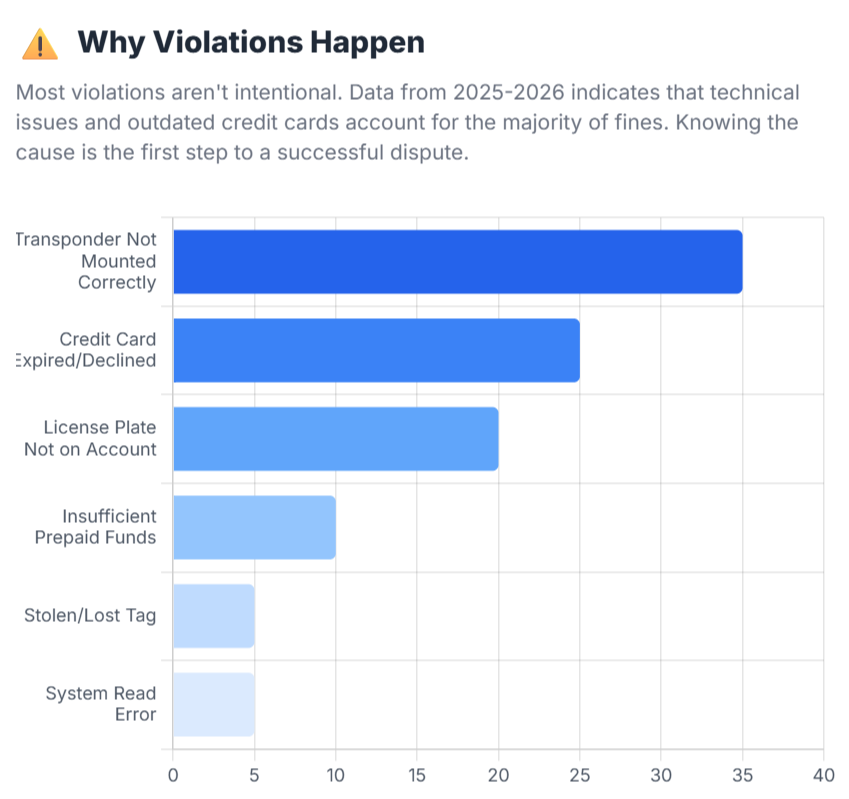
6 Common Violation Triggers (Most Are Fixable)
| Reason | Why It Happens | Prevention |
|---|---|---|
| Tag Not Reading | Dead battery, poor mounting, dirty windshield | Clean the mount area, replace old tags, and ensure proper positioning |
| Negative Balance | Account runs dry mid-trip | Enable auto-replenishment at $10 threshold |
| Wrong Address | DMV records outdated after move | Update both DMV and EZPass within 10 days |
| Unlinked Plates | New car plates not added to account | Add all vehicles as backup payment method |
| Damaged Plates | Peeling, bent, or dirty plates | Free replacement at any DMV office |
| Ownership Changes | Bought/sold car with existing violations | Title transfer confirmation, clear old debt |
Why Violations Are Increasing 400% Year-Over-Year
Three factors are driving the explosion:
- Technology Failures: Older EZPass tags (pre-2018) have higher failure rates
- Address Database Issues: Post-COVID moves created massive DMV backlogs
- Enforcement Expansion: New cashless toll locations added monthly
The $8 to $58 Violation Math (It Gets Worse)
Understanding the fee escalation helps you act fast. Here’s the brutal timeline:
Violation Escalation Timeline
| Days | What Happens | Your Cost | Example: $8 Toll |
|---|---|---|---|
| 0-30 | Initial toll bill mailed | Toll only | $8.00 |
| 31-60 | First late notice | +$5 late fee | $13.00 |
| 61-90 | Violation notice issued | +$50 violation fee | $63.00 |
| 91+ | Collections referral | +25% collection fee | $78.75+ |
| 3+ violations | DMV suspension threat | Potential misdemeanor | Legal costs |
Critical Point: Once you hit 3 unpaid violations OR $200+ in outstanding tolls, your registration faces suspension. Driving with suspended registration = Class B Misdemeanor (up to 90 days jail, $500 fine).
Real Case Study: The $2,400 Commuter
Mike from Westchester got 15 violations over 3 months due to a faulty EZPass tag. Original tolls: $180. Final bill with penalties: $2,400. His registration was suspended, and he faced a civil judgment.
The outcome: Mike used the dispute process (covered below) and got all penalties waived, paying only the original $180.
How to Pay EZPass Violations (Updated for 2026)
New York just upgraded its entire payment system. Here are your options:
Online Payment Options
| Platform | Features |
|---|---|
| E-ZPass NY Website | – Apple Pay & Google Pay support – Live chat support – 24/7 service with instant processing – Online payment plan setup |
| Tolls NY Mobile App | – Push notifications for violations – Photo bill scanning for quick payment – GPS-based toll tracking |
Phone and In-Person Options
24/7 Phone Line: 1-800-333-8655
- Automated payments are available 24/7
- Live agents: Monday-Friday, 6 AM – 10 PM
- Spanish language support is available
Cash Payment Locations:
- 7-Eleven, CVS, Walgreens (VanillaDirect network)
- Bring a payment coupon barcode from your bill
- $2.95 processing fee per transaction
Payment Plan Strategies
Most tolling authorities offer payment plans, but you need to ask before accounts go to collections:
- Short-term: 3-6 months, no interest
- Long-term: Up to 24 months for balances over $500
- Hardship programs: Available for low-income drivers
Pro Tip: Call and say, “I want to discuss payment plan options for my toll violations.” Representatives have more flexibility than the automated system suggests.
Step-by-Step: How to Dispute EZPass Violations
Step 1: Contact the Right Authority (Critical First Step)
Never contact the DMV first. They only handle suspensions, not toll disputes.
Start here based on your violation location:
| Location | Contact | Website |
|---|---|---|
| Thruway, I-87, I-90 | 1-800-THRUWAY | thruway.ny.gov |
| NYC Bridges/Tunnels | 1-800-333-8655 | mta.info |
| Port Authority | 1-800-221-9903 | panynj.gov |
| State Bridges | 1-518-471-5300 | nysba.ny.gov |
Step 2: Gather Winning Documentation
Your dispute success depends on solid proof. Here’s what works:
Vehicle Sales:
- ✅ Copy of title transfer with date stamps
- ✅ Bill of sale showing transaction before violation
- ✅ DMV transfer confirmation receipt
Stolen Vehicles:
- ✅ Police report filed BEFORE violation date
- ✅ Insurance claim documentation
- ✅ Recovery report (if applicable)
Technical Errors:
- ✅ EZPass account statements showing payment
- ✅ Screenshots of transaction history
- ✅ Photos proving your car wasn’t there (GPS data, parking receipts)
Address Issues:
⚠️ Caution: Proving you moved is not enough. You must prove your address was correct in the DMV system at the time of the violation.
- ✅ DMV Abstract (proving correct address on file at time of violation).
- ✅ Proof that the Authority mailed the bill to an address other than your official DMV address.”
Step 3: The Dispute Call Script That Works
Use this proven script for your initial call:
“Hi, I’m calling to dispute toll violations on my account. My violation number is [X]. I have documentation that shows [specific reason]. I’ve been a customer for [X] years and this is my first dispute. Can you help me resolve this?“
Key phrases that get results:
- “I have documentation to support my dispute.”
- “This is causing financial hardship.”
- “I’m a long-time customer in good standin.g”
- “I want to resolve this fairly.”
Step 4: Escalate to Toll Payer Advocates
If customer service can’t help, escalate to the Toll Payer Advocate (TPA). These independent offices have more authority:
- NY Thruway TPA: thruway.ny.gov/tpa
- MTA TPA: mta.info/tpa
- Port Authority TPA: panynj.gov/tpa
What TPAs can do:
- Override customer service decisions
- Investigate technical failures
- Recommend policy changes
- Waive penalties in hardship cases
Step 5: Appeal DMV Registration Suspension
If your registration gets suspended:
- Call immediately: Use the specific number on your suspension notice
- Request a hearing: You have 60 days to challenge
- Resolve underlying tolls: Pay or dispute with the toll authority
- Wait for clearance: DMV updates take 3-5 business days
Important: The fastest path to restore your registration is resolving the toll debt, not fighting the DMV.
The Status of Toll Amnesty (2026 Update)
Statewide Amnesty Proposals (Stalled):
Several bills (including S7278 and S2245) were introduced in previous sessions proposing comprehensive toll forgiveness. As of February 2026, these bills have not passed into law. Do not ignore violation notices hoping for a future amnesty window; the dates originally proposed (Aug–Dec 2025) have passed without implementation.
Current Relief Options: While there is no blanket amnesty, you can still utilize:
- Hardship Dismissals: Toll Payer Advocates (TPAs) retain the discretion to waive fees for proven financial hardship (e.g., bankruptcy, unemployment), though this is done on a case-by-case basis.
- Settlement Agreements: The MTA and Port Authority may offer settlement amounts (often reducing fees) to avoid the cost of civil litigation, but you must contact them proactively to request this.”
Current status: All bills are in committee review. Track progress at nysenate.gov.
Preventing Future Violations: The Complete System
Monthly Account Maintenance (5 Minutes)
Week 1 of each month:
- Log into your EZPass account
- Check recent transactions for accuracy
- Verify account balance above $25
- Review auto-replenishment settings
Red flags to watch for:
- Transactions at unfamiliar locations
- Failed payment attempts
- Balance drops below $10
- Multiple “tag not read” incidents
EZPass Tag Optimization
Proper mounting saves money:
✅ Do:
- Clean the windshield with alcohol before mounting
- Place behind the rearview mirror (not on the dashboard)
- Ensure a clear line of sight to sensors
- Keep tags dry and at room temperature
❌ Don’t:
- Mount near metal objects or electronic devices
- Place on the tinted areas of the windshield
- Leave in hot cars when not needed
- Use damaged or cracked mounting strips
Battery life indicators:
- Intermittent beeping during transactions
- “Low Battery” warning (newer tags)
- Transactions not posting within 24 hours
- Tag older than 8 years (replace proactively)
Address Management Strategy
Moving triggers most violation problems. Here’s your checklist:
Within 10 days of moving:
- Update DMV registration address
- Update EZPass account address
- Forward mail with USPS
- Test mail delivery to new address
Verification steps:
- Request address confirmation from both DMV and EZPass
- Update auto-replenishment banking information if needed
- Notify any family members who use your account
Multi-Vehicle Account Setup
Best practices for families:
- Add all household vehicles to one EZPass account
- Use license plates as backup payment method
- Set higher auto-replenishment threshold ($50+)
- Enable notifications for all family members
Cost comparison:
- Multiple accounts: $25/year per transponder
- Single-family account: $25/year total
- Backup plate coverage: Free with account
When You’re Already in Deep Trouble
Registration Suspended? Act Fast
Immediate steps (within 24 hours):
- Stop driving immediately – it’s a criminal offense
- Call the suspension hotline on your notice
- Gather all violation notices and documentation
- Contact the toll authority to resolve the debt
- Arrange alternative transportation
Timeline for restoration:
- Payment processed: 1-2 business days
- DMV record update: 3-5 business days
- Suspension lifted: 5-7 business days total
Alternative transportation during suspension:
- Uber/Lyft (can be expensive for long-term)
- Public transportation (MTA, NJ Transit)
- Car rental (some companies check suspension status)
- Family/friend assistance
Facing Civil Judgment
As of September 2024, MTA can pursue civil judgments for persistent violators. This escalates your situation significantly:
What does civil judgment mean?
- Court order to pay a specific amount
- Potential wage garnishment (up to 25% of income)
- Bank account levies
- Vehicle towing and immobilization
- Damaged credit score
Your defense options:
- Negotiate a settlement before judgment
- Request a payment plan through the court
- Challenge violation validity
- Seek legal representation for complex cases
Case study: Jennifer from Queens faced a $4,200 judgment for 47 violations. She negotiated a $1,800 settlement and an 18-month payment plan, avoiding wage garnishment.
Collection Agency Tactics
Your Rights Under the Fair Debt Collection Practices Act (FDCPA)
| Category | Details |
|---|---|
| ✅ What Collectors Can Do | – Call between 8 AM and 9 PM – Send written collection notices – Report to credit bureaus – Pursue legal action |
| ⛔ What Collectors Cannot Do | – Harass or threaten you – Call your workplace (in most cases) – Discuss debt with family members – Use deceptive practices |
| 📝 Your Response Strategy | – Request debt validation in writing within 30 days – Document all communications – Never admit fault or make partial payments – Report violations to the Consumer Financial Protection Bureau (CFPB) |
Advanced Dispute Strategies and Legal Insights
Using FOIL Requests for Evidence
New York’s Freedom of Information Law gives you access to toll system records:
Useful requests:
- Camera photos from violation incidents
- Equipment maintenance logs for specific dates
- Sensor calibration records
- System outage reports
How to file:
- Submit requests through agency websites
- Specify exact dates and locations
- Allow 30 days for a response
- Appeals are available if denied
Key Legal Cases on NY Toll Violations
Farina v. MTA (2019)
- Ruling: The court ruled that the $50 violation fees are administrative charges, not interest.
- What this means: This limits your ability to legally challenge the amount of the fee.
- Takeaway: If you’re disputing a violation, focus on whether the violation itself is valid, not the size of the penalty.
Reese v. TBTA (2020)
- Ruling: The court upheld that toll authorities have broad discretion to set their own fee structures.
- What this means: Courts are unlikely to intervene in how fees are calculated.
- Strategy Tip: Instead of arguing the fairness of the fees, you may have more success by presenting hardship or extenuating circumstances when seeking leniency.
Working with Toll Payer Advocates
TPAs have significant authority but specific limitations:
What TPAs can accomplish:
- Independent investigation of your case
- Override customer service decisions
- Recommend policy changes
- Waive penalties in appropriate cases
- Mediate complex disputes
What TPAs cannot do:
- Process payments directly
- Reverse DMV suspensions (only recommend)
- Change violation fees set by statute
- Handle non-toll related DMV issues
Maximizing TPA effectiveness:
- Document all prior contact attempts
- Present clear, factual case
- Provide supporting evidence
- Be persistent but respectful
Bankruptcy and Toll Debt: What You Need to Know
When Bankruptcy Helps
Toll violations are generally dischargeable in Chapter 7 bankruptcy, but the reality is more complex:
Dischargeable aspects:
- Violation penalties and fees
- Collection agency charges
- Interest and late fees
Non-dischargeable aspects:
- Registration suspensions often remain
- Underlying toll amounts (varies by case)
- Future violations not covered
Alternatives to Bankruptcy
Before considering bankruptcy for toll debt:
- Hardship payment plans – Most authorities offer these
- Settlement negotiations – Often accept 50-70% of the total. Contact the toll authority legal department immediately to negotiate a settlement before judgment is entered.
- TPA mediation – Free and often effective
The Complete 2026 Action Plan
If You Have No Violations (Prevention Mode)
This month:
- Set up auto-replenishment at a $25 threshold
- Add all vehicle plates to your account
- Enable low-balance and transaction notifications
- Test your EZPass tag at the next toll
Quarterly:
- Review account statements for accuracy
- Check the transponder mounting and battery
- Verify the DMV address matches the EZPass account
- Update any changed vehicle information
If You Have Current Violations (Resolution Mode)
Week 1:
- Gather all violation notices and documentation
- Call the appropriate toll authority customer service
- Request a payment plan if the amount is substantial
- Document all conversations
Week 2:
- If customer service fails, contact the Toll Payer Advocate
- Submit any dispute documentation
- Follow up on payment plan applications
- Monitor the account for updates
Ongoing:
- Check the account weekly for status changes
- Check for ‘Account Conversion’ eligibility if you receive a new violation.
- Avoid accumulating new violations
- Consider legal consultation if facing a judgment
If You’re Suspended (Emergency Mode)
Day 1:
- Stop driving immediately
- Call the DMV suspension number
- Contact the toll authority
- Arrange alternative transportation
Days 2-3:
- Resolve underlying toll debt
- Submit any required documentation
- Confirm payment processing
Days 4-7:
- Monitor DMV records for updates
- Confirm suspension lift before driving
- Update insurance if needed
Frequently Asked Questions
Can I dispute violations from years ago?
Yes, but it’s harder. New York has no statute of limitations on toll violations, but older cases require more documentation. Success rates drop significantly after 2 years.
Will violations affect my credit score?
Not initially. Toll authorities don’t report to credit bureaus, but collection agencies and civil judgments do. Act before accounts reach collections stage.
Can I get violations dismissed for financial hardship?
Sometimes. TPAs have discretion to waive penalties for genuine hardship cases. Document unemployment, medical issues, or other significant financial problems.
What if I’m not the registered owner?
You can dispute if someone else was driving, but you need strong evidence. The registered owner is legally responsible unless the vehicle was stolen or sold.
Are there payment plans for large balances?
Yes. Most authorities offer plans for balances over $200. Terms vary but typically allow 12-24 months with no interest if you qualify.
Can violations be dismissed if I was never notified?
Possibly. “Lack of notice” is a valid defense if you can prove proper address updating and mail delivery issues. Success varies by case.
What happens if I move out of New York?
Your violations don’t disappear. Most states have reciprocal agreements for registration suspensions. Pay or dispute before moving.
Can I negotiate the penalty amounts?
Individual negotiations rarely work for the tolls themselves, but penalties can often be negotiated if you are facing a large judgment.
Contact the agency’s legal department or the Toll Payer Advocate and ask for a ‘settlement to avoid litigation.’ Do not wait for a blanket amnesty program.
Essential Resources and Emergency Contacts
Toll Authority Customer Service
| Authority | Phone | Hours | Website |
|---|---|---|---|
| NY Thruway | 1-800-THRUWAY | 24/7 automated | thruway.ny.gov |
| MTA B&T | 1-800-333-8655 | 24/7 automated | mta.info |
| Port Authority | 1-800-221-9903 | 6 AM – 10 PM | panynj.gov |
| NYS Bridge Authority | 1-518-471-5300 | 8 AM – 4:30 PM | nysba.ny.gov |
DMV Suspension Hotlines
- Thruway suspensions: (718) 313-9414
- MTA suspensions: (718) 313-9424
- Port Authority suspensions: (718) 313-9425
Legal and Financial Resources
- NY Legal Aid: legalaidnyc.org
- Consumer Financial Protection Bureau: consumerfinance.gov
- NY Attorney General Consumer Protection: ag.ny.gov
Legislation Tracking
- NY Senate: nysenate.gov
- NY Assembly: nyassembly.gov
- Governor’s Office: governor.ny.gov
Take Action Today: Your Next Steps
Don’t let toll violations destroy your finances or driving privileges. Here’s what to do right now:
Immediate Actions (Next 30 Minutes)
- Check your status: Log into e-zpassny.com and review your account
- Enable notifications: Set up low-balance and transaction alerts
- Update your address: Verify DMV and EZPass records match
- Save this guide: Bookmark or download for future reference
This Week’s Tasks
- Call customer service if you have violations: 1-800-333-8655
- Set up auto-replenishment to prevent future issues
- Add all vehicle plates to your account as backup
- Document any disputes with photos and records
Stay Informed About 2026 Relief Programs
While blanket amnesty is not active, settlement policies change frequently. Stay updated by:
- Checking the MTA and Port Authority ‘Toll Payer Advocate’ pages for new settlement guidelines.
- Monitoring the ‘Tolls NY’ app for account conversion offers.”
Remember: Every day you wait, penalties grow larger and options shrink. Take action today to protect your financial future and driving privileges.
Note: This guide was compiled using official New York State sources, current legislation, and real case studies from toll violation disputes. Information is current as of 2026, and reflects the latest policy changes and pending legislation.
Disclaimer: This guide provides general information and should not be considered legal advice. Laws and policies may change. Always verify current information with official sources and consider consulting an attorney for complex situations.

Pavithra Vinoth is the founder of nytollsinfo.com, where she simplifies U.S. toll systems through expert insights and custom-built calculators. Her research-driven tools help drivers avoid costly mistakes and make smarter car decisions.