

Florida has officially ditched the “stop and pay” toll booths, leaving over 734 miles of highway that strictly use cameras and sensors to bill you. If you show up at a toll plaza with a handful of quarters, you’re basically bringing a knife to a laser-tag fight.
I recently helped a friend who flew into Orlando, and they almost paid more in rental car “convenience fees” than they did for their actual theme park tickets. Believe me, you don’t want to be that person.
| Feature | Visitor Toll Pass (VTP) | E-PASS Uni | Rental Agency Plan |
| Best For | MCO Fly-in Tourists | Multi-state Travelers | One-time/Incidental Users |
| Setup Cost | $0 ($10 deposit) | $14.95 + tax | $0 upfront |
| Daily Fee | $0 | $0 | $4.95 – $15.00 |
| Toll Rate | Lowest (Discounted) | Lowest (Discounted) | Highest (Plate Rate) |
| Hardware | Rearview Hangtag | Suction Cup Transponder | Built-in or Plate Capture |
- The Reality of 2026: No Cash, No Stopping
- The King of All Shortcuts: The Visitor Toll Pass (VTP)
- The E-PASS Uni: One Device for 19 States
- The "Double-Billing" Trap: A Warning
- Dealing with the Rental Car "Convenience" Fees
- Using Your Phone: The Mobile App Revolution
- Regional Hotspots: Where You’ll Definitely Pay
- The "Avoid Tolls" Strategy: Is it Worth It?
- Staying Safe from 2026 Digital Scams
- The Future of Tolling: What to Expect
- Choosing the Best Strategy for Your Trip
The Reality of 2026: No Cash, No Stopping
You won’t find a single human being waiting to take your cash on Florida’s main arteries anymore. The Central Florida Expressway Authority (CFX) and the Florida Turnpike Enterprise completed their shift to all-electronic tolling (AET).
This means overhead gantries snap a photo of your plate or read a chip while you’re cruising at 70 MPH. Stopping in the middle of a highway to find a coin slot is now a great way to get rear-ended.
The state did this to improve safety and keep traffic moving, but it can feel like a trap if you aren’t prepared. Ever wonder why the “Cash” lane signs look like they belong in a museum?
It’s because, in 2026, they basically do. Have you ever wondered why rental car companies seem so eager to “help” you with tolls?
It’s because their “convenience” programs are massive profit centers that charge you every single day, whether you hit a toll or not. It’s essentially a tax on being a tourist, but luckily, you’re smarter than the average bear.
The King of All Shortcuts: The Visitor Toll Pass (VTP)
If your Florida adventure begins at Orlando International Airport (MCO), stop whatever you’re doing and download the Visitor Toll Pass app. This is a government-run program specifically designed to stop rental companies from overcharging you.
- Cost: Completely free to use (you just pay for the tolls).
- Deposit: A $10 refundable deposit is required upfront.
- Pick-up Location: Vending machines are located near the rental counters in Terminals A, B, and C at MCO.
- Return Policy: You must drop the tag in a return box at the airport before you fly home.
- Validity: Good for up to 90 days of travel.
- Coverage: Works on ALL toll roads and most bridges throughout Florida.
You reserve a pass in the app and pick up a physical hangtag from a vending machine at MCO. It’s essentially a “get out of jail free” card for those annoying $15-a-day rental fees.
The best part? You pay the discounted electronic rate, which is usually 25% cheaper than the standard “Toll-By-Plate” rate.
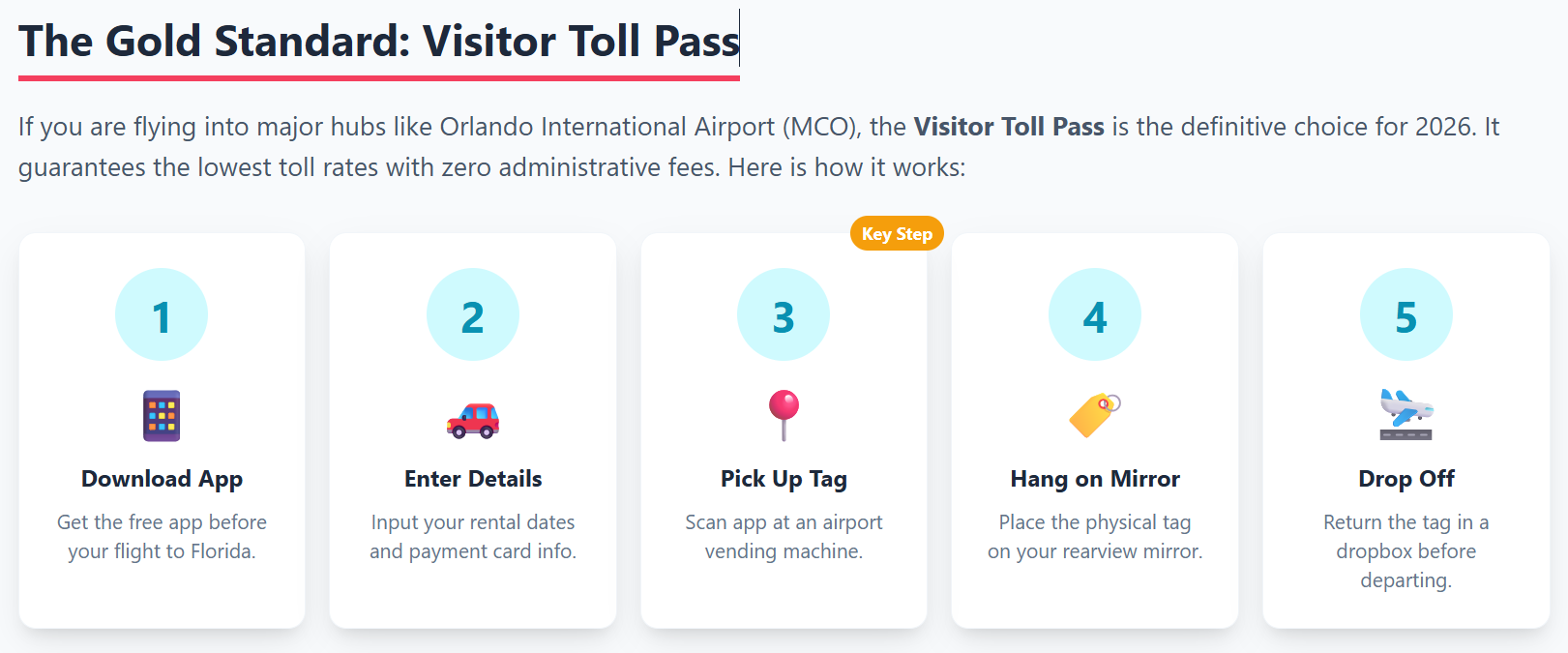
Just make sure you register your rental car’s license plate in the app before you leave the airport parking garage. If you forget this step, the cameras won’t know the car belongs to you, and the rental company will swoop in to charge you anyway.
The E-PASS Uni: One Device for 19 States
Maybe you’re planning a massive East Coast road trip that starts in Florida and ends in Maine? If so, the E-PASS Uni is your new best friend.
It’s a portable, black transponder that sticks to your windshield with suction cups. Unlike the SunPass, which is often a permanent sticker that you can’t easily move, the Uni is built for flexibility.
- Buy it for $14.95 online or at select retail locations before you travel.
- Stick it to the windshield of your rental car using the suction cups.
- Manage your balance through a single app on your phone.
- Compatibility: Works in FL, GA, NC, VA, WV, MD, DE, PA, NJ, NY, RI, MA, NH, ME, OH, IN, IL, KY, and MN.
Does anyone actually enjoy having five different toll accounts for one road trip? Of course not.
That sounds like a special kind of administrative hell. The Uni solves that by consolidating everything into one bill.
Plus, you can use it to pay for parking at MCO and Port Canaveral cruise terminals. This is a nice little bonus for those heading to the ships.
The “Double-Billing” Trap: A Warning
Here is where most tourists get burned. Even if you have a VTP or a Uni, your rental car likely has its own toll device built into the windshield.
- Step 1: Slide the rental company’s transponder box to the “closed” position.
- Step 2: If it doesn’t slide, check if it’s tucked into an RF-shielded bag.
- Step 3: Explicitly decline the rental agency’s toll program at the counter.
If you don’t disable or shield the rental car’s device, the gantry might read both tags at once. Guess what happens then?
You get charged twice. Always double-check your rearview mirror setup before you pull out onto the highway.
Dealing with the Rental Car “Convenience” Fees
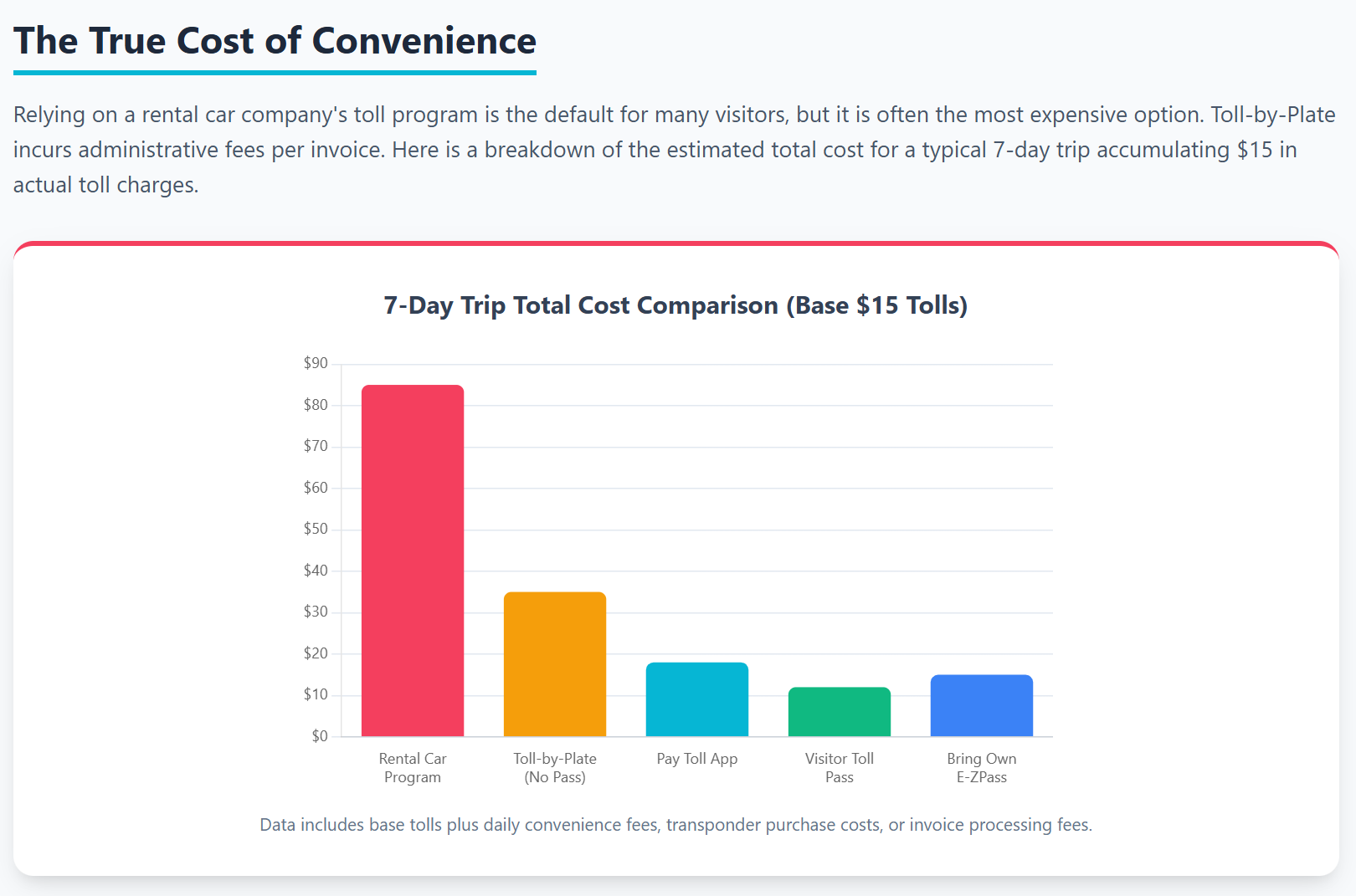
If you decide to do absolutely nothing, you’ll end up using the rental car company’s default toll program. This is the “path of least resistance,” but your wallet will feel the sting later.
Comparison of Rental Agency Fees
- Enterprise / Alamo / National: $4.95 – $5.35 daily fee (only on days used), capped at $34.65.
- Avis / Budget: $6.95 daily fee, capped at $34.95.
- Hertz / Dollar / Thrifty: $9.99 fee if used but declined, or a flat $13.99/day unlimited plan.
- Fox Rent A Car: $12.99 daily fee, capped at a whopping $194.85.
Most agencies in 2026 use one of these models, and none of them are particularly “friendly” to your budget. If you’re staying at a Disney resort and only driving to the parks, you’ll likely pay $100 for $5 worth of tolls.
If you decline their program but use a toll road anyway without your own transponder, you fall into the “Toll-By-Plate” backstop. The agency receives the bill and then passes it to you with an administrative fee that can hit $9.99 per event.
Seriously, don’t let this happen. It’s the most expensive way to travel in Florida.
Using Your Phone: The Mobile App Revolution
By 2026, we finally have apps that let you pay for tolls without any extra hardware. Apps like GoToll and NeoRide use your phone’s GPS or your license plate to track your trips.
- GoToll: Uses GPS tracking; you receive a “tap to pay” notification after your trip.
- NeoRide: Member-based; uses plate imaging to cover 95% of US toll roads.
- Uproad: Offers detailed trip tracking with a small transaction fee (approx. 15%).
Is it weird to let an app track your every move just to save $2 on a toll? Maybe, but in 2026, convenience is king.
These apps are perfect for the “incidental” toll user who only expects to hit one or two gantries. You don’t have to mess with physical hardware or airport vending machines.
Regional Hotspots: Where You’ll Definitely Pay
Not all Florida roads are created equal. Some areas are much more “aggressive” with their tolling than others.
- Orlando (CFX): The Central Florida Expressway Authority manages roads like the SR 408 and SR 528 which are 100% cashless.
- Miami (MDX): I-95 Express Lanes often require a transponder; Toll-By-Plate is not an option there.
- Tampa (THEA): The Tampa Hillsborough Expressway Authority operates the Selmon Expressway which uses higher rates for plate billing.
- Florida Turnpike (FTE): The Homestead Extension and Orlando segments are completely cashless.
If you’re heading to these spots, you absolutely need a plan. The cameras are much faster than your ability to explain yourself to a highway patrol officer later.
The “Avoid Tolls” Strategy: Is it Worth It?
Can you actually navigate Florida without paying a dime in tolls? Technically, yes.
All major navigation apps like Google Maps and Waze have an “Avoid Tolls” toggle in the settings. However, be warned: what is a 20-minute drive on the SR 408 can easily become a 60-minute crawl.
In 2026, the toll roads are safer and much better maintained than the side streets. If you’re on vacation, your time is probably worth more than the $2.00 toll.
Use the avoidance strategy for short trips around your hotel. For cross-state travel, just bite the bullet and get a pass.
Staying Safe from 2026 Digital Scams
As the system goes digital, scammers have gotten craftier. You might receive a text message claiming you have an “outstanding Florida toll balance” with a link to pay.
This is a scam. 🛑 Official agencies like SunPass or CFX will never text you out of the blue asking for credit card info.
They send formal invoices via mail or through their official apps. If you get a suspicious text, just delete it immediately.
Florida law is strict, but they don’t do collections via SMS. Always check your official VTP or Uni app for your real balance.
The Future of Tolling: What to Expect
The landscape of 2026 is also shaped by politics. Current trends, like Florida Senate Bill 228, show a move toward targeted toll relief for residents and veterans.
This means the state is increasingly looking to tourists to foot the bill for highway maintenance. Don’t expect toll prices to go down for visitors.
Instead, expect more sophisticated ways to pay that keep you off the “administrative fee” list. The informed tourist remains the most efficient traveler on the road.
Choosing the Best Strategy for Your Trip
Which option should you pick? It really depends on where you’re going and how you got there.
- Flying into MCO? Use the Visitor Toll Pass.
- Multi-state road trip? Get the E-PASS Uni.
- Only one toll all week? Use the rental car’s daily fee (if they are a “per-use” company).
- No hardware wanted? Use the GoToll or NeoRide apps.
Florida’s roads are beautiful and fast in 2026, provided you don’t spend your whole vacation worrying about a $2.50 charge. Grab a pass, stick it on the glass, and get to the beach.
Enjoy the sunshine!

Pavithra Vinoth is the founder of nytollsinfo.com, where she simplifies U.S. toll systems through expert insights and custom-built calculators. Her research-driven tools help drivers avoid costly mistakes and make smarter car decisions.