

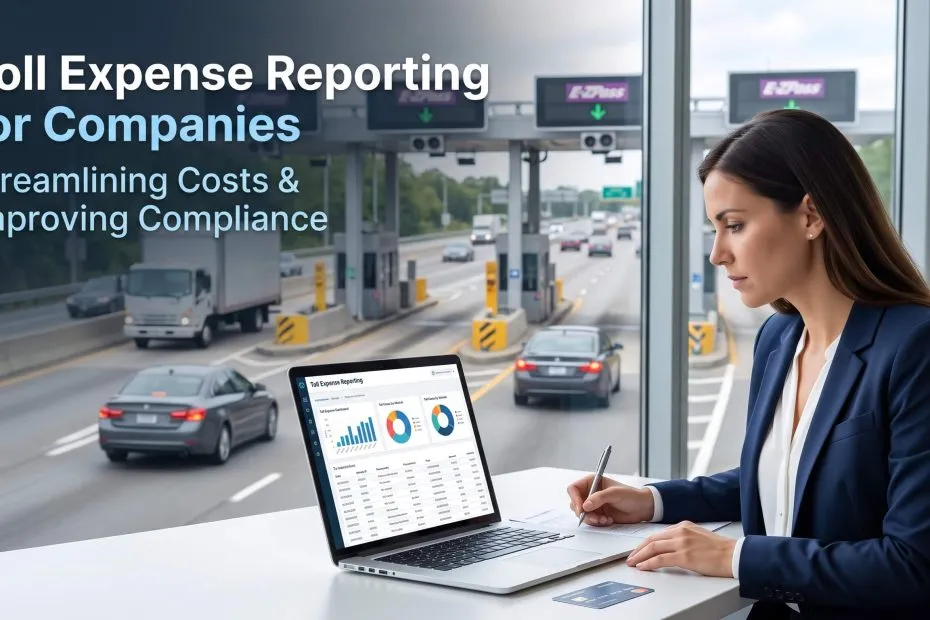
Every dollar your company spends on tolls is either tracked, reimbursed correctly, and deducted from your taxes or it is quietly lost. With toll costs rising across the country in 2026, the difference between a tight system and a sloppy one adds up fast.
This guide walks you through everything: tracking, reimbursement policy, IRS rules, and the tools that make it all manageable.
- The State of Tolling in the US Right Now
- Why Toll Tracking Is Harder Than It Looks
- What Counts as a Reimbursable Toll Expense
- IRS Rules and Tax Deductions in 2026
- State-Level Reimbursement Laws
- Building a Toll Tracking System
- AI-Powered Expense Reporting in 2026
- Writing a Toll Expense Policy That Actually Works
- Monthly Audit Checklist for Toll Expenses
- Make Toll Data Work for Your Business
The State of Tolling in the US Right Now
Toll costs are not a small line item anymore. The electronic toll collection (ETC) market is valued at approximately $12.12 billion in 2026, growing at nearly 10% per year. The North American market alone sits at $3.21 billion.
What is driving this growth? States are replacing traditional toll booths with all-electronic tolling (AET) systems. These systems process every trip automatically, which means more transactions, more charges, and more complexity for your finance team.
If your company has employees who drive for work, toll expenses are already a bigger operational cost than most CFOs realize.
Why Toll Tracking Is Harder Than It Looks
Here is the core problem. The United States does not have one universal toll pass. Instead, it has over 12 interoperability groups and more than 20 distinct tolling brands operating across the country.
Despite federal mandates under the MAP-21 Act requiring agencies to make systems compatible, the reality is a patchwork. Your employees might use different passes depending on which state they are driving in.
Here is a quick overview of the major networks:
| Interoperability Group | Participating States | Primary Technology |
|---|---|---|
| E-ZPass | 20 States (NE, MW, SE) | RFID / TDM and 6C |
| CUSIOP | TX, KS, OK, CO, FL | RFID / 6C |
| SunPass System | FL, GA, NC | RFID / 6C and TDM |
| FasTrak | California | RFID / ISO 18000-63 |
E-ZPass alone covers 20 states and manages over 53 million devices. Even so, it functions as a group of independent agencies, each with its own fees and rules. A New York E-ZPass account is not the same as a Virginia one.
The key takeaway here is that no single pass solves everything. Your policy needs to account for multiple systems.
What Counts as a Reimbursable Toll Expense
Before you set up any tracking system, your team needs to agree on what qualifies. Not every toll an employee pays is a company expense.
Reimbursable tolls include:
- Tolls paid while traveling to a client meeting, job site, or work event
- Tolls on routes that are reasonably necessary to complete the work
- CRZ charges during approved business trips into Manhattan
- Tolls incurred during multi-day approved business travel
Non-reimbursable tolls include:
- Daily commute tolls (even if the route is expensive)
- Tolls on personal detours added to a business trip
- Tolls for convenience routes when a free alternative exists
This distinction matters for tax purposes too. According to IRS Publication 463, only tolls incurred during business-related travel qualify as deductible expenses.
IRS Rules and Tax Deductions in 2026
Understanding the tax treatment of toll expenses protects your company during an audit and ensures employees are not unfairly absorbing costs. The rules changed significantly in recent years, and they remain in effect through 2026.
Standard Mileage Rate vs. Actual Expenses
For the 2026 tax year, the IRS standard mileage rate is 72.5 cents per mile for business use.
Many businesses assume tolls are already included in this rate. They are not. According to IRS Topic 511, tolls and parking fees are separate deductions that can be claimed on top of the mileage rate.
| Deduction Method | What It Covers | Toll Treatment |
|---|---|---|
| Standard Mileage Rate | Gas, oil, repairs, insurance, depreciation | Deduct tolls separately on top of mileage |
| Actual Expense Method | All direct vehicle operating costs | Tolls included as a line item in actual costs |
Can Employees Deduct Tolls?
Short answer: generally no, not on their personal federal returns. The Tax Cuts and Jobs Act suspended the deduction for unreimbursed employee business expenses. That suspension continues through the 2026 tax year.
This is why a strong employer reimbursement program matters. If you do not reimburse employees for legitimate toll costs, they have no way to recover that money at tax time.
The Accountable Plan Requirement
To keep reimbursements tax-free for employees, your company must operate under an Accountable Plan as defined by the IRS. This plan requires three things:
- Business purpose: The toll was incurred while performing work for the employer.
- Substantiation: The employee provides a receipt or log showing the date, amount, and business reason.
- Return of excess: Any reimbursement above the actual expense must be returned.
Also worth noting: the IRS caps the commuter transportation benefit exclusion at $340 per month in 2026. Reimbursements above this threshold or for trips close to an employee’s home may be treated as taxable income.
State-Level Reimbursement Laws
Federal rules set the floor, but several states go much further. If your company operates in any of these states, your policy needs to reflect their stricter requirements.
California
California Labor Code Section 2802 is the strongest employee protection in the country. It requires employers to reimburse employees for all necessary expenses related to using a personal vehicle for work. This includes tolls and could extend to future mileage-based road usage charges.
Texas
Texas does not have a state mandate for toll reimbursement. However, the FLSA (Fair Labor Standards Act) applies. If unreimbursed toll costs bring an employee’s effective take-home pay below the federal minimum wage, the employer is in violation.
Illinois and New York
Both states require employers to cover expenses that are a direct consequence of an employee’s job duties. Tolls incurred during work travel fall squarely within that requirement.
Building a Toll Tracking System
The right system depends on how many vehicles your company operates and how often employees drive for work. Here is a breakdown by company size.
Small Businesses (1 to 10 Employees)
Start simple and stay consistent.
- Set up a business-level E-ZPass account for employees who drive frequently
- Use a shared expense tracking app like Expensify or a structured spreadsheet
- Require employees to log the business purpose of every trip
The goal at this stage is creating a paper trail. You do not need complex software. You need consistent documentation.
Mid-Size Companies (10 to 100 Employees)
At this scale, manual tracking starts to break down. Consider:
- Expense management software with toll categorization, such as SAP Concur or Ramp
- Company-wide transponder accounts for frequent drivers
- Policy rules built into your software that automatically flag out-of-policy toll claims
Look for software that tracks both mileage and tolls in a single interface. Many platforms handle one but not both.
Large Enterprises and Fleets (100+ Employees)
At this level, you need purpose-built fleet toll management. Two of the leading platforms are Bestpass (now Fleetworthy Toll Management) and PrePass.
Bestpass consolidates charges from over 60 toll authorities into a single monthly invoice and provides 100% major toll road coverage. Here is their current pricing:
| Bestpass Tier | Nationwide Cost | Regional Cost | Key Features |
|---|---|---|---|
| Essentials | $3.75 per vehicle/month | $2.75 per vehicle/month | Basic management, toll calculator, portal access |
| Plus | $4.50 per vehicle/month | $3.50 per vehicle/month | 10 Cost Centers, Advanced Reporting |
| Enterprise | $5.50 per vehicle/month | $4.40 per vehicle/month | Unlimited Cost Centers, API Access, ERP Integrations |
Key features that make fleet platforms worth the investment:
- Misread identification: Flags “max tolls” where an exit was not recorded and challenges the charge with the toll authority
- Violation reduction: A single account for all tolls reduces violations and manual resolution work by an average of 90%
- Route intelligence: Helps you decide whether a $113 Port Authority crossing is worth it versus a free alternative route
- API integration: Syncs directly with your ERP system so transponder updates happen automatically
Visit Bestpass or PrePass to explore their current offerings.
AI-Powered Expense Reporting in 2026
The most significant shift in corporate expense management right now is the move toward automated, zero-touch reporting. AI tools are changing how quickly and accurately toll expenses get captured and submitted.
Here is what modern platforms can do:
| AI Feature | Impact on Toll Reporting |
|---|---|
| Predictive Categorization | Matches a toll charge to a specific client project based on GPS data and calendar entries |
| Real-Time Transaction Notifications | Creates an expense entry the moment a vehicle clears a gantry, using card network partnerships |
| Anomaly Detection | Flags a $113 toll charge on a sedan as a likely gantry error or vehicle classification mistake |
| Spend Intelligence | Analyzes historical routes and recommends alternatives to reduce toll costs |
SAP Concur’s 2026 platform introduced two AI agents specifically for expense work. The Expense Automation Agent builds and populates reports automatically. The Expense Pre-Submit Audit Agent validates receipts against company policy before the report is submitted. These tools reduce manual expense processing work by 50 to 70% in the first year of use.
For companies already using Microsoft 365, Copilot integration means employees can submit toll expenses directly from their email or Teams interface without ever opening a separate app.
Writing a Toll Expense Policy That Actually Works
Most companies reimburse tolls. Far fewer have a written policy that explains the rules clearly. Without one, you expose yourself to inconsistent claims, audit risk, and employee frustration.
A complete toll reimbursement policy should cover:
- Which trips qualify — define “business purpose” clearly so there is no guessing
- How to submit — pick one method (app, email, or form) and stick to it
- Submission deadline — a 30-day window for manual receipts is the industry standard
- Documentation required — receipt, transponder statement, or app confirmation
- Reimbursement timeline — tell employees when they will be paid back
- CRZ-specific rules — specify how Manhattan trip expenses should be documented and submitted
For AI-era compliance, also add:
- A requirement to use the company travel and expense app’s automated toll capture features
- A clear distinction between reimbursable business tolls and non-reimbursable commuting tolls
- Rules for how vendor invoices involving tolls should be formatted and approved
Include this policy in your employee handbook and get a signed acknowledgment from every driver. It protects the company legally and sets clear expectations from day one.
Monthly Audit Checklist for Toll Expenses
Running a monthly review of toll expenditures catches billing errors, flags fraud, and keeps your data clean. Here is what to check each month:
Vehicle and Account Matching
- Confirm every vehicle maps to its assigned transponder
- Identify any trips billed as Toll-by-Mail, which typically cost 50 to 100% more than transponder rates
CRZ Verification
- Spot-check vendor invoices for Manhattan trips
- Confirm CRZ tolls are listed separately from NYS surcharges
- Verify that crossing credits were applied where applicable
Anomaly Review
- Flag any vehicle charged for two CBD entries in a single day (passenger vehicles should only be charged once daily)
- Identify unusually high charges that may indicate an axle count error
Dispute Management
- File disputes within the 30 to 60-day window allowed by most agencies
- Use platform tools like Bestpass’s analytics suite to identify “max tolls” and incorrect charges
Make Toll Data Work for Your Business
Toll expense reporting is not just about staying compliant. It is a source of real operational data. When you track tolls properly, you can answer questions like: Which routes cost the most? Which drivers are taking toll roads unnecessarily? Where can route optimization save money?
A well-run toll management system transforms raw transaction data into decisions. Companies that invest in the right tools and policies do not just avoid problems. They cut costs, improve compliance, and go into every audit with confidence.
Start with a clear policy. Add the right tracking tools for your company size. Apply the IRS rules correctly. And review your data every month.
The work is straightforward. The payoff is real.

Pavithra Vinoth is the founder of nytollsinfo.com, where she simplifies U.S. toll systems through expert insights and custom-built calculators. Her research-driven tools help drivers avoid costly mistakes and make smarter car decisions.