

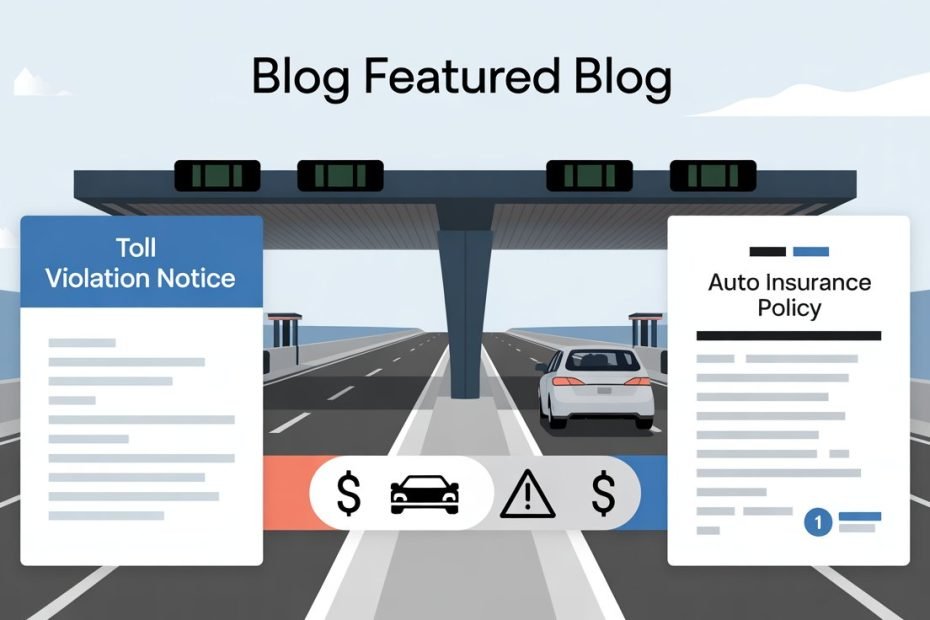
You missed a toll. Maybe your E-ZPass tag ran dry, or the camera caught you off guard. Now a violation notice is sitting in your mailbox and you are wondering: Is my insurance about to go up?
Here is the short answer: a single toll violation will not directly raise your insurance premium. But ignoring it absolutely can. The way it spirals is what most people never see coming.
- The Quick Answer: Toll Violations vs. Insurance
- How Toll Violations Actually Escalate
- The Credit Score Connection
- The Registration Suspension Trap
- The Full Risk Escalation Timeline
- State-by-State Breakdown for 2026
- Interstate Enforcement: Out-of-State Violations Follow You
- Rental Cars and Fleet Vehicles
- How to Handle a Toll Violation
- If Your License Is Already Suspended
- Frequently Asked Questions
- Stop the Snowball Before It Starts
The Quick Answer: Toll Violations vs. Insurance
Most drivers assume a toll notice and a speeding ticket carry the same weight. They do not. Understanding this one distinction saves you a lot of stress.
Standard toll violations are classified as civil administrative infractions, not moving violations. That classification is everything when it comes to your car insurance.
Here is why it matters:
| Violation Type | Goes on MVR? | Adds Points? | Affects Insurance Directly? |
|---|---|---|---|
| Speeding ticket | Yes | Yes | Yes |
| DUI or DWI | Yes | Yes | Yes |
| License suspension | Yes | Yes | Yes |
| Toll violation (automated) | No | No | No |
| Parking ticket | No | No | No |
Your insurer prices your policy based on your Motor Vehicle Record (MVR). Automated toll violations do not appear there. So your insurer has no way of knowing you missed a toll, and no reason to raise your rate.
That said, the story does not end there.
How Toll Violations Actually Escalate
One unpaid toll is a minor annoyance. Multiple unpaid tolls become a financial emergency. Here is how a $3 toll can snowball into hundreds of dollars in penalties and eventually push your insurance premium higher.
Stage 1: The Initial Violation
An overhead camera reads your license plate and a notice gets mailed to the registered vehicle owner. The fee is small, usually between $1 and $10, depending on the road.
Because automated cameras cannot prove who was driving, liability falls entirely on the registered owner. That strict liability setup is why toll violations stay civil rather than becoming criminal.
Stage 2: Administrative Fees Stack Up
Ignore the first notice and the fees multiply fast.
Some real examples from toll agencies across the US:
- California Toll Roads: First violation notice carries a $57.50 penalty. A second notice adds another $42.50 on top.
- Pennsylvania Turnpike: A late fee hits after 30 days. The account goes to a collections agency after 60 days.
- Illinois Tollway: Five unpaid violations trigger enforcement. That $3 toll can turn into $80 of total debt per infraction.
These are not hypothetical numbers. These are the published enforcement policies of real toll authorities.
Stage 3: Collections and Credit Damage
Once your toll debt gets handed to a collections agency, that agency reports your delinquency to the three major credit bureaus: Experian, Equifax, and TransUnion.
That is where your insurance enters the picture, through the back door.
The Credit Score Connection
Most people do not realize that auto insurers use something called a Credit-Based Insurance Score (CBIS). This is different from your regular FICO credit score.
A CBIS is specifically designed to predict how likely you are to file an insurance claim. Research consistently shows that people with lower credit scores file more frequent and more costly claims. So insurers use your credit data to set your rate.
When a toll debt hits your credit report as a collection account, your CBIS drops. When your CBIS drops, your insurer moves you into a higher risk tier at your next renewal.
Here is what that path looks like:
- Toll agency sends debt to collections
- Collections agency reports to Experian, Equifax, and TransUnion
- Data broker LexisNexis Risk Solutions ingests the derogatory mark
- LexisNexis calculates a lower CBIS for your profile
- Your insurer pulls the updated score at renewal and raises your rate
This happens without a single moving violation on your record. According to the Illinois Department of Insurance, the presence of collection accounts is one of the factors that drives credit-based insurance scores down most sharply.
States Where Credit Cannot Affect Your Insurance
Four states ban insurers from using credit scores entirely:
- California
- Hawaii
- Massachusetts
- Michigan
If you live in one of these states, the credit damage from an unpaid toll will hurt your mortgage and loan rates, but it will not touch your car insurance premium.
The Registration Suspension Trap
This is the part that actually destroys insurance premiums. And most drivers never see it coming until it is too late.
When toll debt reaches a certain threshold, your state DMV can suspend your vehicle registration or your driver’s license. At that point, driving becomes a criminal offense.
State Thresholds for Suspension in 2026
| State | Trigger for Suspension | What Gets Suspended |
|---|---|---|
| California | Any unpaid toll or parking violation on record | Registration renewal blocked |
| Pennsylvania | 4 or more unpaid invoices OR $250 or more in accumulated debt | Vehicle registration suspended by PennDOT |
| Illinois | 5 or more unpaid tollway fines | Driver’s license and vehicle registration |
| Texas | 100 or more unpaid toll charges within 12 months | Registration blocked, vehicle can be impounded |
Sources: Pennsylvania DMV, Illinois Legal Aid Online, Texas Mobility Authority
What Happens When You Drive on a Suspended Registration
Once your registration is suspended, operating your vehicle becomes a criminal traffic offense. If a police officer pulls you over, they issue a citation directly to you as the driver.
That citation is not a civil infraction anymore. It is a major moving violation. It goes straight onto your MVR.
In Pennsylvania, the State Police and Pennsylvania Turnpike Commission actively partner to use license plate cameras to find vehicles with suspended registrations. They are specifically looking for this.
When that conviction hits your MVR, your insurer has three typical responses:
- Severe premium increase of up to 70% of your base rate
- Loss of good driver discounts that you have built up over years
- Policy non-renewal, forcing you into expensive high-risk insurance markets
The Full Risk Escalation Timeline
Here is the complete picture of how a $5 toll turns into thousands of dollars in insurance costs over time.
| Stage | Violation Type | MVR Impact | Credit Impact | Insurance Impact |
|---|---|---|---|---|
| Initial toll violation | Civil / Administrative | None | None | None |
| Debt sent to collections | Civil / Administrative | None | High damage to CBIS | Moderate rate increase at renewal |
| Registration suspended | Civil / Administrative | None | Continued damage | Moderate rate increase |
| Caught driving on suspension | Criminal / Moving | Severe, major violation added | High | Severe increase or policy cancellation |
The insurer remains completely unaware during stages one and two, unless your state uses credit scoring. The damage becomes visible the moment a moving violation appears on your MVR.
State-by-State Breakdown for 2026
Toll enforcement rules vary significantly by state. Here is what you need to know in the major states.
New York
In February 2026, New York overhauled its Driver Violation Point System. The key changes:
- Look-back period extended from 18 months to 24 months
- Suspension review threshold lowered from 11 points to 10 points
- New points added for speeding 1 to 10 mph over the limit and distracted driving
Automated toll violations still carry zero points. But with the tighter suspension threshold, a driver whose registration is suspended for unpaid tolls faces a faster license suspension if caught driving. See the 2026 New York point system changes for the full breakdown.
Florida
Florida has a unique legal quirk. Under Florida Statute 316.1001, failing to pay a toll is technically defined as a moving violation.
This sounds alarming. In practice, it is not as bad as it reads.
Because automated cameras cannot identify the driver, the Florida Department of Highway Safety and Motor Vehicles does not assign demerit points for camera-based violations. The “moving violation” label mainly governs how fines are processed in county courts, not your driving record. Florida drivers still face the same risks as everyone else: collections and registration holds.
Illinois
Illinois runs one of the strictest toll enforcement systems in the country. Five unpaid fines trigger a license and registration suspension. The Secretary of State is legally required to act at that threshold.
There is also a unique point system detail here. Driving below the minimum speed limit on an Illinois tollway carries a massive 20-point penalty. That is the same as driving 25+ mph over the speed limit. Any driver hitting that point total faces guaranteed insurer action. See the Illinois Secretary of State Point System for the full schedule.
Texas
Texas processes toll violations as civil matters and assigns no DPS points for evasion. However, Texas has a strong tool called the Habitual Violator program.
Any driver with 100 or more unpaid toll charges in a 12-month window becomes a Habitual Violator. Consequences include:
- Complete ban from Mobility Authority toll roads
- Immovable registration renewal block
- On-road vehicle impoundment
Once a driver is caught in enforcement, the resulting citations integrate into insurance data systems. Texas insurers react swiftly to these patterns. Read more at the Central Texas Regional Mobility Authority.
New Jersey
Standard automated toll evasion in New Jersey carries no demerit points. But the state point system specifically targets dangerous behaviors on toll roads.
Two violations that do carry points on NJ toll facilities:
- Moving against traffic on the Turnpike, Parkway, or Atlantic City Expressway: 2 points
- Unlawful use of the median strip on those same roads: 2 points
New Jersey also raised its mandatory auto liability minimums in 2026 to $35,000 per person and $70,000 per accident. Your baseline insurance costs in the state are already higher before any violations are even considered. See the NJ MVC Points Schedule for specifics.
California
California keeps toll violations clearly in the civil lane. No points get assigned for automated toll evasion. The state blocks registration renewals for unpaid violations under California Vehicle Code Section 40267.
Because California bans credit-based insurance scoring entirely, the CBIS pathway is completely blocked. The only way a toll violation damages your insurance in California is if you drive an unregistered vehicle, get cited by the California Highway Patrol, and a conviction appears on your MVR.
Interstate Enforcement: Out-of-State Violations Follow You
Unpaid tolls from another state do not disappear when you cross the border. Interstate enforcement has expanded significantly in recent years.
In 2026, the Maryland MVA identified over 73,000 vehicles improperly registered in Virginia specifically to avoid Maryland tolls and safety inspections. When those drivers were caught, they faced charges for registration fraud and uninsured vehicle operation.
North Carolina has passed GS 136-89.220, authorizing the Turnpike Authority to enter reciprocal agreements with other states. Under this law, if a North Carolina vehicle owner evades tolls in another state, that state can certify the debt and North Carolina places a local registration renewal block on the vehicle.
The bottom line: unpaid out-of-state tolls carry the same escalation risk as domestic ones.
Rental Cars and Fleet Vehicles
These situations have their own rules worth knowing.
Rental cars: Most rental companies charge the toll amount plus a processing fee of $15 to $30 per toll directly to your credit card. No formal violation notice reaches you. Always check your statement after a road trip in a rental.
Work and fleet vehicles: Violations go to the fleet manager or the registered owner. If you drive a leased company vehicle, make sure you understand who carries the liability for toll violations before you hit the road.
Commercial fleets face additional scrutiny from the Federal Motor Carrier Safety Administration, which requires annual MVR checks for all commercial drivers.
How to Handle a Toll Violation
Getting a violation notice is not the end of the world. It becomes one only when you ignore it. Here is exactly what to do.
Step-by-step guide:
- Do not ignore it. The fee grows with every notice.
- Pay online through the official toll authority website.
- Contest it if you have proof of payment or a tag malfunction. Most agencies have a formal dispute process.
- Check for camera errors. License plate misreads happen. Dispute any notice where the plate or vehicle description does not match yours.
- If you recently bought a used car, contact the DMV to verify no outstanding violations are attached to the plate.
- Set up auto-replenishment on your transponder account so your balance never runs out.
If Your License Is Already Suspended
If your registration or license is currently suspended due to unpaid tolls, stop driving immediately and address it directly.
Here is the reinstatement path:
- Pay all outstanding toll debt and administrative fees
- Pay the DMV’s reinstatement fee
- In some states, file an SR-22 certificate to prove financial responsibility
- Maintain a clean record for 1 to 3 years to return to standard insurance rates
An SR-22 is not an insurance policy. It is a certificate your insurer files with the state confirming you have the required coverage. Drivers who require an SR-22 typically pay 50% to 200% more for insurance until the requirement expires.
Frequently Asked Questions
Will one toll violation raise my insurance?
No. A single automated toll violation will not appear on your MVR and will not affect your premium.
Can an unpaid toll affect my credit score?
Yes. If it goes to collections and gets reported to the credit bureaus, it can lower your CBIS and indirectly raise your insurance rate in states that allow credit-based pricing.
What states ban credit-based insurance scoring?
California, Hawaii, Massachusetts, and Michigan.
Can I get insurance canceled over a toll violation?
Not directly. But if the violation escalates to a license or registration suspension and you are caught driving, the resulting moving violation can trigger non-renewal.
Do toll violations go away?
Most states have a 3 to 7-year statute of limitations for collection. They do not simply disappear. Pay them.
Stop the Snowball Before It Starts
A toll violation on its own is a small problem. The only thing that makes it catastrophic is inaction.
Pay the notice when it arrives. Set up auto-replenishment on your transponder. Keep your registration current. Those three habits completely eliminate the risk chain described in this article.
Your insurance premium has nothing to do with whether you paid a toll last Tuesday. It has everything to do with what happens next if you did not.

Pavithra Vinoth is the founder of nytollsinfo.com, where she simplifies U.S. toll systems through expert insights and custom-built calculators. Her research-driven tools help drivers avoid costly mistakes and make smarter car decisions.