

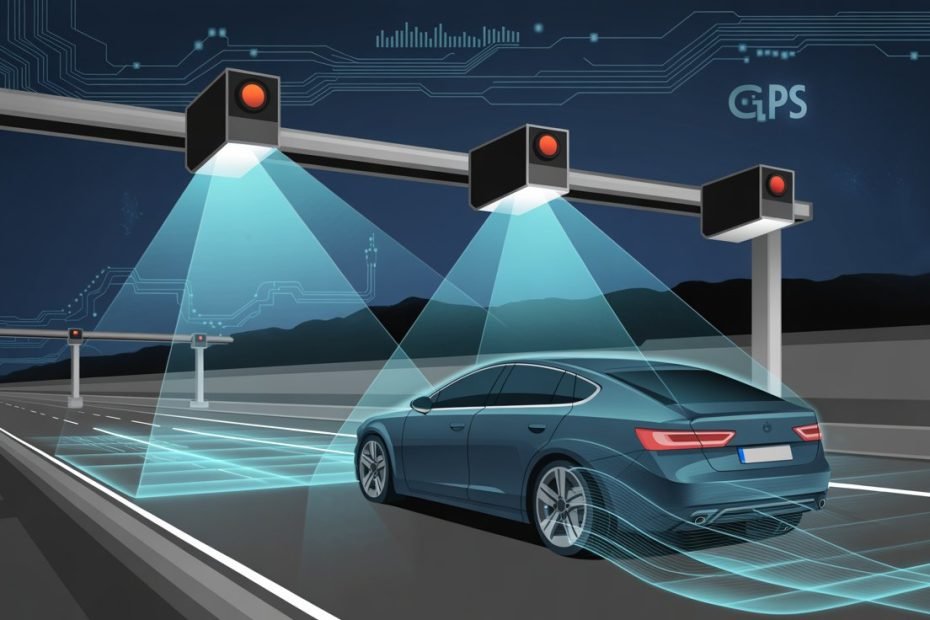
Yes, toll authorities absolutely can track your vehicle across state lines. And in 2026, it is not just possible, it is standard operating procedure.
If you drove from New Jersey to Virginia last week with your E-ZPass, every toll gantry you passed logged your trip. That data was reconciled overnight and sent back to your home agency. Your whole journey left a digital trail, and you probably never thought twice about it.
- The Short Answer You Need to Know
- How the Technology Actually Works
- Which States Share Your Toll Data?
- What Data Gets Collected About You?
- Real-Time Tracking vs. Stored Records
- Who Else Can Access Your Toll Records?
- State Privacy Protections: Who Is Pushing Back?
- The Road User Charging Future
- What You Can Actually Do About It
- Your Mile, Your Data: What Happens Next?
The Short Answer You Need to Know
The interstate tolling system in the United States has gone from a patchwork of isolated booths to a deeply connected national network. Every major toll corridor now participates in some form of data sharing with neighboring states.
This is not a conspiracy theory. It is the result of decades of infrastructure investment, standardized data protocols, and regional partnerships that now span the country.
The key takeaway: Whether you carry a transponder or not, your vehicle generates a trackable record every time it passes through a modern toll facility.
How the Technology Actually Works
Modern toll tracking is not one system. It is several technologies working together, and each one captures your vehicle differently. Understanding how they work helps you appreciate just how comprehensive this network really is.
RFID Transponders (The Little Tag on Your Windshield)
When you carry an E-ZPass or similar transponder, you are carrying a radio beacon. Every overhead gantry reads it and logs the interaction instantly.
Here is what has changed recently. Many states, including Massachusetts, Rhode Island, and Illinois, are now replacing traditional hard plastic transponder units with thin RFID sticker tags. These sticker tags cost only 37 cents to produce, compared to about $7 for a traditional hard tag.
The stickers are designed to be permanent. If you try to remove one, it breaks the internal antenna and becomes useless. This creates a permanent, one-to-one link between your account and your specific vehicle.
Automatic License Plate Recognition (ALPR)
No transponder? It does not matter. ALPR cameras at modern gantries can now read license plates with over 95% accuracy, even at highway speeds and in bad weather.
These cameras do not just read characters. They use machine learning to identify:
- The vehicle’s make and model
- The vehicle’s color
- The state of plate registration
When your plate is captured, it triggers a lookup in the national DMV registry. A bill gets mailed to your home address. The transaction is logged just like a transponder read.
GPS and Satellite-Based Tolling
This is the newest and most extensive form of tracking. Instead of physical gantries, some states now use virtual geofences powered by GPS satellites.
Washington State completed a major pilot program in early 2026 using the GoCarma smartphone app. The app tracks your location continuously via your phone’s GPS and charges you automatically when you cross a digital boundary.
This is a shift from “spot tracking” at individual gantries to “route tracking” across your entire journey.
Technology Comparison Table
| Technology | How It Works | Real-Time Access | Privacy Risk |
|---|---|---|---|
| Passive RFID Sticker | Radio signal at gantry | Limited (mostly nightly) | Moderate |
| Active RFID Hard Tag | Radio signal at gantry | Limited (mostly nightly) | Moderate |
| ALPR Camera | Photo capture at gantry | High (instant) | High |
| GPS / Satellite App | Continuous location stream | Very high (live) | Very high |
Which States Share Your Toll Data?
State-level toll data does not stay within state borders. Regional hubs coordinate the sharing of transaction data across dozens of agencies, and the network keeps growing.
The E-ZPass Network
The E-ZPass Interagency Group (IAG) is the largest toll interoperability network in the country. It currently covers 20 states from Maine to Florida and as far west as Illinois and Minnesota.
Member states include:
- New York, New Jersey, Pennsylvania, Delaware, Maryland
- Virginia, West Virginia, North Carolina
- Ohio, Indiana, Illinois
- Massachusetts, New Hampshire, Maine
- And several more
When your tag is read in another member state, your home agency receives that record the same night. That nightly data exchange means a complete, time-stamped log of your journey is stored across multiple state jurisdictions.
The CUSIOP Network (Central US)
In the central United States, the Central United States Interoperability Partners (CUSIOP) hub connects tolling agencies across Texas, Kansas, and Oklahoma. By 2026, this network has expanded to include Colorado (ExpressToll) and Florida (SunPass).
Florida SunPass Pro
Florida’s SunPass Pro works across all E-ZPass states plus the CUSIOP network, making it one of the broadest-reaching individual transponders in the country. You can learn more at the official SunPass interoperability page.
Regional Hub Summary
| Network | Core States | 2026 Expanded Reach |
|---|---|---|
| E-ZPass IAG | NY, NJ, PA, MA, VA, OH, IL + more | FL, MN, GA (partial) |
| CUSIOP | TX, KS, OK | CO, FL |
| SunPass Pro | FL | All E-ZPass + CUSIOP states |
| FasTrak (CA) | CA | TX (one way) |
What Data Gets Collected About You?
Every toll transaction generates a detailed digital record. This is not just about collecting payment. The data captured goes well beyond what most drivers expect.
What a Single Toll Read Captures
Each time your vehicle passes a gantry, the system logs:
- The exact date and time of passage
- The specific gantry or plaza location
- Your transponder ID or license plate number
- Your account holder information (if using a transponder)
- Vehicle classification and speed data
- A high-resolution camera image of your vehicle
Some agencies also retain full photo captures, which can include a visible image of the driver through the windshield.
How Long Is This Data Kept?
Retention policies vary significantly by state and agency. Here is a general picture:
- Some agencies: 18 months
- Others: Up to 7 years
- A few states have passed laws limiting retention
No uniform federal standard exists for toll data retention. This is one of the most significant privacy gaps in the current system.
Real-Time Tracking vs. Stored Records
There is an important distinction between what toll systems capture instantly and what gets shared between states. Both matter, but they work differently.
The Nightly Batch Process
Most interstate data sharing still happens through overnight “batch processing.” Agencies exchange lists of transactions at the end of each day. In this model, an authority can tell where your vehicle was yesterday, but not necessarily in real time.
This is how the E-ZPass network has operated for years. It is efficient and handles millions of transactions at once.
The Shift Toward Real-Time Analytics
That is changing. The market for tolling compliance analytics is projected to reach $1.9 billion in 2026. New AI systems now match toll charges with vehicle locations in near real time to catch fraud, cloned plates, and stolen accounts.
For commercial trucks, telematics integration already creates a live tracking feed as vehicles cross state lines.
GPS Apps Are Always Live
When drivers use a GPS-based app like GoCarma, tracking is continuous. The Washington State pilot showed “near-perfect accuracy” when the app paired with a vehicle’s Bluetooth. There is no batch process here. It is a constant stream of location data.
Who Else Can Access Your Toll Records?
Toll data does not stay exclusively with toll agencies. Several other parties can access your records, and some of those access pathways are more surprising than others.
Law Enforcement Access
Police can access toll records through a subpoena or court order in most jurisdictions. This is a standard legal process. The Electronic Frontier Foundation has documented multiple criminal cases where toll and ALPR data helped reconstruct a suspect’s movements.
The Data Broker Problem
Here is where it gets more complicated. Federal agencies including ICE and the DEA have been documented purchasing location data from private data brokers rather than obtaining court orders. The ACLU has reported extensively on this practice.
Private companies like Flock Safety aggregate billions of license plate reads per month from both public and private sources. Because this data is purchased rather than seized, some agencies argue it does not require a warrant.
This practice is the target of the “Fourth Amendment Is Not For Sale Act”, a bill being debated in Congress in early 2026, aimed at closing this loophole. You can read more about it from the Brennan Center for Justice.
Hidden Surveillance Infrastructure
Investigations in early 2026 uncovered a network of ALPR cameras hidden inside construction barrels and trailers along the California-Arizona border. These cameras were operated by federal agencies under permits from state transportation departments, and they logged the license plate of every vehicle that passed through.
CalMatters reported on this surveillance network in February 2026. The story highlights a critical reality: even in states with strong privacy laws, federal agencies can place their own hardware on state-owned roads.
State Privacy Protections: Who Is Pushing Back?
Not every state is accepting this level of data collection without resistance. Several states have passed or are considering laws that place real limits on what toll agencies can do with your data.
Washington State
Washington’s “Driver Privacy Act” (SB 6002), introduced in 2026, sets strict limits on ALPR use. Key provisions include:
- Data must be deleted within 72 hours
- Data cannot be used for immigration enforcement
- Data cannot be used to track constitutionally protected activities like attending religious services or seeking healthcare
California
California law (AB 334) restricts toll operators from sharing more than basic transaction data with out-of-state agencies. That means only the license plate, transponder ID, and timestamp can cross state lines. California also enforces the CCPA, which allows consumers to opt out of the sale or sharing of their personal data.
You can review the full text of AB 334 on LegiScan.
Connecticut
Connecticut lawmakers are actively considering restrictions on ALPR data sharing to prevent it from being used to enforce out-of-state laws, including federal immigration enforcement and out-of-state abortion bans.
State Privacy Protection Summary
| State | Key Law | What It Does |
|---|---|---|
| Washington | SB 6002 | Restricts the enforcement use of ALPR data |
| California | AB 334 + CCPA | Limits cross-state data sharing |
| Connecticut | Proposed (2026) | Restricts enforcement use of ALPR data |
The Road User Charging Future
Traditional tolling is evolving into something much bigger. As electric vehicles replace gas-powered cars and fuel tax revenues drop, states need a new way to charge drivers for road use. That means even more tracking.
What Is Road User Charging?
Road User Charging (RUC) replaces the flat toll or per-gallon gas tax with a per-mile charge. To calculate that charge accurately, the system needs to know:
- Every mile you drove
- Whether those miles were on urban or rural roads
- Whether you drove during peak or off-peak hours
19 state DOTs are now members of RUC America, with Oregon and Utah already running active programs.
What This Means for Privacy
RUC systems require continuous tracking. There is no way to charge per mile without monitoring every mile driven. The GPS-based GoCarma app tested in Washington proved this works technically. The question is whether Americans will accept it politically.
The Road User Charging Conference 2026 has made interoperability and privacy one of its central themes this year.
What You Can Actually Do About It
You cannot fully opt out of toll tracking if you drive on major highways. But you can make smarter decisions about your data and stay informed about your rights.
Practical Steps to Take Now
- Read your agency’s privacy policy before signing up for any transponder account
- Request your own data — many agencies let account holders request transaction records under state public records laws
- Check your state’s data retention rules — some states limit how long your records are stored
- Use cash toll lanes where they still exist — a shrinking option, but still available on some older facilities
- Be aware of your state’s privacy protections and whether your legislature is actively working on new laws
What Probably Will Not Work
Wrapping your transponder in foil to block the signal mostly just causes misreads and unpaid toll violations. It does not make you anonymous. It just gives you a fine.
Your Mile, Your Data: What Happens Next?
The American highway in 2026 is a sensor-rich environment. Every major toll corridor feeds into a national network of regional hubs, standardized data protocols, and shared clearinghouses. Whether you carry a transponder, drive under a camera, or use a GPS toll app, your movement is logged and stored.
For most drivers, this system works invisibly and efficiently. It pays for roads. It keeps traffic moving. But the data it generates outlives your trip, and who can access it is still being decided in courtrooms and legislatures across the country.
Know your rights. Read your state’s privacy laws. And if you get a suspicious text about a toll bill, delete it and go directly to your agency’s official website.
The road is yours. The data generated on it is a conversation worth having.

Pavithra Vinoth is the founder of nytollsinfo.com, where she simplifies U.S. toll systems through expert insights and custom-built calculators. Her research-driven tools help drivers avoid costly mistakes and make smarter car decisions.