

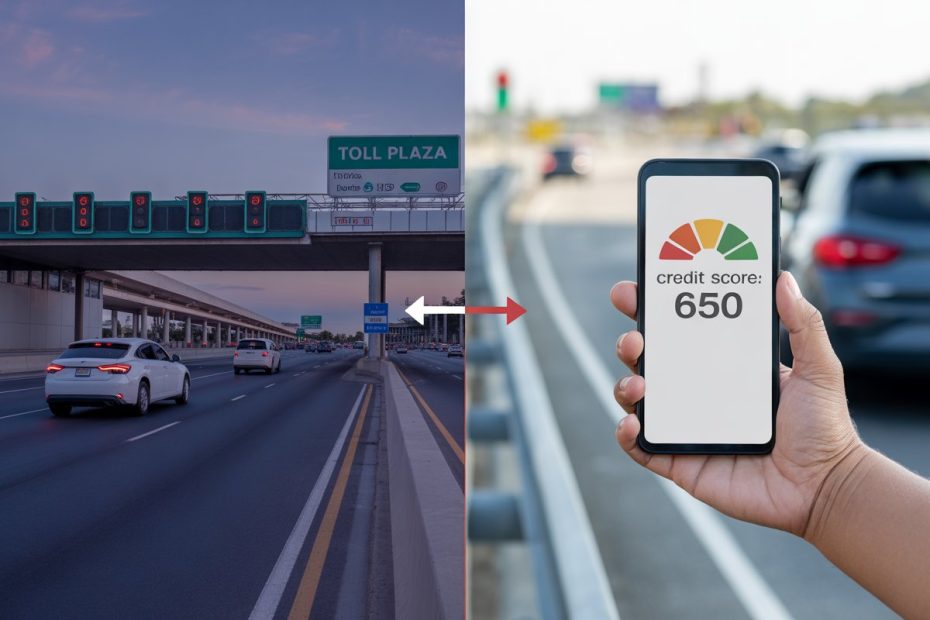
You skipped a toll booth. It was late, you were tired, and it was just a couple of bucks. No big deal, right?
Here is the short answer: Unpaid tolls do not directly hurt your credit score. But ignore them long enough, and they absolutely can. That small forgotten toll can travel through a chain of escalating consequences and land on your credit report as a collection account.
This guide breaks down exactly how that happens, what it means for your score in 2026, and what you can do about it.
- Why Toll Debt Is Different From Regular Credit Debt
- The $100 Rule That Could Save Your Score
- How Credit Scoring Models Treat Toll Collections in 2026
- The Escalation Timeline: From Missed Toll to Credit Damage
- How Different States Handle Unpaid Tolls in 2026
- The Hidden Danger: Specialty Reports and Alternative Data
- Your Rights When Toll Debt Goes to Collections
- How to Resolve Unpaid Tolls and Protect Your Credit
- Monitor Your Credit Report Weekly. It Is Free
- Quick Reference: The Toll to Credit Damage Timeline
- The Bigger Picture: $18.21 Trillion in Consumer Debt
- Do Not Let Two Dollars Cost You One Hundred Points
Why Toll Debt Is Different From Regular Credit Debt
Before we get into the damage, it helps to understand why tolls work differently from credit cards or auto loans.
Toll violations are statutory obligations. That means the law creates them, not a signed contract between you and a lender. Because of this, Metro 2 guidelines from the Consumer Data Industry Association (CDIA) instruct credit reporting agencies not to add toll violations as standard tradelines on your credit file.
In plain terms, the toll agency itself will not call up Equifax and file a report on you. That is not how the system works.
So, How Does a Toll End Up on Your Credit Report?
The risk appears when the toll authority sells your debt to a third-party collection agency. Once that happens, the collection agency can report it as a collection account. And collection accounts? They hit very differently.
Here is a simple comparison of how different debt types are treated:
| Debt Type | Standard Credit Reporting | Collection Reporting | Statutory Exclusion |
|---|---|---|---|
| Credit Cards | Yes, monthly | Yes | No |
| Auto Loans | Yes, monthly | Yes | No |
| Toll Violations | No | Possible | Yes |
| Parking Tickets | No | Possible | Yes |
| Medical Debt (under $500) | No | No | No |
The key takeaway: tolls are excluded from standard reporting, but not from collection reporting. That gap is where your score can get hurt.
The $100 Rule That Could Save Your Score
Here is something most people do not know about. Credit scoring models have built-in protections specifically for small debts like tolls.
FICO 8, the most widely used scoring model for lending decisions, ignores collection accounts where the original balance was under $100. A single toll violation, which often amounts to a $5 toll plus a $25 administrative fee, would fall under this threshold.
That is genuinely good news. But there is a catch.
Toll authorities do not always refer debts one violation at a time. They often bundle multiple violations together into a single collection referral. If your total unpaid balance crosses the $100 mark, the nuisance threshold disappears and your score takes the full hit.
What That Looks Like in Practice
Imagine you live near a toll road and miss a few transactions over several months. Individually, each is small. But grouped together, they can easily total $150, $300, or more. At that point, the debt is no longer ignored by FICO 8 and a collection account can cause a score drop of 50 to 110 points depending on your starting point.
How Credit Scoring Models Treat Toll Collections in 2026
The good news is that newer scoring models are significantly more forgiving. Understanding which model your lender uses can make a real difference.
FICO 8: The Widely Used Standard
FICO 8 remains the most common model for credit decisions. It applies the $100 threshold rule described above and does penalize paid collections. If a toll collection appears on your report and was paid, FICO 8 can still count it against you.
FICO 9 and FICO 10T: Better for Consumers
These newer FICO models completely ignore paid collection accounts. Once you settle a toll collection, the scoring penalty goes away entirely under these models. FICO 10T also incorporates trended data, which means it looks at patterns over time rather than just a snapshot.
VantageScore 4.0: The Most Consumer Friendly
VantageScore 4.0 has gained traction in mortgage and personal lending in 2026. It ignores all paid collection accounts and uses trended data to distinguish between someone who had a single lapse and someone with a pattern of delinquency.
For the estimated 33 million Americans with thin credit files, VantageScore 4.0 also incorporates alternative data like rent and utility payments. A minor toll collection may barely register if your other financial behavior is solid.
Here is a side-by-side comparison of how the models handle toll collections:
| Factor | FICO Score 8 | VantageScore 4.0 | Impact of Toll Collection |
|---|---|---|---|
| Payment History | 35% | 41% | High (if over $100) |
| Credit Utilization | 30% | 20% | Low |
| Length of History | 15% | 20% | Neutral |
| New Credit | 10% | 11% | Neutral |
| Credit Mix / Balances | 10% | 8% | Low |
| Paid Collections | Negative Impact | Ignored | Varies by Model |
The Escalation Timeline: From Missed Toll to Credit Damage
Understanding how quickly things can escalate is important. The window to act without consequences is shorter than most people think.
Here is the typical progression from a missed payment to a credit event:
- Days 1 to 30: You receive a notice for the original toll plus a small administrative fee. No credit impact at this stage.
- Days 31 to 60: Late fees begin stacking. Some agencies add $25 to $100 in administrative fees on top of the base toll.
- Days 61 to 90: The agency may place a hold on your vehicle registration. Still no credit reporting, but real consequences for renewals.
- After 90 days: The debt gets referred to a third-party collection agency. This is the moment your credit becomes at risk.
- 30 days before reporting: Under 2026 regulations, collectors must provide a pre-reporting notification giving you one final window to resolve the debt before it hits your credit file.
- Collection account filed: A derogatory mark appears on your credit report and can remain there for seven years from the original delinquency date.
The message is simple: the earlier you deal with an unpaid toll, the better.
How Different States Handle Unpaid Tolls in 2026
Not every state takes the same approach to toll enforcement. Some focus on registration holds. Others are moving toward criminal penalties for chronic offenders. And a few are taking more driver-friendly approaches with income-based relief programs. Knowing your state’s specific rules makes a real difference.
Here is a quick snapshot across all states covered below before we get into the details:
| State | Transponder System | Registration Hold? | Collections Risk? | Notable Rule |
|---|---|---|---|---|
| Maryland | E-ZPass | Yes | Yes | 90-day limit before Ohio AG collections referral |
| Pennsylvania | E-ZPass | Yes (at $250) | Yes | Felony charges possible above $10,000 |
| New York | E-ZPass | Yes | Yes | Toll Payer Advocate office created |
| Texas | TxTag / TollTag | Yes | Yes | 100 toll threshold for Habitual Violator status |
| Florida | SunPass | Yes | Yes | $100 fine per violation under Florida Statute 318.18 |
| Illinois | I-PASS | Yes | Yes | $20 fine per toll after 3rd invoice; income relief available |
| California | FasTrak | Yes (via DMV) | Yes | Low income plan caps payments at $25/month |
| New Jersey | E-ZPass NJ | Yes | Yes | Low-income plan caps payments at $25/month |
| Georgia | Peach Pass | Yes | Yes | $70 civil penalty via OSAH if unpaid after 30 days |
| Ohio | E-ZPass OH | Yes | Yes | $50 admin fee per violation; driver’s license suspension possible |
| Virginia | E-ZPass VA | Yes (3+ violations) | Yes | Tiered civil penalties up to $500 per offense |
The Hidden Danger: Specialty Reports and Alternative Data
Most people think that if a toll does not show up on their Equifax or TransUnion report, they are in the clear. That assumption can be costly.
Companies like LexisNexis Risk Solutions maintain specialty consumer reports that track what they call “non-credit events.” These reports are used by insurers, landlords, and some employers. They can include:
- Public record data, such as judgments and liens from toll-related litigation
- Vehicle registration records and ownership transfers
- Professional license status in jurisdictions where unpaid government debt affects credentials
- Residential stability data that can be cross-referenced with billing addresses
An unpaid toll that never appears on your FICO score can still show up as a risk signal in these reports. This matters if you are applying for car insurance, renting an apartment, or being considered for certain jobs.
You have the right to access your LexisNexis consumer disclosure report for free. Most people do not even know this report exists.
Your Rights When Toll Debt Goes to Collections
Federal and state law give you meaningful protections when a collector comes calling. Knowing these rights can prevent a bad situation from getting worse.
The Fair Debt Collection Practices Act (FDCPA) is the primary federal protection. It limits how, when, and how often collectors can contact you. In 2026, several states have added even stronger rules on top of the federal baseline.
New York City’s Amended Rules (Effective September 2026)
New York City adopted some of the toughest debt collection rules in the country, effective September 1, 2026. Key protections include:
- Collectors cannot attempt more than three total contacts per week per account
- Collectors must obtain written consent before contacting you by email, text, or social media
- Collectors must provide a pre-reporting notification before filing a negative entry on your credit report
- For time-barred debt (past the statute of limitations), collectors must send a written disclosure via US mail confirming you do not have to admit the debt
These rules create a meaningful buffer between you and aggressive collection tactics. If a collector violates them, you may have grounds for a complaint or legal action.
How to Resolve Unpaid Tolls and Protect Your Credit
Whether you are dealing with a fresh unpaid toll or a collection account that has already appeared on your report, there are practical steps you can take.
Step 1: Check Your Account Balance Now
Do not wait for a notice in the mail. Most toll agencies have online portals where you can check your balance at any time. The E-ZPass Group covers 19 states and lets you review your account status online in minutes. Make this a monthly habit if you drive through tolled areas regularly.
Step 2: Dispute Anything That Looks Wrong
Errors happen. Plate misreads, rental car mix-ups, and technical glitches can all generate incorrect violations. If you receive a notice for a toll you did not owe, dispute it in writing immediately. The longer you wait, the harder it becomes to resolve, and fees continue to grow in the meantime.
Step 3: Keep Your Transponder Account Funded
If you use a prepaid transponder like E-ZPass or SunPass, make sure your linked payment card is current and your account balance stays positive. Transponders keep recording trips even when payments fail, which means you can rack up violations without realizing it. A quick monthly check saves a lot of headaches.
Step 4: Negotiate a Pay for Delete
If a collection account has already been filed on your credit report, you can try negotiating a “pay for delete” agreement. Under this arrangement, the collection agency agrees to remove the account from your report in exchange for payment. It is not legally required of them, but some agencies will agree to it.
Get any such agreement in writing before you make a payment. Verbal agreements are not reliable in this situation.
Step 5: Request a Goodwill Deletion for Paid Accounts
If you have already paid the collection, but it is still showing on your report, you can write a goodwill letter asking the agency to remove it. This works best if your overall credit history is otherwise clean. It is not guaranteed, but it costs nothing to try.
Step 6: Know Your Dispute Rights Under the FCRA
Under the Fair Credit Reporting Act, you can dispute any inaccurate information on your credit file with each of the three major bureaus. If a toll collection was reported with the wrong amount, wrong name, or has exceeded the seven-year reporting limit, file a dispute. The bureaus must investigate and remove information they cannot verify.
All three bureaus now offer streamlined online dispute portals that accept documentation like payment records and debt validation letters.
California’s Low-Income Payment Plan
California offers a useful model for anyone who cannot pay their toll debt in full. Under California Vehicle Code Section 40269.5, drivers earning 200% or less of the federal poverty guidelines can set up payment plans capped at $25 per month for debts up to $600. Making the first payment immediately releases any DMV registration hold.
Monitor Your Credit Report Weekly. It Is Free
One of the best habits you can build in 2026 is regularly checking your credit report. The Consumer Financial Protection Bureau (CFPB) permanently extended free weekly credit report access from all three major bureaus.
You can pull all three reports for free at AnnualCreditReport.com, the only federally authorized site for free reports. Check specifically for:
- Collection accounts you do not recognize
- Accounts listed under unfamiliar agency names
- Any entries that look inaccurate in amount or date
Catching a toll collection early gives you the best chance of resolving it before it causes lasting damage.
Quick Reference: The Toll to Credit Damage Timeline
| Stage | Credit Impact? | What to Do |
|---|---|---|
| Original toll unpaid | None | Pay online immediately |
| Late fees added | None | Pay before further escalation |
| Registration hold placed | None | Pay to clear the hold |
| Sent to collections | Not yet | Pay before pre reporting deadline |
| Collection account filed | Yes, significant | Negotiate deletion or dispute if inaccurate |
| Collection on report for 7 years | Yes | Dispute if past the reporting limit |
The Bigger Picture: $18.21 Trillion in Consumer Debt
Here is some context that puts toll debt in perspective. According to Equifax’s January 2026 National Consumer Credit Trends Report, total U.S. consumer debt now stands at $18.21 trillion. That is a 2.9% increase from 2025.
In this environment, lenders and financial institutions are paying closer attention to all forms of delinquency, including administrative debts like tolls. When household budgets are stretched, people tend to prioritize mortgages and car payments over minor government obligations. That prioritization, reasonable as it sounds, is exactly how a forgotten toll becomes a collections problem.
According to TransUnion’s 2026 consumer credit forecast, credit card delinquency rates remain stable, but the window for early intervention on smaller debts is getting narrower as collection timelines speed up.
Do Not Let Two Dollars Cost You One Hundred Points
The connection between unpaid tolls and credit scores is real, but it is not automatic. A single forgotten toll will not tank your score overnight. The danger is in letting small balances compound, ignoring notices, and eventually crossing the threshold where debt becomes a collection event.
Stay on top of your accounts, check your credit report weekly, and deal with any toll notices the moment they arrive. Your future self, the one applying for a mortgage or negotiating a car loan rate, will be genuinely grateful.

Pavithra Vinoth is the founder of nytollsinfo.com, where she simplifies U.S. toll systems through expert insights and custom-built calculators. Her research-driven tools help drivers avoid costly mistakes and make smarter car decisions.