


So you’re staring at your SunPass transponder, wondering how many digits that mysterious number has? The standard SunPass transponder number is 13 digits long – that’s your quick answer right there. But honestly, Florida’s toll system loves to keep things interesting, so there’s more to this story than meets the eye.
I’ve been dealing with Florida toll roads for years, and let me tell you, the transponder number game can get confusing fast. Between SunPass, E-PASS, and various regional quirks, figuring out your exact digit count isn’t always straightforward. Let’s break this down so you never have to second-guess yourself again.
- What Makes a SunPass Transponder Number Tick?
- The Plot Twist: When 13 Digits Enter the Chat
- The Card Sound Bridge Curveball
- The Mysterious Case of the Disappearing Digit
- Where to Find Your Transponder Number (No Treasure Map Required)
- SunPass vs. E-PASS: Know Your System
- Why Your Transponder Number Actually Matters
- Security Tips That Actually Matter
- The Bottom Line on SunPass Digits
What Makes a SunPass Transponder Number Tick?
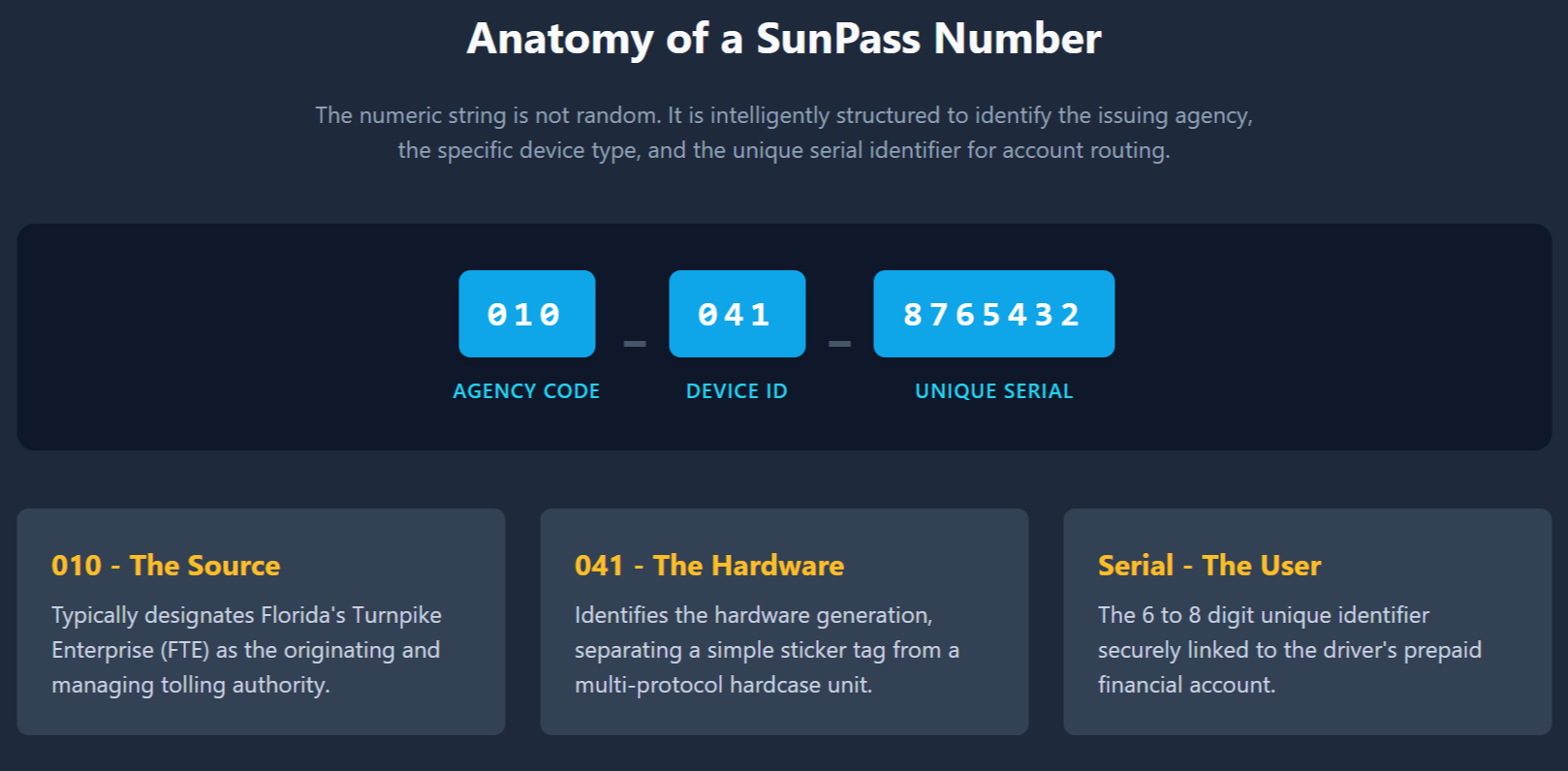
Your SunPass transponder number isn’t just some random sequence of characters – it’s your unique identifier that connects your physical device to your prepaid toll account. Think of it as your transponder’s social security number, if you will.
The current standard format uses a 13-digit numeric code. This purely numerical sequence gives the system billions of possible unique identifiers. Pretty smart, right? This format applies to all the main SunPass models you’ll encounter:
- SunPass Mini (the sticker version)
- SunPass PRO™ (the portable, multi-state compatible one with suction cups)
Here’s what’s interesting, though all these SunPass-branded devices stick to the 13-digit rule, the broader Florida tolling landscape throws some curveballs your way.
The Plot Twist: When 13 Digits Enter the Chat
Now here’s where things get spicy. Ever heard of E-PASS? It’s another major electronic toll collection system in Florida, and their transponders use 13-digit numbers. But here’s the kicker – E-PASS transponders work perfectly fine on SunPass roads.
So you might be cruising along thinking you’ve got a “SunPass” device when you’re actually rocking an E-PASS transponder. The systems play nice together, but your digit count will be different. E-PASS devices include:
- E-PASS Sticker
- CollegePass
- Uni (this portable transponder works across the E-ZPass network
Pro tip: If you’ve got a 13-digit transponder, check above the barcode – that’s typically where E-PASS puts their numbers.
The Card Sound Bridge Curveball
Want to see where things get really interesting? The 2026 Card Sound Bridge Annual SunPass Plan specifically asks for a “full 13 digits” of your “SunPass transponder number.” Wait, what?
This little detail suggests that certain SunPass programs or regional agreements might accept 13-digit formats. Whether this means older SunPass models still floating around or they’re being flexible with E-PASS compatibility, I can’t say for sure.
But it definitely shows that the “SunPass transponder number” umbrella can mean different things depending on context.
The Mysterious Case of the Disappearing Digit
Here’s something that’ll make you scratch your head – sometimes when you enter a 13-digit transponder number into an online account, it might display as 12 digits. Don’t panic! Your transponder didn’t lose a digit overnight.
This happens because of internal system processing. One digit (usually a checksum or verification digit) might not display in certain parts of the account management system. The physical number on your device stays the same – it’s just how the backend handles things.
Where to Find Your Transponder Number (No Treasure Map Required)
Alright, so you know what format to expect, but where exactly do you find this magical number? I’ve got you covered with several foolproof methods:
Method 1: Check the Device Itself
For SunPass transponders, look at the front of the device — the 13-digit FL ID is printed there, typically above the barcode. If it’s permanently stuck to your windshield, you might need to carefully peel it off (just saying, be gentle).
For 13-digit E-PASS transponders, look above the barcode – that’s their favorite spot.
Method 2: Go Digital with Your Online Account
Log into SunPass.com and navigate to “Transponder Details” or “Account Overview.” This is honestly my favorite method because:
- No physical inspection needed
- Available 24/7 from anywhere
- Shows the authoritative record linked to your account
Method 3: Use the Mobile App
The official SunPass mobile app puts your transponder info right in the “Transponder” or “Account” section. Perfect for when you’re on the go and need that number ASAP.
Method 4: Dig Out Your Welcome Kit
Remember that paperwork you got when you first bought your transponder? (The stuff you probably shoved in a drawer somewhere?) Your transponder number should be printed on the packaging or included documentation.
Method 5: Call in the Cavalry
If all else fails, contact SunPass customer service at 1-888-TOLL-FLA (1-888-865-5352). They can look up your transponder number using other account details. Sometimes the old-school approach works best!
SunPass vs. E-PASS: Know Your System
Let’s clear up the confusion between these two systems once and for all:
| System | Digits | Format | What You Need to Know |
|---|---|---|---|
| Standard SunPass | 13 | numeric | Your typical Florida toll pass |
| E-PASS | 13 | Usually numeric | Works on SunPass roads but different authority |
| Special Applications | 13 | Varies | Like that Card Sound Bridge form |
The key thing to remember? E-PASS transponders work on SunPass roads, but they’re run by the Central Florida Expressway Authority (CFXway), not the Florida Department of Transportation. Different bosses, compatible systems.
Why Your Transponder Number Actually Matters
You might think, “It’s just a number, right?” Wrong! This little sequence of digits is your golden ticket for:
- Monitoring account balances (because nobody likes surprise toll bills)
- Reviewing transaction history (where did all my money go?)
- Updating vehicle information (got a new car? Tell them!)
- Resolving billing disputes (when the system thinks you drove through three tolls simultaneously)
- Replacing lost or damaged devices (life happens)
Without this number, you’re basically stuck calling customer service for everything. Trust me, having it handy saves you time and headaches.
Security Tips That Actually Matter
Since your transponder number links to your money, let’s talk security. Here are some real-world tips:
Keep it accessible but private – Store it somewhere safe but easy to find when you need it.
Use official channels only – Always log into SunPass.com directly, never through email links.
Watch out for scams – SunPass does not send unsolicited toll violation demands via text or email. If you receive one, it’s a scam. Official toll invoices and notices are sent by U.S. mail, though SunPass may send account notifications by email if you’ve opted in.
I’ve seen too many people fall for fake “SunPass violation” texts. Don’t be that person!
The Bottom Line on SunPass Digits
So there you have it – 13 digits for both SunPass and E-PASS transponders in 2026. Just remember that while the digit count is the same, the two systems are run by different agencies with slightly different coverage and benefits. Florida’s toll system might seem like it’s trying to confuse you, but once you know the rules, it’s pretty straightforward.
My advice? Figure out exactly what type of transponder you have (SunPass vs. E-PASS), keep that number somewhere accessible, and always verify requirements for specific applications. When in doubt, the official SunPass website and app are your best friends.
The next time someone asks you about SunPass transponder digits, you can confidently give them the full story. Just remember – in the world of Florida tolls, knowing your numbers is half the battle!

Pavithra Vinoth is the founder of nytollsinfo.com, where she simplifies U.S. toll systems through expert insights and custom-built calculators. Her research-driven tools help drivers avoid costly mistakes and make smarter car decisions.